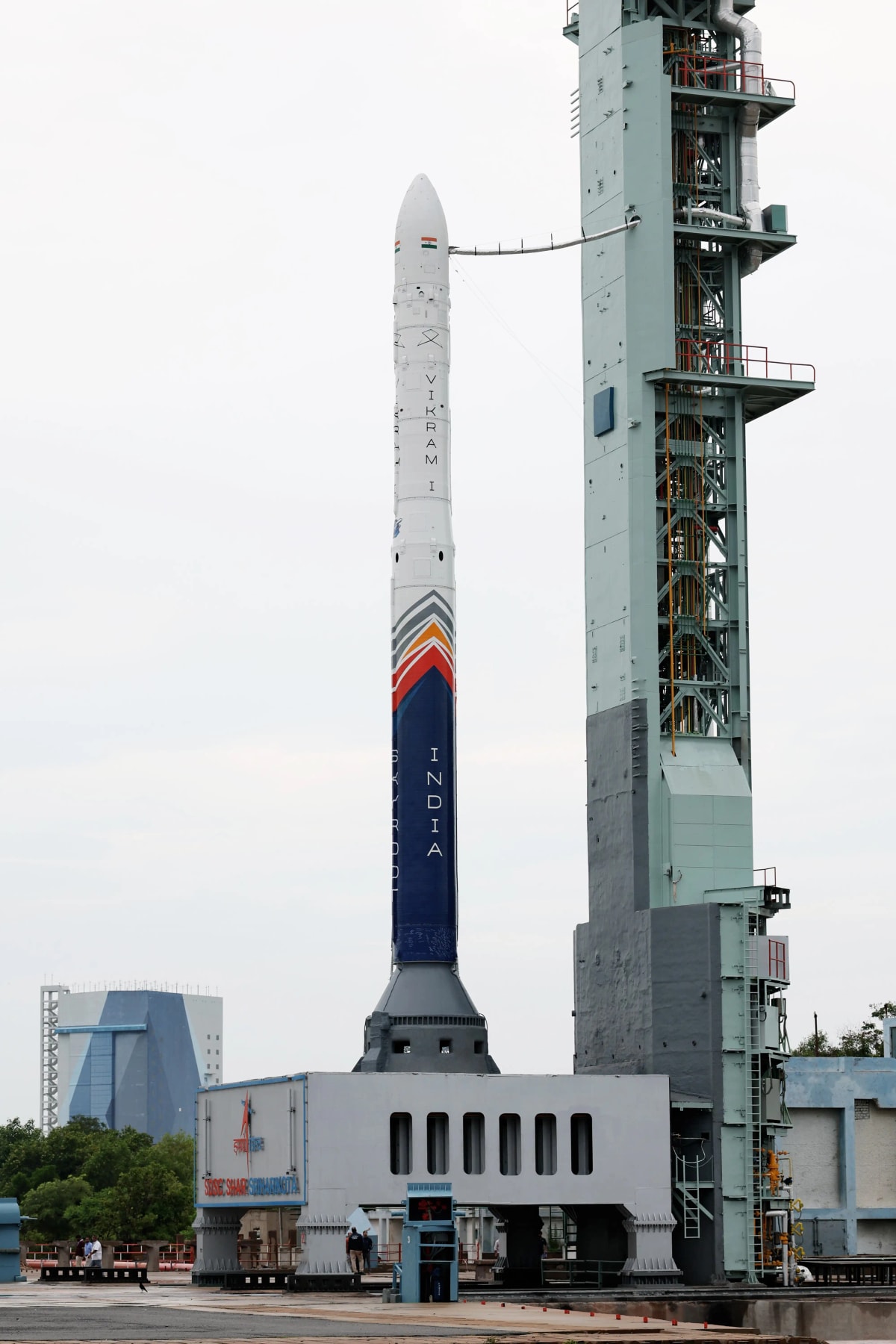
As of 2026-07-19 05:39 UTC, Skyroot Aerospace's Vikram-1 has completed India's first successful orbital launch by a private Indian company from Indian soil. The rocket lifted off from the Satish Dhawan Space Centre at 12:05:30 p.m. IST on July 18 (06:35:30 UTC). ISRO says two satellites, SCOPE and Grahaa, entered low Earth orbit; Reuters reported payload injection at about 450 kilometres, roughly 15 minutes after liftoff.[1][2]
That is a genuine first. It is also easy to describe badly. Vikram-1 was developed by a private company, but its motors, engine, trajectory, integration and launch campaign passed through public facilities and public oversight. The achievement is therefore not a story about the state disappearing. It is evidence that India's post-2020 model—private vehicle development connected to national test stands, expertise, regulation and a government launch range—can reach orbit.[1][3]
This Q&A synthesizes launch accounts, policy documents, technical records and reported interviews. It is not a transcript. The central distinction throughout is between what one successful flight establishes and what only repeated commercial missions can establish.
The Record At A Glance
| Record | What it establishes | Confidence boundary |
|---|---|---|
| ISRO, July 18 | Vikram-1 lifted off at 12:05:30 p.m. IST; ISRO calls Skyroot the first private company to launch successfully to orbit from Indian soil and says SCOPE and Grahaa entered low Earth orbit.[1] | High confidence in ISRO's official mission account. The page does not publish orbital elements, payload-health data or a post-flight technical report. |
| Reuters, July 18 | The flight reached a reported 450-kilometre orbit and injected payloads about 15 minutes after launch.[2] | Credible independent event reporting; the precise orbit is reported rather than independently reconstructed here. |
| Indian Space Policy 2023 | Private entities may build and operate launch vehicles and launch infrastructure; IN-SPACe authorizes launches and governs access to public facilities.[3] | High confidence in the policy design. A policy permission does not prove commercial demand or equal access in practice. |
| ISRO support record | ISRO says its facilities supported solid-motor casting and tests, upper-stage engine testing, handling, trajectory analysis, integration and range safety; IN-SPACe supplied reviews and clearance.[1][6] | High confidence that the agencies report providing these functions. Public sources do not itemize their full cost or contractual allocation. |
| Skyroot's commercial plan | The company advertises up to 350 kilograms to low Earth orbit and 260 kilograms to sun-synchronous orbit; its CEO described Aagaman as the first of three development flights before routine service.[5][8] | These are company specifications and plans, not demonstrated payload capacity, price, cadence or reliability. |
1. What Exactly Happened?
Vikram-1, a four-stage small-satellite launcher with three solid stages and a liquid upper stage, left Sriharikota on its maiden orbital attempt.[1] ISRO says the flight placed two satellites into low Earth orbit and left other payloads attached to the upper stage for hosted experiments. Reuters reported a roughly 450-kilometre insertion about 15 minutes after liftoff.[1][2]
Those formulations should remain separate. Low Earth orbit is the official agency description. About 450 kilometres is the more precise altitude in Reuters' account and Skyroot's published mission target.[2][8] None of the sources listed below supplies a public set of independently verified orbital elements at this as-of time, and ISRO's short announcement does not report whether the two satellites have completed commissioning or whether the hosted experiments have met their objectives.
The defensible result is therefore specific: the launch vehicle completed the ascent and payload-injection sequence that ISRO and independent reporting describe as successful. It is too early to convert that into a verdict on every payload's health or every mission objective.
2. Why Is It Called India's First Private Orbital Launch?
The adjective belongs to the company and vehicle-development role, not to every part of the launch system. Skyroot, founded in 2018, developed Vikram-1. ISRO's wording is careful: this was the first time a private Indian company undertook an orbital rocket launch from Indian soil, and the first such company to reach orbit from India.[1]
It was not India's first private rocket flight. Skyroot's smaller Vikram-S flew a suborbital mission from Sriharikota on November 18, 2022, reaching about 89.5 kilometres before returning to Earth. That mission was also authorized by IN-SPACe and supported by ISRO.[7] Vikram-1 crossed the harder boundary from a brief trip to space into the horizontal speed, staging accuracy and injection sequence required to remain in orbit.
Nor was this a “fully private” launch in the sense of a company owning the range, test infrastructure and regulatory process. The rocket stood on ISRO's First Launch Pad. Its development used government facilities, and IN-SPACe handled technical consultation, mission-readiness reviews and launch clearance.[1] Calling it merely a state mission would erase Skyroot's engineering responsibility; calling it state-free would erase the system that made the attempt possible.
3. So Is Public Infrastructure A Footnote Or The Main Story?
It is the main institutional story. India's 2020 reforms opened end-to-end space activity to non-government entities. The Indian Space Policy 2023 then made the division of labour explicit: private entities may manufacture and operate launch vehicles and build launch infrastructure; IN-SPACe acts as the authorization window and allocates access to facilities created with public money; ISRO is directed to concentrate on research, new technology and the sharing of processes and expertise.[3]
Vikram-1 turns that policy chart into a physical sequence. ISRO says the first-stage motor was cast and tested at Satish Dhawan Space Centre, the second stage was validated there, and the upper-stage Raman engine was tested at an ISRO propulsion facility. During the campaign, ISRO supported stage preparation, transport, trajectory analysis, integration on the launch pad and round-the-clock safety operations.[1] A 2023 ISRO record shows the model earlier in the pipeline: Skyroot designed a Raman-II engine, while an ISRO test stand and instrumentation, enabled through IN-SPACe, supplied the firing environment.[6]
The best description is a private builder inside a shared national launch system. That model lets a startup avoid reproducing every capital-intensive stand and range before its first orbital attempt. In exchange, the state remains a facility provider, technical collaborator, safety authority and gatekeeper. The unresolved governance question is whether future companies receive predictable access on transparent terms when several vehicles compete for the same public infrastructure.[3][4]
4. What Did Vikram-1 Prove—And What Did It Not Prove?
It proved an end-to-end flight once. That is substantial. Three solid stages had to ignite and separate in sequence; avionics, telemetry, guidance and navigation had to survive ascent; the liquid orbital stage had to complete the injection job; and payload separation had to occur on the intended timeline.[1][2] Ground tests became a flight result.
It did not demonstrate the rocket's advertised maximum capacity. Skyroot markets Vikram-1 for payloads of up to 350 kilograms to low Earth orbit and 260 kilograms to sun-synchronous orbit, but those are service specifications, not the disclosed mass and performance margin of Aagaman.[5] The flight also does not establish a failure rate, an on-time record, turnaround time, insurance terms, price, production yield or the health of payloads after deployment.
One more boundary matters. A first-attempt success can validate architecture without proving routine operations. Launch businesses are judged across repeated vehicles built by different teams, weather holds, supplier lots, payload interfaces and orbital profiles. Aagaman retires the question “can this system reach orbit at all?” It opens the more demanding question “can the organization reproduce the result on a customer schedule?”
5. What Is Skyroot Actually Trying To Sell?
Skyroot's pitch is not simply a smaller rocket. Its website advertises dedicated and rideshare missions with customized orbital deployment.[5] In pre-launch reporting, chief executive Pawan Kumar Chandana compared the dedicated small-launch proposition to hiring a cab rather than taking a train: a customer pays for control over destination and timing instead of accepting the orbit and schedule of a larger shared mission.[8]
That flexibility has value only if it clears a hard commercial comparison. Large-rocket rideshare can offer low prices per kilogram; a dedicated vehicle must earn its premium through schedule control, orbital precision, faster integration or access for payloads poorly served by a shared manifest. Vikram-1's restartable liquid upper stage is designed to support that flexibility, but Aagaman did not publish a customer price or demonstrate a multi-mission service record.[5][8]
Chandana told Space.com that this was the first of three planned development flights and described a longer-term ambition to build toward one orbital rocket per month.[8] Those are useful milestones because they are falsifiable. They remain plans. The next evidence should be dated flights, repeat customers, disclosed deployment performance and a cadence achieved without treating each launch as a bespoke national campaign.
6. Who Should Care Over The Next 24 Hours, 7 Days And 30 Days?
Next 24 hours: payload operators and mission analysts need confirmation that SCOPE and Grahaa are trackable, communicating and in useful orbits, plus status reports from the hosted experiments. Editors should preserve the exact first: a private Indian company successfully launched to orbit from Indian soil. They should not promote the reported 450-kilometre target into independently verified orbital precision without tracking data.[1][2]
Next 7 days: prospective customers should look for a post-flight account covering insertion accuracy, stage performance, separation events and anomalies, not only celebratory footage. Regulators and ISRO should explain which support functions were standard services, which were exceptional for a maiden flight and how lessons will be shared without blurring accountability between vehicle developer, authorizer and range operator.[1][3]
Next 30 days: Skyroot's most decision-useful update would be a date range and objective for the second development flight. Investors and competitors should watch whether the launch produces contracted follow-on missions rather than treating one success as proof of a monthly production system. Indian policymakers should watch the queue: the shared-infrastructure model becomes an ecosystem only if other authorized companies can obtain test and launch access predictably.[3][4][8]
7. What Would Turn One Flight Into A Durable Breakthrough?
Base path — the development programme continues. Skyroot publishes a bounded mission review, confirms useful payload operations and flies the next test with a clear new objective. Trigger: a dated second-flight plan plus evidence that Aagaman's trajectory and deployment performance met stated tolerances.
Upside path — shared infrastructure produces repeatable private service. Several vehicles use ISRO facilities under transparent IN-SPACe procedures, while Skyroot completes its development series and begins customer missions at a measurable cadence. Trigger: repeat orbital successes across different payloads, published service terms and facility access that does not depend on one-off arrangements.[3][8]
Downside path — the first flight remains an isolated demonstration. Payload problems, an undisclosed vehicle anomaly, long delays or constrained access prevent the next missions from reproducing Aagaman. Trigger: the development series slips without a technical explanation, or official mission reporting materially revises the injection result. That would not erase the July 18 launch; it would narrow what the launch can support as a commercial claim.
What To Verify Next
- Look for payload-health statements from SCOPE and Grahaa operators, not just launch-provider confirmation.
- Distinguish a reported target altitude from published orbital tracking and insertion accuracy.
- Ask for the objective and date range of development flights two and three.[8]
- Compare achieved cadence, price and payload integration with Skyroot's advertised service—not with the emotional force of a maiden success.[5]
- Track how IN-SPACe allocates public test and launch facilities among multiple private applicants.[3][4]
- Keep the responsibility map visible: Skyroot owns vehicle performance; IN-SPACe owns authorization; ISRO owns the public facilities and range functions it provides.[1][3]
The central interpretation should be revised immediately if tracking data or an official mission review retracts the reported orbital injection. It should be strengthened only when repeat flights show that a private vehicle can move through India's shared public system without exceptional delay or hidden one-off support. For now, Vikram-1 has crossed an orbital proof point. It has not yet crossed the commercial one.
Sources
- Indian Space Research Organisation, “First private orbital launch lifts off from Sriharikota” (July 18, 2026) — official launch time, first-status wording, payload disposition, public-infrastructure support and source page for the real Vikram-1 cover photograph.
- Gopika Gopakumar and Nivedita Bhattacharjee, Reuters via MarketScreener, “India's Skyroot launches Vikram-1 in first private orbital rocket mission” (July 18, 2026) — independent event report, reported 450-kilometre injection and mission timeline.
- Government of India, Indian Space Policy 2023 — primary policy text on private launch vehicles, IN-SPACe authorization, access to publicly funded facilities and ISRO's research-and-technology-sharing role.
- Press Information Bureau, Government of India, “India's Space Sector: From Government-Led Programme to a Vibrant Public-Private Ecosystem” (July 18, 2026) — reform timeline, IN-SPACe role, Vikram-S context and current public-private infrastructure framework.
- Skyroot Aerospace, “Vikram-I” vehicle page — company-stated LEO and sun-synchronous capacity, vehicle construction and dedicated, rideshare and custom-deployment proposition.
- Indian Space Research Organisation, “ISRO Supports a Space Start-up's Rocket Engine Test” (July 22, 2023) — primary record of Skyroot's Raman-II engine test at an ISRO facility enabled by IN-SPACe.
- Indian Space Research Organisation, “Mission Prarambh” (November 18, 2022) — official record of Vikram-S's 89.5-kilometre suborbital flight, three payloads and IN-SPACe authorization.
- Sharmila Kuthunur, Space.com, “Getting Vikram-1 to orbit” (July 13, 2026) — on-site reporting and reported interview on the manifest, dedicated-launch proposition, three-flight development plan and monthly-cadence ambition.