As of 2026-07-19 01:36 UTC, the latest public operating snapshot available for El Obeid, the capital of Sudan's North Kordofan state, is the World Food Programme's July 17 update. In it, WFP said its trucks were moving 200 metric tons a day from partner warehouses to distribution points and the agency was assisting just over 100,000 people in the city. But those recipients were receiving only half rations.[1]
That July 17 combination is the news. The latest public record does not describe a city where the aid operation has disappeared. It describes a functioning operation being asked to stretch across a city swollen by displacement while fuel, money, protected movement and inventory are all running short. WFP said it had positioned food to reach more than 250,000 people in or around the city if conditions allow. “If” carries the weight of the whole response.[1]
The Brief
| Verified signal | What the record says | Confidence boundary |
|---|---|---|
| Food was moving on July 17 | WFP reported 200 metric tons per day moving from NGO partner warehouses to distribution points, with just over 100,000 people receiving food or some cash support.[1] | High confidence in WFP's dated operating account; no independent daily throughput series or newer public WFP update was found by this brief's as-of time. |
| Need is outrunning the ration | WFP says camps are beyond capacity, new families arrive daily, and current recipients receive 50% rations because of funding shortfalls.[1] | High confidence that this is the agency's current allocation; the total number of people needing help inside the city remains an estimate. |
| Hunger is already severe | Nearly 400,000 people across Sheikan district, including El Obeid, and neighboring Bara and Gharb Bara are at IPC Phase 4, Emergency.[1] | Phase 4 is not a famine classification. The figure covers three districts, not El Obeid alone. |
| The logistics chain is exposed | WFP says scarce fuel has impaired commercial transport and forced it to use its own fleet. It diverted supplies intended for rainy-season prepositioning to prepare the El Obeid response.[1] | Access can differ by route, hour and actor. A successful warehouse-to-distribution run does not prove every road into or out of the city is safe. |
| Civilian infrastructure is under attack | UN Human Rights documented 15 drone strikes in and around El Obeid from June 6 to 28, killing at least 45 civilians and injuring 41; it said the true toll was likely higher.[2] | These are documented minimums for that period, not a complete or current casualty count. |
The pressure did not begin with the latest ration warning. The Sudanese Armed Forces broke a siege of El Obeid that had lasted more than a year in February 2025; the Rapid Support Forces have since mounted offensives aimed at restoring pressure around the city, according to the Associated Press.[5] That history explains why an aid route can be open today without being dependable tomorrow.
Access Exists, But It Has Four Failure Points
The most useful correction to the crisis shorthand is that access is not a yes-or-no condition. After a one-day visit to El Obeid, WFP's Sudan country director said the agency could enter the city and deliver food; resources were the immediate limit. In the same account, he said fuel had become so scarce that partners could not move food, requiring WFP trucks to take over the warehouse-to-distribution leg.[1]
That leaves four connected failure points.
First, physical security. The Human Rights Office says both the Sudanese Armed Forces and the Rapid Support Forces have used drones across Kordofan, while attributing recent damage to at least 13 fuel stations in El Obeid and Al Rahad to RSF drones. Attacks on fuel, water and vehicles do not have to hit a food sack to interrupt a food operation. They can stop the pump, the truck or the person trying to reach a distribution point.[2] The Human Rights Council requested an urgent inquiry into alleged violations in and around the city, but an inquiry can preserve evidence; it does not secure tomorrow's route.[3]
Second, fuel. A warehouse full of grain is not yet a meal. WFP's reported 200-metric-ton daily movement depended on trucks completing the last internal leg. Fuel scarcity can also raise the cost of collecting a ration and constrain water pumping, commercial resupply and voluntary movement out of the city. This is why a delivery number must be read beside fuel availability and distribution reach, not celebrated in isolation.[1][2]
Third, funding. Half rations are already the visible form of a financing shortage. WFP says it needs $646 million from June through November to reach a planned 8.5 million people across Sudan. That is a national appeal, not a price tag assigned only to El Obeid, and it should not be misreported as one. It does show that the city's shortfall sits inside a response already making allocation choices at national scale.[1]
Fourth, inventory. For its Sudan-wide operation, WFP says specialized food used to prevent and treat malnutrition will begin running out in August, general food stocks will be severely depleted by September, and they will be exhausted in October under current planning. It has also diverted supplies from rainy-season prepositioning to build the El Obeid buffer. The city therefore has an immediate delivery problem inside a national pipeline problem.[1]
What Changes Over 24 Hours, 7 Days and 30 Days
Next 24 hours: the meaningful operating check is whether a new update confirms that the reported 200-metric-ton internal movement continued, distribution points remained reachable and fuel was available for water and food delivery. One dated operating snapshot is reassuring but insufficient. Agencies and reporters should seek a rolling count of people reached, ration share, tonnage dispatched and any cancelled routes.
Next 7 days: watch whether stocks positioned for more than 250,000 people become actual distributions, and whether the ration remains at 50%. The G7 has called for safe voluntary passage, rapid humanitarian access and an end to hostilities; the question is whether those demands produce specific security guarantees that aid organizations can use.[4] The diplomatic statement is evidence of attention, not proof of compliance.
Next 30 days: the horizon reaches the first WFP stock warning. Specialized nutrition supplies are expected to start running out in August under the current pipeline.[1] That makes the next month a replenishment deadline, not simply a fundraising period. Water also belongs on the same dashboard: WFP reported more than 30 new cholera cases alongside power outages and shortages of safe drinking water.[1]
Three Conditional Paths
Base path — the lifeline keeps moving, but below need. WFP maintains internal deliveries, avoids a prolonged movement suspension and expands some distributions, while half rations and overcrowding continue. Trigger: daily food movement remains near the reported operating level, fuel is available for distribution and no major new offensive interrupts the routes the operation uses.
Upside path — access becomes capacity. Negotiated security guarantees hold, new funding converts positioned stock into distributions for more than 250,000 people, and full rations begin to replace half rations. Trigger: WFP reports a sustained rise in people reached and ration size, a funded replacement pipeline and fewer conflict-related cancellations. The Human Rights Council inquiry and G7 pressure would matter here only if they help change conduct on the ground.[3][4]
Downside path — one weak link stops the chain. Drone attacks, fighting or fuel loss interrupts warehouse-to-point movement; new displacement raises the denominator; or the August nutrition-stock warning arrives without replacement supply. Trigger: WFP reports suspended or sharply reduced movement, distribution sites become inaccessible, the ration is cut again, or acute malnutrition and cholera response supplies begin to lapse.[1][2]
The Action Checklist
- Do not say “aid cannot enter El Obeid” when describing WFP's July 17 field report; say the agency reported access and active internal deliveries under severe resource and security constraints.[1]
- Do not turn IPC Phase 4, Emergency into a famine declaration. Preserve the classification and the three-district geographic boundary.[1]
- Track four measures together: people reached, ration share, tons delivered to distribution points and days of usable fuel.
- Ask whether the 250,000-person plan is funded, supplied and protected, not merely whether stock has been positioned.[1]
- Treat attacks on fuel stations, water systems and civilian vehicles as aid-access events, not as a separate infrastructure story.[2]
- Invalidation condition: improve this brief's assessment if WFP documents sustained full-ration delivery, a funded replacement pipeline and protected movement at a scale that catches up with new arrivals. Worsen it immediately if the agency suspends operations, loses its usable route, cuts rations again or confirms that August nutrition stocks are failing to arrive.
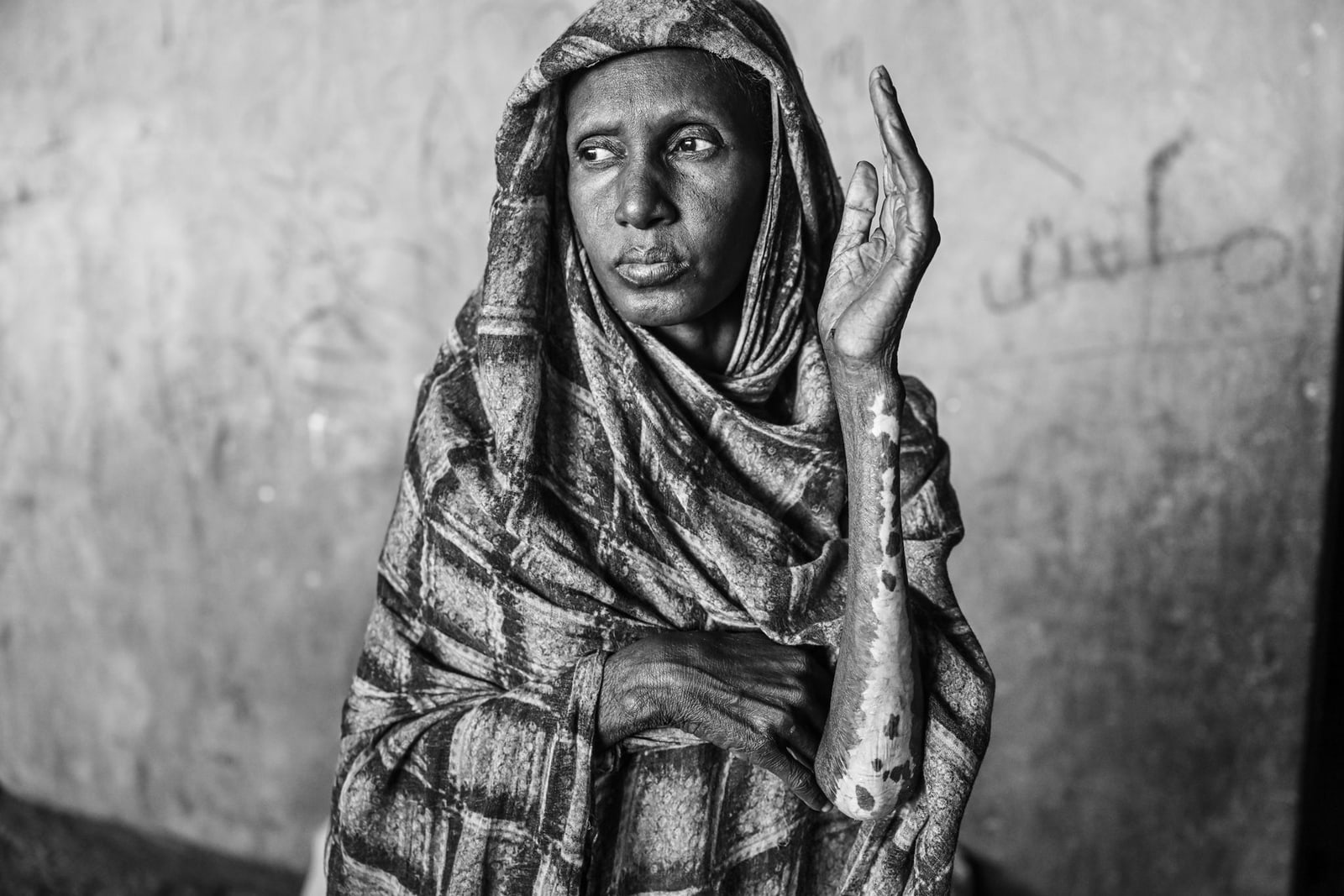
The independent visual record is a reminder of what the logistics vocabulary can hide. In Abdulmonam Eassa's December 2025 photograph from Al-Mohad camp, Alhaja Abdallah shows scars from a fire at the camp after displacement from Bara.[6] The latest WFP numbers describe trucks, metric tons and pipeline months. Their purpose is to keep people already carrying that history from being asked to survive on half of what an emergency ration is supposed to provide.
Sources
- World Food Programme, “WFP warns El Obeid is becoming the new epicentre of Sudan's displacement and hunger crisis” (July 17, 2026) — current food-security, throughput, ration, fuel, stock and funding figures. Companion field briefing from WFP's Sudan country director.
- United Nations in Sudan / Office of the High Commissioner for Human Rights, “Türk calls for strong action at the highest level to prevent atrocity crimes in Sudan” (July 3, 2026) — documented strikes, casualties, infrastructure damage, access risks and attribution boundaries.
- United Nations Office at Geneva, “Human Rights Council Concludes Sixty-Second Regular Session after Adopting 28 Resolutions” (July 8, 2026) — adoption without a vote of the El Obeid resolution and mandate for an urgent inquiry.
- UK Foreign, Commonwealth & Development Office, “Joint Statement of G7 Foreign Ministers on El-Obeid (Sudan)” (July 14, 2026) — demands on civilian protection, safe passage, humanitarian access and cessation of hostilities.
- Sam Mednick, Associated Press, “UN human rights chief sounds ‘red alert’ over violence around Sudan's el-Obeid city” (July 3, 2026) — independent reporting on the warning, conflict context and renewed pressure around the city.
- World Press Photo, “Sudan's War: A Nation Trapped” by Abdulmonam Eassa for Le Monde — source page, date, place and subject for the real El Obeid cover photograph.