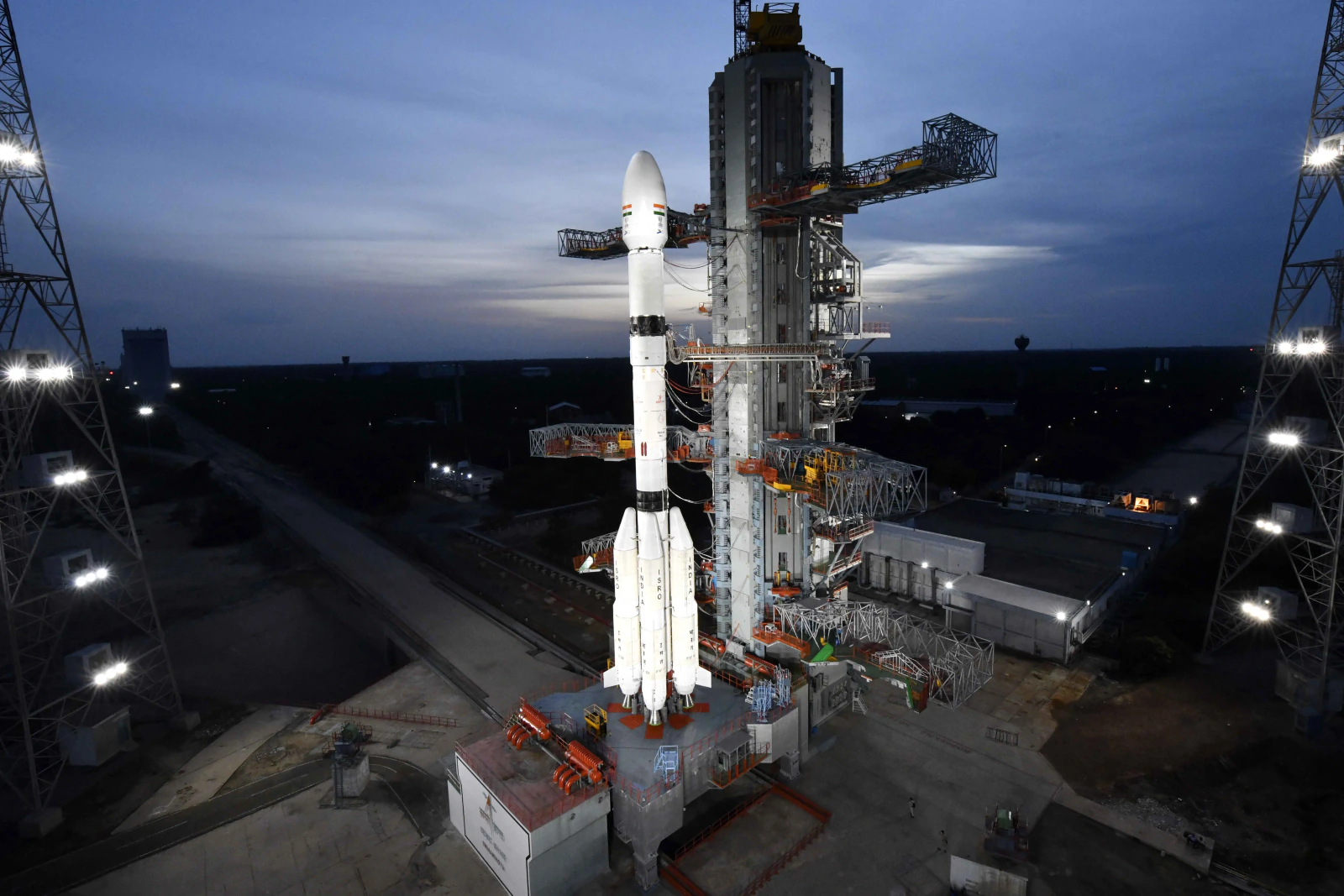
As of 2026-09-04 12:35 UTC, India’s GSLV-F17 had placed the 2,367-kilogram EOS-05 Earth-observation satellite into its intended sub-geosynchronous transfer orbit. That verifies the launcher’s job and spacecraft separation; it does not yet verify a working imaging service.[1][2]
Post-launch reporting says EOS-05’s solar array deployed, the spacecraft was healthy, and orbit-raising manoeuvres would follow. ISRO’s own spacecraft register records the September 4 launch but, at this cutoff, leaves EOS-05’s status field blank.[3][4] The urgent distinction is simple: the rocket delivered; the satellite must now perform.
Image context: the cover is an official ISRO photograph of the actual GSLV-F17 stack at the Second Launch Pad before liftoff.[7] It documents the hardware that flew. It is not evidence that EOS-05 has reached its final orbit or returned an image.
The verified file
| Checkpoint | What the public record establishes | Confidence at cutoff |
|---|---|---|
| Liftoff | GSLV-F17 launched from Sriharikota at 02:55 IST on September 4 (21:25 UTC on September 3).[4][6] | High; the time is consistent across two independent reports. |
| Rocket outcome | ISRO says the vehicle placed EOS-05 into the intended sub-geosynchronous transfer orbit.[1] | High for mission status; ISRO is the operator. |
| Planned injection | The preflight brochure specified a nominal 170 × 28,934-kilometre transfer orbit at 19.28° inclination.[2] | High for the plan, not a measurement of the achieved orbit. |
| Reported injection | On-site reports from the post-launch briefing give roughly 171 × 31,026 kilometres at 19.28°.[5] | Medium-high; attributed to ISRO’s chairman, but those achieved elements were not posted on the short official mission page at cutoff. |
| Initial spacecraft health | The chairman said the solar array had deployed, health was normal, and onboard manoeuvres would raise the orbit.[4][5] | Medium-high; direct remarks reported by two outlets, without a separate ISRO spacecraft-health bulletin yet. |
| Operational imagery | No first image, calibration result, product specification, service date or operational designation was public in the reviewed sources.[1][3] | High for this time-bounded absence; a later update can change it quickly. |
What “sub-GTO” leaves unfinished
A transfer orbit is a route, not the destination. GSLV-F17 released EOS-05 into a long ellipse whose low point remained close to Earth. The spacecraft must use its own propulsion to reshape that orbit, then establish attitude control, power, thermal stability, communications and payload readiness before imaging claims can be tested. The achieved orbit reported after launch may give the spacecraft a higher starting apogee than the brochure’s nominal target, but it does not remove that sequence.[2][4][5]
This boundary matters because the phrase “from geosynchronous orbit” describes the mission EOS-05 is meant to become. ISRO calls it India’s first imaging satellite from such an orbit.[1] It should not be read as proof that the satellite was already in its working orbit when the rocket released it, nor as proof that usable data had reached customers. At cutoff, ISRO’s public spacecraft list did not label EOS-05 “Operational,” even though the same list did apply that status to established Earth-observation missions such as NISAR and INSAT-3DS.[3]
The comparison with EOS-03 sharpens the point without turning F17 into a simplistic comeback story. In August 2021, GSLV-F10’s first two stages performed normally, but the cryogenic upper stage failed to ignite and EOS-03 never reached its intended transfer orbit.[8] GSLV itself returned to successful flight afterward; Space.com counts F17 as its fifth consecutive success since that failure.[6] What September 4 repairs is the unfinished geosynchronous imaging mission line: a successor has finally crossed the launch boundary that stopped EOS-03. It still has to cross the spacecraft boundary EOS-03 never had the chance to attempt.
Why one first image will matter so much
The first public frame will be more than a publicity object. It can prove that the payload sees Earth, but it will not by itself establish geometric accuracy, radiometric quality, revisit performance, latency or an operational delivery chain. Those require calibration, repeated acquisitions and product documentation.
The official material is notably spare. ISRO’s four-page launch brochure gives the rocket configuration, payload mass and target transfer orbit, yet publishes no detailed imaging specification or commissioning timetable.[2] Several news reports describe ambitious uses and sensor capabilities, but the cleanest current claim is the one ISRO itself makes: EOS-05 is an Earth-observation spacecraft intended to be India’s first imaging satellite from geosynchronous orbit.[1] Until the agency releases payload and product documentation, more specific performance claims should be treated as reported expectations, not demonstrated service.
That restraint is especially important for disaster managers, agricultural users, researchers and defence analysts. A high vantage point can support frequent views of a broad region, but usefulness depends on what the instrument can distinguish, how often it can acquire a target, how clouds and atmospheric conditions affect the relevant bands, how quickly data is processed, and who can obtain it. “Persistent” is not a substitute for those answers.
The next 24 hours, 7 days and 30 days
Next 24 hours: watch for an official launch-and-early-orbit update. The decisive signals would be a burn plan or confirmation that orbit raising has begun, alongside stable telemetry and power-positive operation. A celebratory launch statement without spacecraft detail would leave the present confidence boundary unchanged.
Next 7 days: look for completion of the orbit-raising sequence, final-orbit acquisition and payload activation. ISRO may also update the blank status cell in its spacecraft register.[3] None of those events should be inferred from silence, and an “operational” label should not be applied before the agency does so.
Next 30 days: the strongest proof would be a dated first-light image accompanied by enough metadata to say what it shows, followed by calibration or product-access information. No reviewed source promises that timetable; thirty days is a watch window, not an ISRO deadline.
Three possible next chapters
Base case — orderly commissioning. EOS-05 completes its manoeuvres and checkout, ISRO publishes a first image, and the mission moves from a blank status to an operational one. Trigger: an official orbit-and-health update followed by identified imagery or product documentation.
Upside — transparent service begins quickly. Alongside first light, ISRO publishes acquisition cadence, spatial and spectral specifications, calibration status, latency and an access route. That would let civilian users assess capability rather than repeat a broad “eye in the sky” metaphor. Trigger: a technical release tied to an accessible, dated data product.
Downside — the launch success does not convert cleanly. An orbit-raising, power, thermal, communications or payload issue delays commissioning. A slower update cadence alone would not prove a failure, but it would widen uncertainty. Trigger: an official anomaly notice, a missed manoeuvre, a revised commissioning plan or a prolonged absence of spacecraft-status evidence.
What to do with the headline now
- Newsrooms: say EOS-05 was placed in its intended transfer orbit. Do not silently upgrade that to “operational at geosynchronous orbit,” and do not describe F17 as GSLV’s first successful flight since the 2021 failure.[1][6][8]
- Prospective data users: wait for a product sheet, calibration statement and access policy before building response plans around claimed cadence or resolution.
- Space-program analysts: separate three scorecards—launch-vehicle performance, spacecraft commissioning and delivered data. F17 has cleared the first; early reports are encouraging on the second; the third has not begun publicly.
- Editors maintaining this brief: update it if ISRO revises the insertion result, reports a spacecraft anomaly, assigns EOS-05 an operational status or releases first imagery. Any of those events changes the live boundary.[1][3]
The launch headline is deserved. GSLV-F17 lifted off in darkness, completed ascent and released the 2,367-kilogram Earth-observation payload into the planned class of orbit.[4][5] The more consequential headline will arrive when EOS-05 can look back—and ISRO shows what it sees.
Sources
- Indian Space Research Organisation, “GSLV-F17/EOS-05 Mission” (page dated August 29, 2026; accessed September 4) — official mission outcome, orbit class, payload role and first-from-geosynchronous-orbit claim.
- Indian Space Research Organisation, GSLV-F17 / EOS-05 Mission Brochure (August 2026) — primary source for vehicle configuration, planned transfer orbit and payload mass.
- Indian Space Research Organisation, “Spacecraft Missions” (accessed September 4, 2026) — official launch register and the blank EOS-05 operational-status field at the article cutoff.
- Press Trust of India, “‘Eye in sky’: ISRO launches advanced earth observation satellite for ‘strategic data’,” ThePrint (September 4, 2026) — post-launch remarks on separation, solar-array deployment, spacecraft health and planned orbit raising.
- U. Tejonmayam, “ISRO’s GSLV-F17 successfully places EOS-05 Earth observation satellite in geosynchronous orbit,” The Times of India (September 4, 2026) — on-site report of achieved injection elements, vehicle mass and the next manoeuvre sequence.
- Mike Wall, “India sends Earth-imaging satellite toward geosynchronous orbit in milestone launch,” Space.com (September 3, 2026) — independent account of launch timing, separation and GSLV’s post-2021 flight sequence.
- Indian Space Research Organisation, “GSLV-F17 / EOS-05 Gallery” (2026) — source page for the official prelaunch photograph used as this article’s cover.
- Indian Space Research Organisation, “GSLV-F10 / EOS-03” (August 12, 2021) — official record of normal first- and second-stage performance, failed cryogenic-stage ignition and the unaccomplished predecessor mission.