As of 2026-08-15 02:33 UTC, Zambia’s presidential vote count was moving again. The Electoral Commission of Zambia had suspended counting on Friday after reporting attacks on election workers and theft of marked ballots, then restarted it hours later after saying the security threat had been contained. The commission said the disruption affected a small number of polling stations in Lusaka.[1]
That sequence is serious, but it does not establish the election’s outcome or credibility by itself. A pause is neither proof of manipulation nor proof that safeguards held. The test now is whether the count’s separate records—the signed form at each polling station, the constituency total and the figures announced at the National Results Centre—can still be matched without unexplained gaps.[2][3]
The uncertainty boundary is sharp. Police said one person was killed at a polling station and nine suspects were arrested, according to the Associated Press. Opposition candidate Brian Mundubile alleged wider interference, but AP reported that he supplied no evidence for several of those claims. No claim of victory should be treated as a result before the commission completes its declaration process.[1]
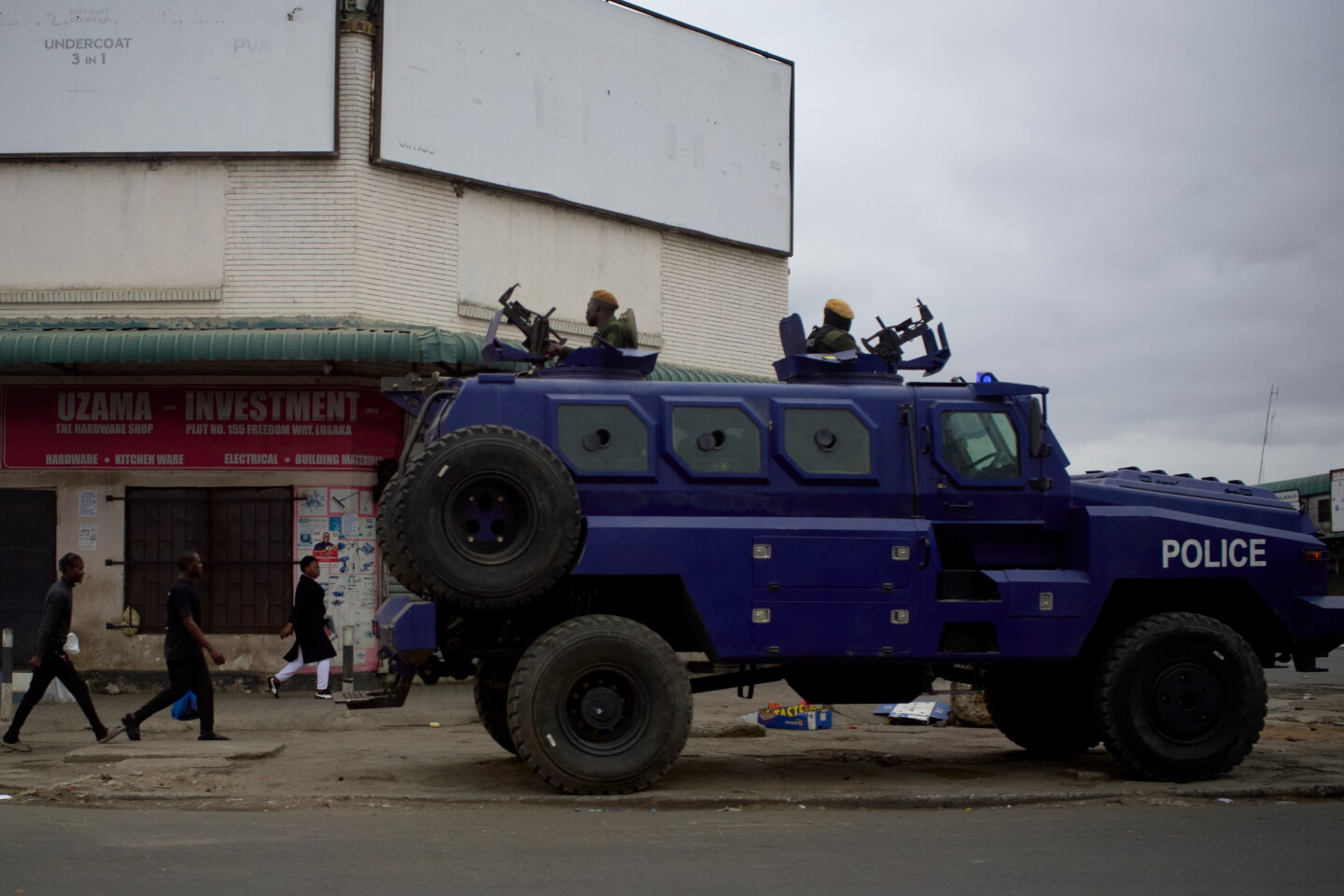
Image context: the cover shows a police vehicle on the outskirts of Lusaka on August 14. AP published the photograph with its report on the halt and restart. It records the visible security posture around the count; it does not show ballot theft, identify responsibility or establish how many stations were affected.[1]
What is confirmed—and what is not
| Timestamp and source | Confirmed fact | Confidence boundary |
|---|---|---|
| August 13 — polling day | About 8 million people were registered to vote at more than 13,500 polling stations, with presidential, parliamentary and local contests held together.[7] | High confidence on the reported scale. Registration is not turnout, and a national station count does not size the later incidents. |
| August 14 — suspension | ECZ said violence targeted poll staff and that marked ballots had been stolen in some instances; counting was suspended while security was reviewed.[1] | High confidence that ECZ made the statement. Lower confidence on attribution and full scope. The commission did not identify who was responsible, and the cited reporting does not independently inventory every affected ballot box. |
| August 14 — restart | ECZ chair Mwangala Zaloumis said the threat had been contained and described the affected locations as a small number of Lusaka polling stations.[1] | High confidence on the restart and official characterization. “Contained” is a security assessment, not yet a published reconciliation of affected election materials. |
| August 15–17 — verification window | ECZ’s revised roadmap schedules receipt and verification of results from Saturday through Monday, with declaration targeted for August 17.[4] | High confidence on the planned timetable, not on guaranteed completion. An operational schedule can slip if incidents, transport or reconciliation require more work. |
| August 15 — observer reporting | The EU and SADC missions both scheduled preliminary statements for Saturday. Their remits cover voting, counting and tabulation; the EU mission explicitly says it does not validate results.[5][6] | High confidence on the scheduled reports. At this article’s cutoff, those findings were still pending and could not be used to characterize the completed count. |
The result begins on paper, not on a national screen
Zambia’s official voter-education material describes a layered count. Immediately after a polling station closes, ballots from each voting stream are counted in front of accredited party agents, monitors and observers. The presiding officer records the votes for each candidate. Those accredited witnesses are expected to confirm the count by signing the results form, and copies of the signed form are given to each accredited person present. Another copy is posted outside the polling station.[2]
That first form matters because it creates several points of comparison before a figure reaches Lusaka. Party agents and observers can retain copies; members of the public can see the posted form; and the constituency process receives the station result. These copies do not automatically prove that every ballot was secure, but they make the later total testable against records created close to the count.
The next layer is physical. ECZ’s results-management FAQ says the presiding officer carries results from the polling station to the constituency totaling centre. There, the returning officer verifies and publicly announces the result before it is captured in the Result Management System and transmitted to the commission in Lusaka.[3] ECZ’s procedure page adds that constituency totaling occurs in the presence of accredited party agents, media, monitors and observers.[2]
The final presidential declaration belongs to the ECZ chair at the National Results Centre. Constituency presidential figures can be announced as they arrive, but they are not the national declaration. Once all presidential results have been received, a candidate needs more than 50% of valid votes cast to be declared president-elect. If nobody clears that threshold, the official procedure calls for a second ballot within 37 days between the leading candidates.[2]
This architecture explains why a temporary stop at the national level need not erase work already completed at polling stations. It also explains why restarting the national count is not enough. Trust depends on continuity between the layers: the posted and distributed station form, the figure announced in the constituency, the record entered into the system and the national total.
What the interruption changes
The interruption raises two different questions that should not be collapsed into one.
The first is material custody. Where ballots or boxes were stolen, officials need to state which polling stations and streams were affected, what had already been counted, which signed forms exist and how any missing material will be handled. “A small number” may be accurate, but it is not precise enough to let parties, observers or voters reconcile those stations.
The second is system continuity. If an unaffected station had completed its count, distributed signed forms and posted its result before the suspension, that record should remain comparable with the later constituency and national figures. If figures change between layers, the explanation—not simply the existence of a pause—becomes the decisive evidence.
This is an inference from ECZ’s published process, not a claim that discrepancies have occurred. At the cutoff, the cited public record did not provide a station-by-station incident list or a completed national reconciliation. It also did not substantiate the opposition’s broader claims of military seizure and electoral interference.[1] Responsible reporting should therefore preserve three labels: confirmed commission action, reported criminal incident and unverified political allegation.
Observer statements will add evidence, but they have limits too. The EU mission says its core team and long- and short-term observer contingents assess the legal framework, election administration, voting, counting, tabulation, complaints and results publication. It also says plainly that it does not legitimize the process or validate results.[5] SADC deployed across all ten provinces and planned to continue longer-term observation after its preliminary statement.[6] Neither mission turns an early assessment into a substitute for published, reconcilable results.
Decision impact: 24 hours, seven days, thirty days
Next 24 hours — protect the distinction between a count and a claim. Newsrooms should attribute every partial figure to the level that produced it: polling station, constituency or National Results Centre. Parties and citizen observers should preserve signed form copies and record when a later figure differs. ECZ should publish a time-stamped list of affected stations, the status of their materials and any remedial decision. Preliminary observer findings should be read for process evidence, not winner prediction.[1][2][5][6]
Next 7 days — test the declaration against its components. ECZ’s roadmap targets declaration on August 17 and publication of results from August 17 through August 24.[4] The useful audit is not merely whether a name is announced on Monday; it is whether constituency totals reconcile with station records and whether exceptions are identified. ECZ says a presidential petition may be filed in the Constitutional Court within seven days of declaration and is to be heard within fourteen days of filing.[2]
Next 30 days — follow the branch actually triggered. If one candidate clears 50%, attention shifts to publication, reconciliation and any petition. If nobody does, preparations for a second ballot must fit the 37-day rule. If violence or missing records expand beyond the commission’s current description, security and evidentiary questions will outlast declaration day.[1][2]
Three paths from the restart
Base path — the interruption remains limited and the result chain reconciles. Counting and verification continue, ECZ identifies the affected stations, and Monday’s declaration can be matched to constituency and station records. Triggers: no material expansion in confirmed incidents, timely receipt of constituency results and explained treatment of every affected stream.
Upside path — disclosure makes the restart more credible than a bare assurance. ECZ releases a granular incident log and reconciliation record; parties’ signed copies align with constituency announcements; observer reports find the tabulation transparent enough to follow. Triggers: public station identifiers, preserved forms, prompt correction of any clerical discrepancies and access for accredited observers.
Downside path — the paper and national records stop agreeing. Unexplained differences appear between signed station forms, constituency figures and national announcements; affected materials cannot be accounted for; violence spreads; or the declaration slips without a clear operational explanation. Triggers: documented form mismatches, an expanding official incident list, restricted observation or unresolved gaps in the results chain.
These are conditional paths, not forecasts. The base case does not assume that the commission’s first scope estimate is complete, and the downside case does not treat an opposition allegation as evidence merely because it is serious.
Action checklist and invalidation conditions
- ECZ: publish affected polling-station and stream identifiers, describe the custody status of ballots and forms, and reconcile any exception before national declaration.
- Parties and observers: retain original signed copies and compare like with like; a station form should be checked against its constituency record before being used to challenge a national aggregate.[2][3]
- Newsrooms: distinguish partial announcements from a declaration, timestamp every result update and label unsupported interference claims as allegations.
- Public-interest monitors: watch the full chain—counting, physical delivery, constituency verification, electronic transmission and national announcement—rather than treating the results screen as the only record.[2][3]
- Readers: wait for the official declaration, but do not confuse waiting with passive trust; the relevant evidence is whether the announced total can be traced back through the records designed to support it.
Invalidation conditions: revise this explainer when ECZ publishes a definitive incident inventory, changes its August 17 target, announces complete constituency results or declares a president-elect. Revise the assessment if the EU or SADC preliminary statements document material facts that alter the current scope, if authenticated station forms reveal unexplained discrepancies, or if verified evidence supports or refutes the broader interference allegations. Until then, the most accurate frame is procedural: Zambia has restarted the count, while the public verification test is still underway.
Sources
- Jacob Zimba, “Vote counting suspended then restarted in Zambia election after attacks at polling stations.” Associated Press, updated August 14, 2026 — suspension, restart, official and opposition statements, reported violence, security response, result timing, and provenance of the Alfonso Nqunjana cover photograph.
- Electoral Commission of Zambia, “Voting Day Activities” — official procedures for station counting, signed result forms, public posting, constituency totaling, national declaration, the 50% threshold, runoff timing and election petitions.
- Electoral Commission of Zambia, “Frequently Asked Questions,” Results Management — official description of physical delivery, constituency verification, Result Management System capture and transmission to Lusaka.
- Electoral Commission of Zambia, “Revised 2026 General Election Roadmap” — August 13 poll date, August 15–17 receipt and verification window, August 17 declaration target and publication period.
- European Union Election Observation Mission Zambia 2026, “About the EOM Zambia 2026” — observer composition, assessment remit, non-validation boundary and scheduled August 15 preliminary statement.
- Southern African Development Community, “SADC Electoral Observation Mission to the Republic of Zambia’s 13 August 2026 General Election” (July 23, 2026) — nationwide deployment, observation scope, preliminary-statement schedule and longer-term mission timeline.
- Jacob Zimba, “Zambians cast ballots in a presidential election that tests incumbent’s economic reforms.” Associated Press, August 13, 2026 — registered-voter and polling-station scale, election-day conditions and the simultaneous contests.