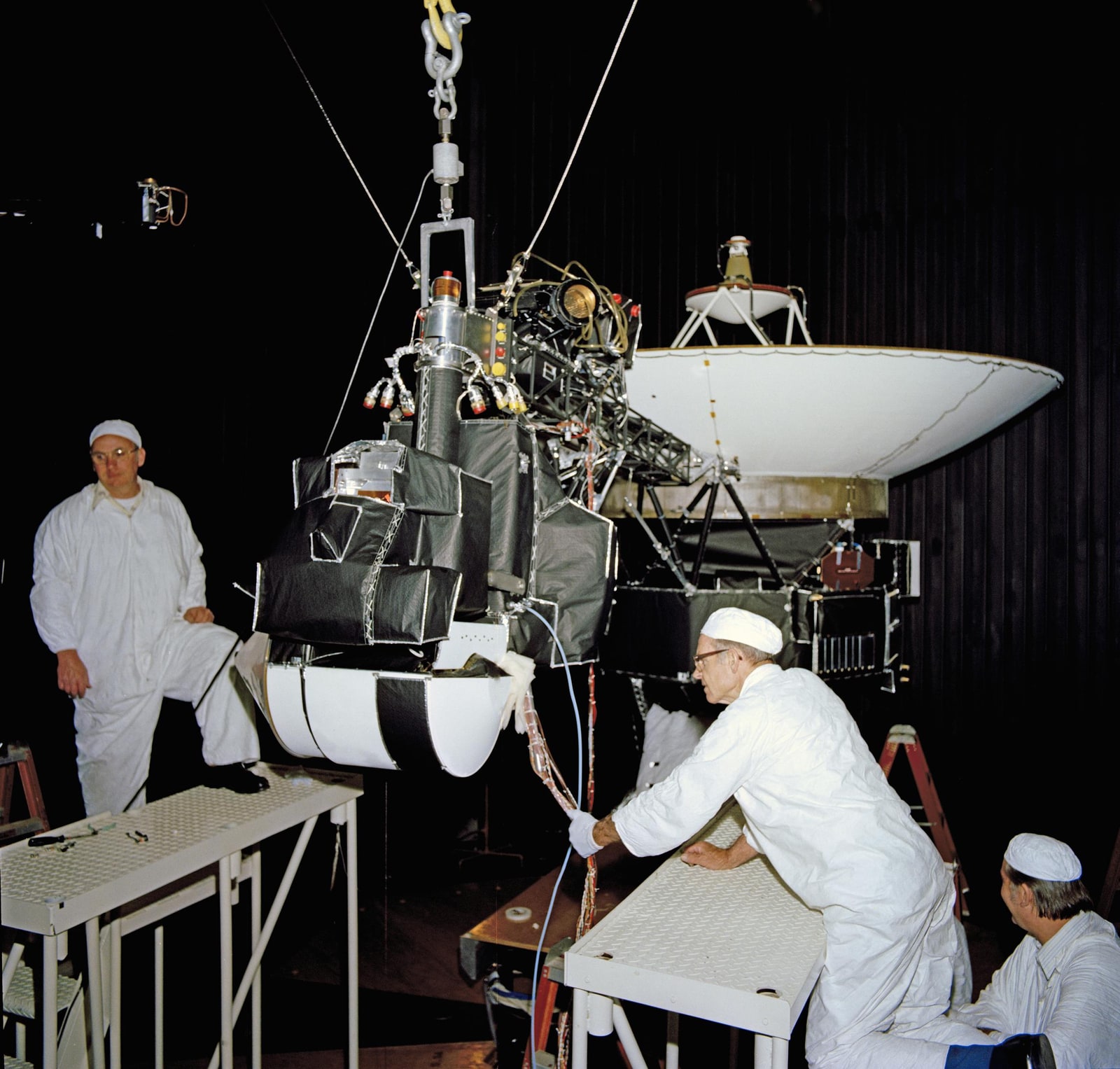
As of 2026-11-01T03:33:28Z (UTC).
Voyager 1 has gained more time to do science through an exercise in careful subtraction. NASA reported on October 29 that engineers completed a coordinated switch to lower-power equipment in September, postponing the need to shut down another instrument as early as summer 2027.[1]
The difficult part is warmth. Equipment consumes electricity, but switching it off also changes the spacecraft's thermal balance. Keeping an aging probe useful means finding a configuration that saves power while leaving its vulnerable parts warm enough to work.[2][4]
What changed this year?
| When | Mission team's report | Evidence boundary |
|---|---|---|
| April 17 | Commands sent to shut down Voyager 1's low-energy particle instrument.[2] | Preserves operation by sacrificing a measurement. |
| August 4 | Power-saving reconfiguration reported successful on Voyager 2.[4] | Establishes a precedent on the sister spacecraft. |
| October 29 | September reconfiguration confirmed for Voyager 1.[1] | Success reported; no final mission end date established. |
These are NASA's operational reports, rather than independent measurements of spacecraft performance.
Why the supply keeps shrinking
Voyager's electricity comes from radioisotope thermoelectric generators. They convert heat from naturally decaying plutonium into electrical power. NASA uses this technology for destinations where sunlight is too weak for practical solar arrays; it supplies energy continuously without depending on day, night or weather.[3]
That independence made the long journey possible. It does not make the supply inexhaustible. NASA says each Voyager loses roughly four watts of electrical power annually.[4] As dispensable loads are removed, further savings become harder: engineers must keep reducing demand to fit the declining supply.
Heat has a second job beyond producing electricity. NASA's radioisotope-power overview explains that excess heat can help spacecraft equipment survive cold environments.[3] On Voyager, the engineering problem reaches down to keeping fuel lines from freezing as heaters and instruments are switched off.[2] A device's usefulness therefore cannot be judged from its electrical consumption alone.
Why several switches had to move together
The team calls the reconfiguration the “Big Bang.” On Voyager 1, three devices were turned off while three lower-power alternatives took over. NASA says the changes had to happen together to reduce demand and distribute heat properly.[1]
Think of the spacecraft as a collection of parts with different needs. A reduction in total consumption is helpful only if the resulting arrangement still supports operation. The relevant question is where the heat remains after each change. That is why a sequence of individually attractive savings may require a coordinated plan.
Voyager 2 supplied the earlier demonstration. NASA's August account said the change would allow its three science instruments to operate for at least an additional year; without it, another instrument would have needed to shut down before the end of 2026.[4] That estimate belongs to Voyager 2. Applying it unchanged to Voyager 1 would ignore their different operating circumstances.
What gets lost when an instrument goes dark?
In April, NASA sent shutdown commands to Voyager 1's Low-energy Charged Particles experiment, preserving operation of its plasma-wave and magnetic-field instruments.[2]
The scientific cost is specific. NASA's instrument descriptions distinguish the particle detectors from the magnetometer and wave receiver.[7] Continuing to receive data does not mean continuing to receive every kind of data. Measurements of waves and magnetic fields cannot simply stand in for a missing particle measurement. Preserving the mission involves choosing which observations can continue, with consequences for the questions researchers can ask.
This is the value of saving electricity elsewhere on the spacecraft: it can defer the next scientific sacrifice. The result is best judged by usable observations over time, alongside the health of the equipment needed to return them.
Does restored contact mean the problems are solved?
NASA's October update also describes missed contacts on October 18 and 19. The signal returned on October 20. Engineers identified an automatic switch to backup thrusters, but the cause of the communication loss remained under investigation.[1]
The distinction matters when reading a recovery headline: contact establishes that a radio link is working again. Explaining why it disappeared requires further evidence.
NASA's Deep Space Network handles commanding, tracking and spacecraft health monitoring through facilities in California, Spain and Australia. Their spacing allows coverage to pass around the rotating Earth.[5] This ground infrastructure keeps distant spacecraft reachable, but interpreting an anomaly still depends on the information returned by the spacecraft.
What to watch next
For researchers and readers following the mission, the next day's useful question is whether NASA reports continued contact. Over the following week, look for an explanation of the interruption. Over the coming month, instrument status and sustained science return will tell more about the reprieve than a declaration that the spacecraft is simply “alive.” These are monitoring priorities, not announced reporting deadlines.
Three conditional outcomes frame that assessment:
- Base case: stable temperatures and continued communications allow the remaining observations to proceed under the lower-power configuration.
- Upside: sustained operating margin supports a longer observing period than engineers previously expected.
- Downside: a recurring fault or inadequate thermal margin forces further shutdowns despite the electrical savings.
Those scenarios are an interpretation of the engineering constraints, not NASA forecasts. When the next update arrives:
- Check which instruments are actually operating before describing the scientific capability as unchanged.
- Look for a diagnosed cause before treating the communications interruption as fully explained.
- Revise the expectation of extended observing time if NASA reports that thermal or power margins cannot support the current configuration.
Sources
- NASA/JPL-Caltech, “NASA's Voyager 1 Conserves Power, Resolves Brief Communications Pause” (October 29, 2026)—September reconfiguration and October communications update.
- NASA/JPL-Caltech, “NASA Shuts Off Instrument on Voyager 1 to Keep Spacecraft Operating” (April 17, 2026)—instrument shutdown, remaining measurements and thermal constraints.
- NASA, “About Radioisotope Power Systems” (updated August 10, 2026)—electricity from radioactive-decay heat and operation far from the Sun.
- NASA/JPL-Caltech, “NASA Engineers Help Prolong Voyager 2's Science Mission” (August 4, 2026)—earlier reconfiguration, annual power loss and Voyager 2's observing-time estimate.
- NASA, “Deep Space Network” (accessed November 1, 2026)—ground facilities, communications coverage and spacecraft monitoring.
- NASA Photojournal, “Voyager Testing,” PIA21737—archival photograph dated April 27, 1977, with location and NASA/JPL-Caltech credit.
- NASA, “Instruments”—Voyager's particle detectors, magnetometer and plasma-wave receiver; cited for measurement functions.