As of 09 November 2026, 17:34 UTC.
Copernicus has reported a gap in Sentinel-5P’s fast atmospheric data while saying that its offline products remain available.[1] That distinction matters to anyone using satellite observations to follow changing air quality: a measurement can survive for later analysis and still miss the moment when it would have been useful.
The immediate question is therefore about delivery. ESA describes the mission’s near-real-time service as supplying atmospheric products within three hours of sensing, a timetable shaped by numerical forecasting needs.[2] An archive and a forecast have different clocks. Today’s interruption makes that difference unusually visible.
The operator’s 9 November notice establishes three facts:[1]
- Incident window: a ground-segment issue delayed data acquisition from 22:19 UTC on 8 November to 06:36 UTC on 9 November.
- Affected coverage: the notice identifies orbits 47011 through 47016; near-real-time products, labelled NRTI, are unavailable for the period.
- Other delivery stream: offline products, labelled OFFL, remain available, with possible slight delays.
Confidence is high in the reported delivery status; downstream forecast impact remains unassessed. The notice does not identify a spacecraft failure, specify affected regions, or quantify any downstream forecast error.[1]
Why a late observation has a different job
The Copernicus Atmosphere Monitoring Service, or CAMS, describes forecasting as a repeated combination of observations and a numerical model. Fresh measurements help constrain the model’s estimate of the current atmosphere, which becomes the starting point for a forecast. Its global system draws on multiple observing instruments; Sentinel-5P is part of a wider network.[3]
The operational implication is straightforward, although the size of any effect here remains unmeasured. A product delivered after a forecast’s observation deadline cannot contribute to that already-issued calculation. It may still help a later analysis. Equally, losing one input does not establish that the whole forecasting system stopped: other observations and the model remain part of the calculation. An assessment of this incident would need to examine which observations individual forecast cycles actually accepted, then evaluate the resulting forecasts.
NASA’s catalogue offers a useful example of the two purposes. Its near-real-time TROPOMI sulphur-dioxide product is intended for rapid assessment, typically arriving within three hours, and is retained there for up to ten days. The catalogue directs users needing a longer record or rigorous analysis to the offline version.[4] That is a policy for this particular NASA collection, not a universal retention rule for every Sentinel-5P service.
For a researcher revisiting a pollution episode, later availability can preserve much of the value. For an analyst trying to understand an unfolding episode, the arrival time is part of the product’s usefulness. The same observation can serve both readers, but it cannot recover time already spent waiting.
A complete map can conceal an earlier gap
There is a second complication for anyone checking the incident retrospectively. Sentinel Hub’s documentation says that, when several products cover the same time and the user has not specified otherwise, it prefers reprocessed data, then offline data, then near-real-time data. Users can explicitly select the processing stream through the timeliness setting.[5]
This creates an important limit on what a later display proves. A complete view of yesterday’s atmosphere may use an offline product that arrived after an operational decision. Its presence would demonstrate present availability, not availability at the earlier deadline. Conversely, an empty response from a request restricted to NRTI would not establish that the observation is absent from every stream.
The distinction is easy to lose in a screenshot. Checking reliability requires the product identity and delivery history alongside the observation time. A historical map answers what can be retrieved now; an incident review asks what a particular service could retrieve then.
What would change the assessment
The next checks should follow those two clocks. Over the next 24 hours, operators consuming the fast stream can inspect new arrivals and mark affected outputs. Over the next week, analysts can reconcile their records with available offline products. Over the next month, service owners can review whether monitoring exposed missing inputs promptly. These are proposed checks, not announced recovery milestones.
Three conditional paths matter:
- Base case: if subsequent fast deliveries arrive normally and offline access holds, treat this as a bounded interruption to timely access while preserving the incident annotation.
- Upside: if ingestion records show that other inputs maintained coverage and forecast verification finds little change, the operational consequence may prove small. That requires evidence from the consuming service.
- Downside: if further orbits are affected, offline products become unavailable, or verification reveals material errors, broaden the review. Any of those findings would invalidate the bounded-interruption assessment.
For teams using these data, the immediate checklist is short:
- Match the incident interval to the product stream and orbit identifiers in your own records.
- Flag missing observations explicitly; a missing pollution measurement is not a zero reading.
- Keep acquisition time, arrival time and forecast-cycle information when assessing impact, and revise the assessment if the operator updates its notice.
Sources
- Copernicus Data Space Ecosystem, “Copernicus Sentinel-5P Unavailability on 08 and 09 November 2026” (9 November 2026) — operational notice, incident window, affected orbits and delivery status.
- European Space Agency, “Data products” — Sentinel-5P’s near-real-time service and its three-hour delivery objective; broader delivery descriptions include legacy planning language.
- Copernicus Atmosphere Monitoring Service, “Satellite observations” — how observations constrain forecasts and the role of multiple instruments.
- NASA Open Data Portal/GES DISC, “Sentinel-5P TROPOMI Near-Real-Time Sulphur Dioxide, Version 2” — rapid-assessment purpose, collection-specific retention and guidance to use offline data for longer records.
- Copernicus Data Space Ecosystem, “Sentinel-5P L2” — Sentinel Hub’s processing-stream selection, default preference and timeliness parameter.
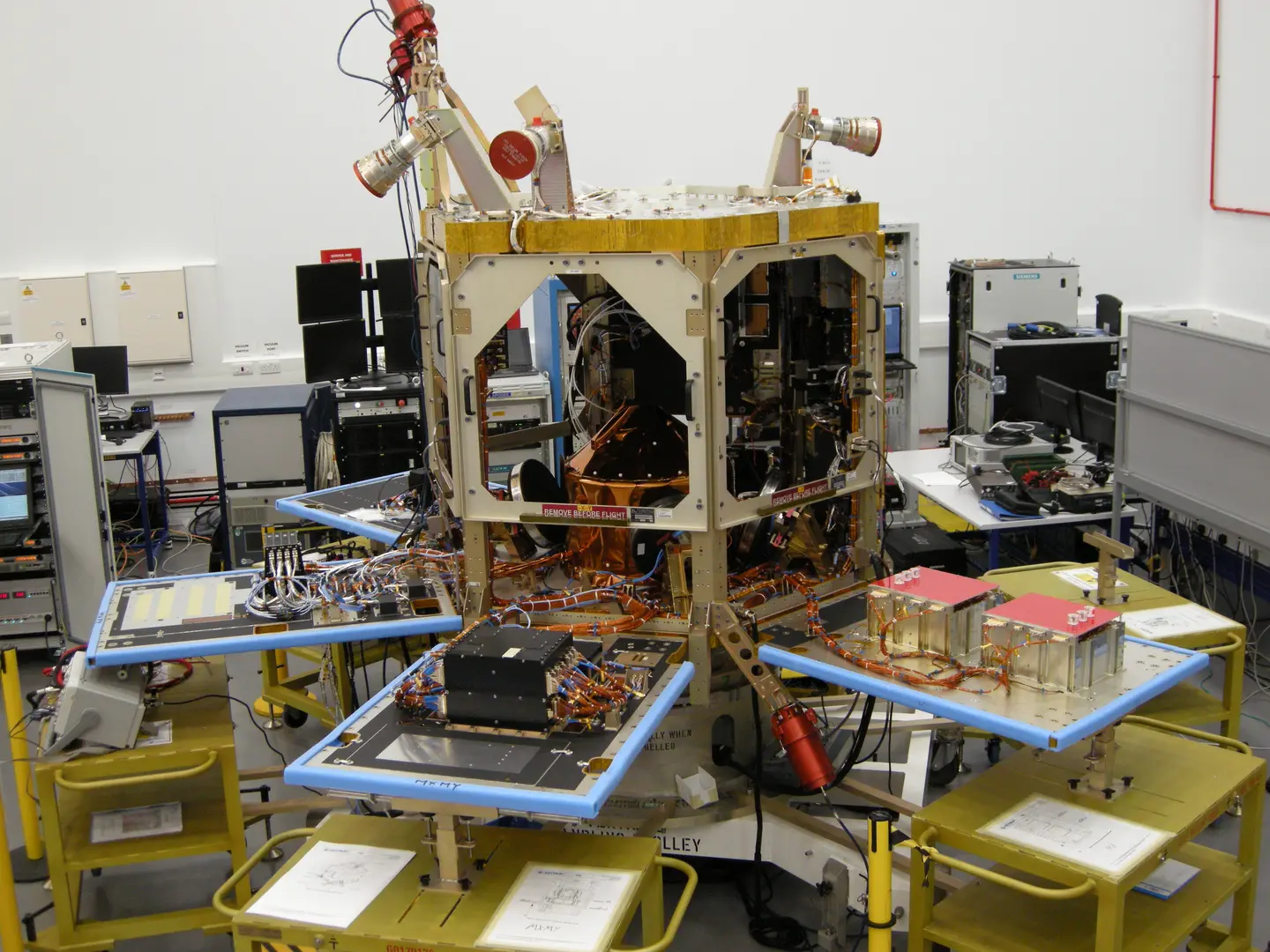
- European Space Agency, “Sentinel-5P in the cleanroom” (27 May 2014) — archival photograph, assembly context and Airbus Defence and Space credit.