As of 2026-11-06 08:36 UTC.
A ski resort can have three weather questions on the same desk: whether to open an exposed lift tomorrow, how many staff to hire for Christmas, and whether a new snowmaking system will earn its keep over decades. Each needs a different answer. The weather symbol beside the village name cannot do all three jobs.
On November 3, the World Meteorological Organization and International Ski and Snowboard Federation released guidance connecting those decisions to the information available. It arrives as the 2026–27 Alpine Ski World Cup season gets underway. WMO reports that weather forced the cancellation of 25 Ski World Cup races last season, citing FIS’s internal calculation. That tally describes disruption; it does not establish how much of it was caused by climate change.[1]
The publication’s practical importance is its separation of immediate conditions, seasonal probabilities and long-term climate change. Understanding that distinction helps operators decide when to act—and helps visitors judge what an opening-date announcement can reasonably promise.[1]
Tomorrow’s problem is local
The practical guide directs daily operations toward observations and short-range forecasts that distinguish conditions across the mountain. Wind on an exposed ridge matters to a lift operator; temperature at different elevations and the freezing level matter to snow management. Snow depth, recent thawing and refreezing, and expected traffic help determine grooming work.[3]
That changes the question from “Will the resort have good weather?” to “Will conditions at this lift or on this slope permit the planned work?” A forecast becomes useful when its location, update time and variables match the decision. The guide also lists avalanche services separately, reflecting the need for specialist information alongside general weather forecasts.[3]
Christmas comes with probabilities
A seasonal outlook answers a broader question. ECMWF explains that predictions beyond ten days generally describe a range of possible conditions and their departure from normal. The averaging period grows with the forecast horizon: roughly a week for sub-seasonal guidance, then a month or season further ahead.[4]
There is a physical reason this remains useful after the precise sequence of daily weather becomes uncertain. Oceans, ice and parts of the land surface change more slowly than the atmosphere. Their influence can persist in average conditions over a season.[4]
For a resort, an increased probability of a mild winter might justify more flexible staffing or opening plans. It cannot establish whether snow will fall on the Friday before a holiday. Nor does a mild seasonal average exclude a cold spell. Planning can respond to a shift in the odds while keeping commitments conditional on nearer-term evidence.[4]
A snow gun still needs the right air
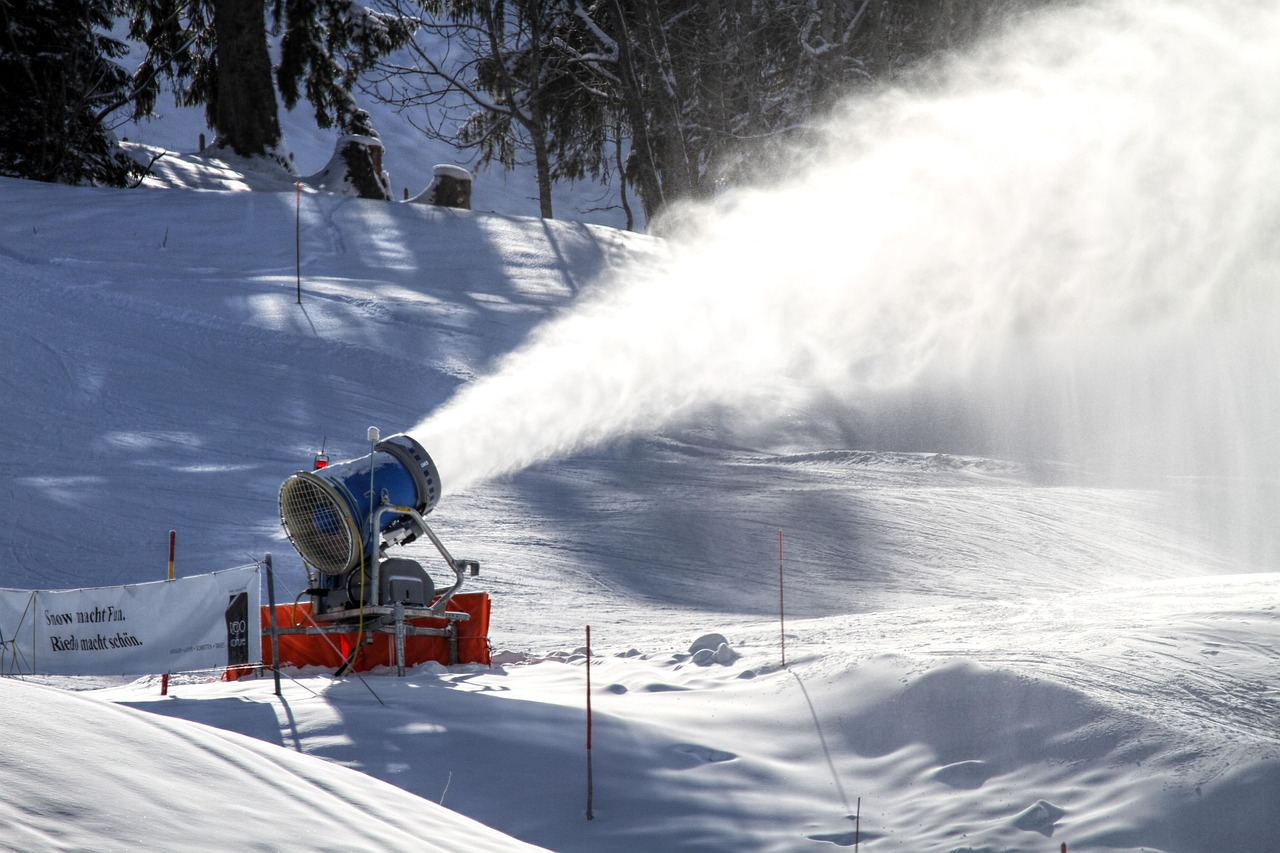
Snowmaking adds control, but its operating window has a physical boundary. Equipment manufacturer TechnoAlpin bases its calculator on wet-bulb temperature, which combines air temperature with relative humidity. Its stated snowmaking threshold is −2.5°C wet-bulb for its generators. That is a manufacturer’s specification, rather than a universal threshold for every machine or site.[5]
The distinction matters because the ordinary air-temperature reading leaves out humidity. Two evenings with the same thermometer reading can offer different snowmaking conditions. Buying more equipment does not remove the need to identify a usable window.[5]
The WMO report adds the other constraints: available water, electricity costs and the competing demands on both. It recommends combining forecasts with resource information and prioritizing terrain. The practical question becomes how much useful snow a resort can produce during suitable hours with the resources it actually has.[2]
A new lift needs a longer view
The stakes become clearer in the research behind the guidance. A 2023 study assessed 2,234 resorts across 28 European countries. At 2°C of global warming above preindustrial levels, it projected very high snow-supply risk for 53% of those resorts without snowmaking. Assuming snowmaking covered half the pistes reduced that share to 27%, with increased water and electricity demand.[6]
Those percentages are conditional projections, not a forecast of closures this winter. The authors explain that their “very high” category means snow-scarce winters occurring at least half the time. Scarcity is measured against each resort’s own historical threshold: the worst fifth of winters in the 1961–90 reference period.[8]
That definition makes the result more useful and more specific. It describes how often unusually poor historical conditions could recur. It does not turn every resort into the same business or determine whether an individual investment pays. The authors also find substantial differences within and between mountain regions, so a continental percentage cannot substitute for a site assessment.[8]
What the guidance establishes
The evidence comes in different forms:
- November 3, 2026 — WMO release: confirms publication and reports the cancellation tally, attributed to FIS’s internal calculation.[1]
- 2023 — European resort study: models snow-supply risk under stated warming and snowmaking assumptions.[6]
- 2026 — Full WMO report: offers worked scenarios, explicitly described as illustrative rather than documented case studies.[2]
That last distinction is easy to miss. The report includes a seasonal-planning example with a 15% resource-efficiency improvement. Because the example is illustrative, the figure cannot be treated as a measured saving achieved by an actual resort—or as evidence that adopting the guide will deliver that return.[2]
For operators, destination managers and the communities depending on them, the next test is implementation. My base case is that the guidance improves the questions asked, while local outcomes remain unproven. The upside trigger would be documented operational improvements, measured against a clear baseline. The downside trigger would be resource shortages or unsuitable weather preventing a planned response even when a forecast provides advance warning. These are assessment scenarios, not WMO predictions.
A short checklist follows from that distinction:
- Next 24 hours: identify the local observation, forecast and responsible person behind each immediate operating decision.
- Next seven days: check whether opening plans retain room to change as conditions develop.
- Next 30 days: ask investment proposals to state their climate, water and energy assumptions, alongside the evidence needed to revise them.
A changed forecast can invalidate an opening plan. A shortage of usable snowmaking hours or water can invalidate a production assumption. Those are reasons to revise the decision, even when the equipment is ready and the calendar says winter.
Sources
- World Meteorological Organization, “Report on weather and climate services for ski resorts supports winter sports,” November 3, 2026—publication, planning horizons and attributed race-cancellation tally.
- WMO and FIS, Weather and Climate Services for Ski Resorts: Full Report, WMO-No. 1405, 2026—section 7.3 on snowmaking resources and sections 13.1–13.2 on illustrative scenarios.
- WMO and FIS, Weather and Climate Services for Ski Resorts: A Practical Guide, WMO-No. 1404, 2026—daily operational information, specialist services and photograph credit.
- ECMWF, “Fact sheet: Sub-seasonal and seasonal predictions,” July 22, 2025—probabilities, averaging periods and sources of seasonal predictability.
- TechnoAlpin, “The TechnoAlpin Wet-Bulb Calculator”—manufacturer’s explanation and equipment threshold; accessed November 6, 2026.
- Hugues François and colleagues, “Climate change exacerbates snow-water-energy challenges for European ski tourism,” Nature Climate Change, 2023—abstract and bibliographic record hosted by Météo-France.
- violetta, snow-cannon photograph, Pixabay—direct JPEG of the archival photograph, also credited in WMO’s practical guide.
- Samuel Morin, Hugues François and co-authors, “How climate change will hit snow levels across Europe’s ski resorts,” Carbon Brief, August 28, 2023—study authors explain the risk definition and local variation.