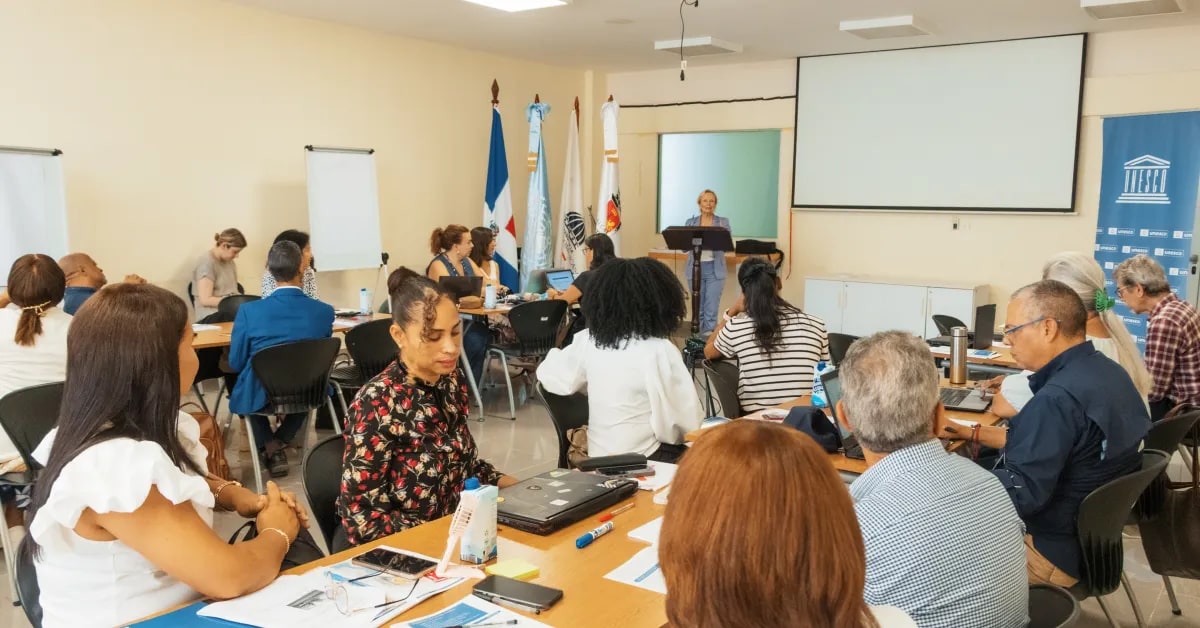
As of 2026-10-17 01:33 UTC, Santo Domingo’s Colonial City is testing the draft Climate Action Toolkit for World Heritage. UNESCO reported the pilot on October 16: it is the first cultural property to test the methodology.[1]
The exercise asks a deceptively difficult question. A climate projection can describe changing conditions; a conservation team must decide what to protect, which intervention will help, and whether the intervention itself could damage the place. Between those tasks lies the work this pilot is trying to make more systematic.
What has happened so far?
Three dated records establish the project’s stage:
- 2023: ICOMOS announced a joint toolkit project, designed for testing across cultural, natural and mixed heritage sites. This establishes the original scope.[2]
- 2023: World Heritage states adopted their climate-action policy and called for practical implementation guidance. This is the policy foundation.[3]
- October 5–9, 2026: Santo Domingo hosted an in-person test of the toolkit’s Zero Draft. UNESCO’s report confirms a pilot, with participants aiming toward a local Climate Action Plan.[1]
There is a useful distinction here between a method and a result. Testing a way of making decisions can reveal whether people understand it and whether it fits their responsibilities. Establishing that those decisions have reduced damage requires subsequent evidence.
What exactly is being conserved?
In Santo Domingo, the answer extends beyond a collection of famous buildings. UNESCO’s account identifies the historic street grid, the widths of streets, the scale of buildings and their continuing uses among the city’s defining characteristics. The listed property covers 106 hectares near the mouth of the Ozama River. Its grid influenced later colonial urban planning across the Americas.[4]
These are examples of the physical and functional features that carry what UNESCO calls Outstanding Universal Value: the significance for which a place receives World Heritage recognition. The official description also records the city’s role as a base for conquest and the expansion of Spanish power. Conserving its historical evidence does not require celebrating that history.[4]
For a planner, this makes the question more precise. Keeping an individual wall standing is one objective. Keeping a historic street’s dimensions, relationships and everyday use legible is another. A project can perform well against one objective while creating difficulties for another.
Why is a hazard forecast insufficient?
The 2026 Managing World Heritage manual separates three ingredients of risk: the hazard, the people or features exposed to it, and their vulnerability. Vulnerability includes both susceptibility to harm and limitations in the capacity to cope. A weather event therefore does not translate into identical consequences everywhere it reaches.[5]
Consider an illustrative assessment of heavy rainfall. The team would need to establish where water travels, which structures and activities lie in its path, and what makes them susceptible to damage. That example is a way to understand the method, not a reported finding about a particular Santo Domingo street.
A regional projection alone cannot answer every one of those questions. Local observations must help connect the projected conditions to a particular building, route or use. The important output is a reasoned chain: this hazard could affect this feature through this process, so this response deserves consideration.
The same manual warns that adaptation can itself harm heritage. It also distinguishes adaptation, which addresses climate impacts, from climate mitigation, which reduces greenhouse-gas emissions or strengthens their removal.[5] Those objectives need separate checks: a measure’s carbon benefit does not establish its suitability for a historic setting.
What does the toolkit add?
The project’s original announcement describes a joint effort by UNESCO’s World Heritage Centre, ICCROM, ICOMOS and IUCN. It envisages a resource manual that helps managers incorporate climate action into existing management strategies. Its intended material includes adaptation plans, case studies, local and Indigenous knowledge, and the contributions of ecosystems.[2]
That scope matters. A city is unlikely to obtain a useful answer by handing a climate dataset to one specialist and treating conservation as somebody else’s responsibility. The tool’s promise is to give different kinds of knowledge a shared route into a decision. Whether it achieves that is something the pilot must test.
The 2023 resolution also recommends integrating adaptation and mitigation into risk-preparedness policies and action plans. It calls for implementation guidance that could include indicators and benchmarks.[3] In practical terms, the conservation decision should come with a way to judge what happened after it was carried out.
Take a hypothetical drainage proposal. A review might compare several designs against flood exposure, effects on historic fabric, access for residents and maintenance needs. A useful assessment would show why one option was selected and what observations would prompt a change. These are illustrative questions, not works announced for Santo Domingo.
What would count as progress?
The pilot process is scheduled to continue through November 15, 2026.[1] That gives the next month a concrete point of reference, while leaving the timing of any completed local plan unresolved.
The following scenarios are interpretations, not announced outcomes. The base case is a refined draft, evidenced by changes responding to pilot feedback. The upside would be a local plan connecting specific heritage features to assessed risks, selected responses and measurable results. The downside would be a process that lists hazards but cannot explain which choices should change. A published assessment that makes those connections would overturn that concern.
For residents, conservation practitioners and reporters following the pilot:
- Within 24 hours: describe the announcement as a test of a draft methodology. Do not infer that a funded construction programme has begun.
- Over seven days: seek examples showing how a climate projection changes a conservation choice, including alternatives considered and whose knowledge informed the assessment.
- Over 30 days: look for pilot feedback, revisions and the status of the local plan. Update this account if authorities publish an adopted plan or evidence of implementation.
The most revealing document will be one that lets a resident follow the reasoning from a projected hazard to a recognisable street—and see why the chosen response belongs there.
Sources
- UNESCO, “UNESCO advances the development of a tool to integrate climate action into World Heritage management,” October 16, 2026—pilot report and photograph.
- ICOMOS, “New Toolkit Underway To Strengthen Capacities for Climate Action in World Heritage Sites,” August 29, 2023—project partners, scope and planned contents.
- UNESCO World Heritage General Assembly, Resolution 24 GA 8, 2023—adoption of the climate-action policy and recommendations for implementation.
- UNESCO World Heritage Centre, “Colonial City of Santo Domingo”—Statement of Outstanding Universal Value, urban attributes and historical context.
- UNESCO, ICCROM, ICOMOS and IUCN, Managing World Heritage (2026), sections 5.6–5.7, pp. 92–100—hazards, exposure, vulnerability, adaptation and mitigation.