As of 2026-06-20 10:32 UTC, the news is not simply that a development banker met a pope. Associated Press reports that Ilan Goldfajn, president of the Inter-American Development Bank, privately met Pope Leo XIV at the Vatican after arguing that Latin America can turn rare earths and other critical minerals into a development opportunity if projects add value locally and operate under stronger labor, environmental, and governance standards.[1]
That is a harder sell than a normal investment roadshow. The Vatican has recently supported a mining-divestment platform focused on Latin American communities affected by extraction, and Leo spent about two decades as a missionary in Peru, close to regions where mining has shaped land, labor, church politics, and Indigenous claims.[1][3] The live question is whether critical minerals can be separated from the older Latin American pattern: foreign demand rises, deposits are opened, the material leaves, and local communities inherit water risk, displacement, and distrust.
Fact File
| Item | What is known now | Confidence note |
|---|---|---|
| Meeting | AP reports Goldfajn met Pope Leo XIV privately on Friday, June 19, after presenting the case for responsible rare-earth development in Latin America.[1] | High for the meeting and reported argument; the Vatican did not issue a detailed readout. |
| IDB pipeline | Goldfajn told AP the IDB has about $4 billion in critical-mineral projects in the region, mostly in Chile, Argentina, and Brazil, with roughly three-quarters involving private companies.[1] | Medium-high; direct reporting from an interview, but project terms can change. |
| IDB platform | IDB LAC Minerals says Latin America and the Caribbean account for about 30% of global mineral supply and about $180 billion in annual metals exports, while most exports remain raw materials.[2] | High for the IDB's public framing; it is also an institutional pitch. |
| Rare-earth reserve map | USGS estimates world rare-earth reserves at more than 75 million tons of rare-earth-oxide equivalent, with China at 44 million tons and Brazil at 11 million tons.[4] | High for the official commodity summary; reserve estimates are periodically revised. |
| Demand and concentration | IEA says demand for nickel, cobalt, graphite, and rare earths rose 6-8% in 2024, and that refining concentration increased across nearly all key energy minerals from 2020 to 2024.[5] | High for the global trend; IEA's figure for rare earths refers to magnet rare earths. |
Why A Vatican Audience Matters
Goldfajn's argument is strategic: if the world wants electric vehicles, wind turbines, advanced electronics, data centers, and defense systems, it needs more secure mineral supply chains. Rare earths are only one subset of the critical-minerals universe, but they carry the political symbolism because magnets and advanced electronics make them visible in both clean-energy and national-security debates.[1][4][5]
The Vatican's role is different. It does not license mines, finance concentrators, or write export-control rules. Its influence runs through moral legitimacy, dioceses, parish networks, religious orders, universities, and local community relationships. That matters in Catholic-majority countries where church actors can either reduce conflict by insisting on credible consultation and benefit-sharing, or harden resistance when projects look like another cycle of extraction imposed from above.[1][3]
The AP story captures the collision: Goldfajn is trying to persuade the pope that the region can avoid old mistakes, while Vatican-aligned activists are explicitly warning that mining demand can become a new form of pressure on Indigenous and local communities.[1][3] This is not a technical disagreement about whether rare earths are useful. It is a governance dispute about who gets to define "responsible" before money, permits, roads, tailings systems, water use, and processing contracts lock in.
The Development Pitch
The strongest case for Goldfajn's approach is that Latin America should not stay only at the ore-export end of the chain. IDB LAC Minerals frames the opportunity around better regulation, infrastructure, private investment, stronger institutions, refining, processing, jobs, and supply-chain resilience.[2] That is a real development claim, not a decorative one. If countries can process more material locally, negotiate long-term offtake, build technical skills, and keep higher-value steps inside the region, the payoff can be larger than royalties alone.
There is also a geopolitical opening. USGS data show that Brazil holds the second-largest listed rare-earth reserve base after China, while China still dominates both reserves and much of the industrial chain.[4] IEA's warning is broader: supply-chain diversification is the energy-security goal, but refining and processing have become more concentrated in recent years, not less.[5] That makes Latin American projects attractive to Europe, North America, Japan, and others looking for alternatives.
The weak version of this story would say: critical minerals are good, therefore mines should proceed. The stronger version says: the same demand that makes these projects strategic also raises the standard of proof. If buyers want non-Chinese supply because they care about resilience, they cannot ignore whether the alternative supply chain repeats the social and environmental failures that made mining politically toxic in the first place.[1][3][5]
The Ethical Gate
The Vatican-backed divestment platform is not operating from a vague anti-technology stance. Vatican News describes the platform as a mechanism for information exchange, study of mining and finance, and cooperation around rights violations and local-community harms.[3] The concern is that the green and digital transition can create a moral shortcut: because the end product sounds clean or strategic, the mine site gets treated as a regrettable input rather than as the place where the real cost is paid.
That shortcut is exactly what Leo is unlikely to accept without evidence. AP notes his Peruvian history and his recent criticism of mineral exploitation in Africa; it also reports that the Vatican gave no detailed readout of the Goldfajn meeting.[1] That silence matters. It leaves the banker's pitch in the conditional lane: possible, interesting, but not yet accepted as morally clean.
For investors and governments, the practical consequence is clear. A project that can show credible consultation, enforceable water protections, labor standards, transparent contracts, local processing, tax discipline, and grievance mechanisms has a chance to be read as development. A project that treats those pieces as public-relations overhead will run into the same opposition even if the minerals end up inside wind turbines or electric vehicles.
Scenarios
Base case: the Vatican keeps pressure on mining finance while leaving room for projects that meet unusually high consultation, water, labor, and transparency standards. In this branch, the pope's influence raises the cost of weak projects more than it blocks the entire sector.[1][3]
Upside case: IDB-backed projects use the moment to create a visible benchmark for responsible critical-mineral development: local processing, community benefit agreements, monitored water systems, and public reporting that dioceses and civil-society groups can verify.[2][3]
Downside case: governments and companies hear only the supply-chain opportunity. If affected communities see rushed licensing, weak enforcement, or benefits leaving the region, church networks become amplifiers of resistance rather than mediators.[1][3]
Falsifier: this article's reading would weaken if the Vatican publishes a supportive follow-up that accepts the IDB framework without major conditions, or if IDB projects disclose enforceable community, water, labor, and local-processing commitments strong enough to satisfy church-linked critics. For now, the evidence points to a contested opening, not a settled endorsement.[1][2][3]
Action Checklist
- Treat "critical" as a supply-chain label, not an ethical pass.
- Track whether IDB LAC Minerals produces public project standards, not only financing totals.[2]
- Watch Brazil, Chile, and Argentina for the first projects that move beyond extraction into refining or processing.[1][2]
- Separate reserve size from readiness: USGS reserve numbers do not by themselves prove a mine can be licensed, financed, processed, and accepted locally.[4]
- Watch Pope Leo's expected Peru visit in November for whether mining appears as a development partnership, a warning about extraction, or both.[1]
The useful reading is narrow: rare earths have entered a politics where supply security, clean-energy hardware, Indigenous rights, church authority, and industrial policy now meet in the same room. Goldfajn's Vatican pitch matters because it shows the new test. Critical-mineral projects will not be judged only by whether the world needs the material. They will be judged by whether the communities closest to the mine can believe the word "responsible" before the first shipment leaves.[1][2][3]
Sources
- David Biller and Nicole Winfield, "A top banker made a case for mining to Pope Leo XIV, who has seen its impact up close," Associated Press (June 20, 2026).
- Inter-American Development Bank, "IDB Group Launches IDB LAC Minerals" (2026).
- Vatican News, "Indigenous peoples and Church launch mining divestment platform" (March 20, 2026).
- U.S. Geological Survey, "Rare Earths," Mineral Commodity Summaries 2026 (PDF).
- International Energy Agency, Global Critical Minerals Outlook 2025 (PDF).
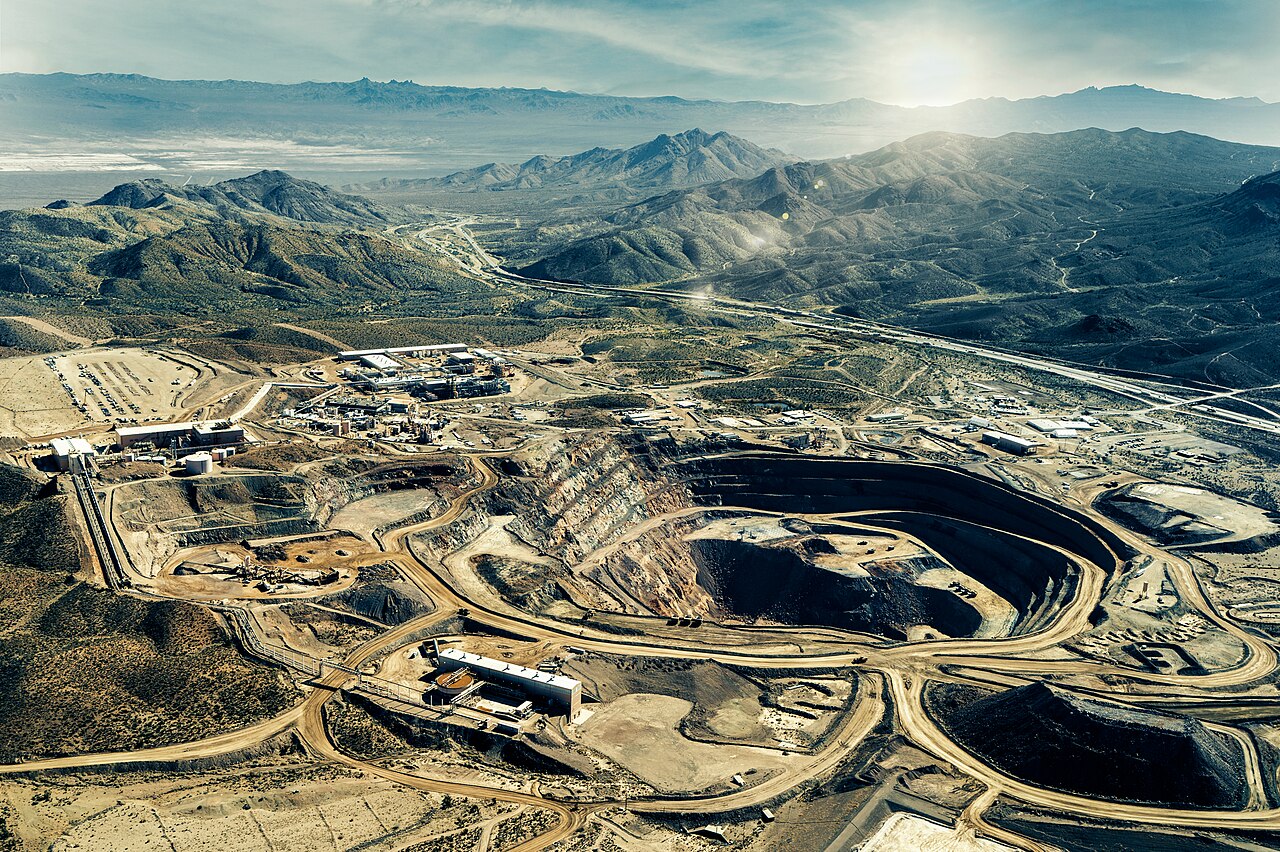
- Wikimedia Commons, "File:Mountain Pass Rare Earth Mine & Processing Facility.jpg" - source page for the article image.