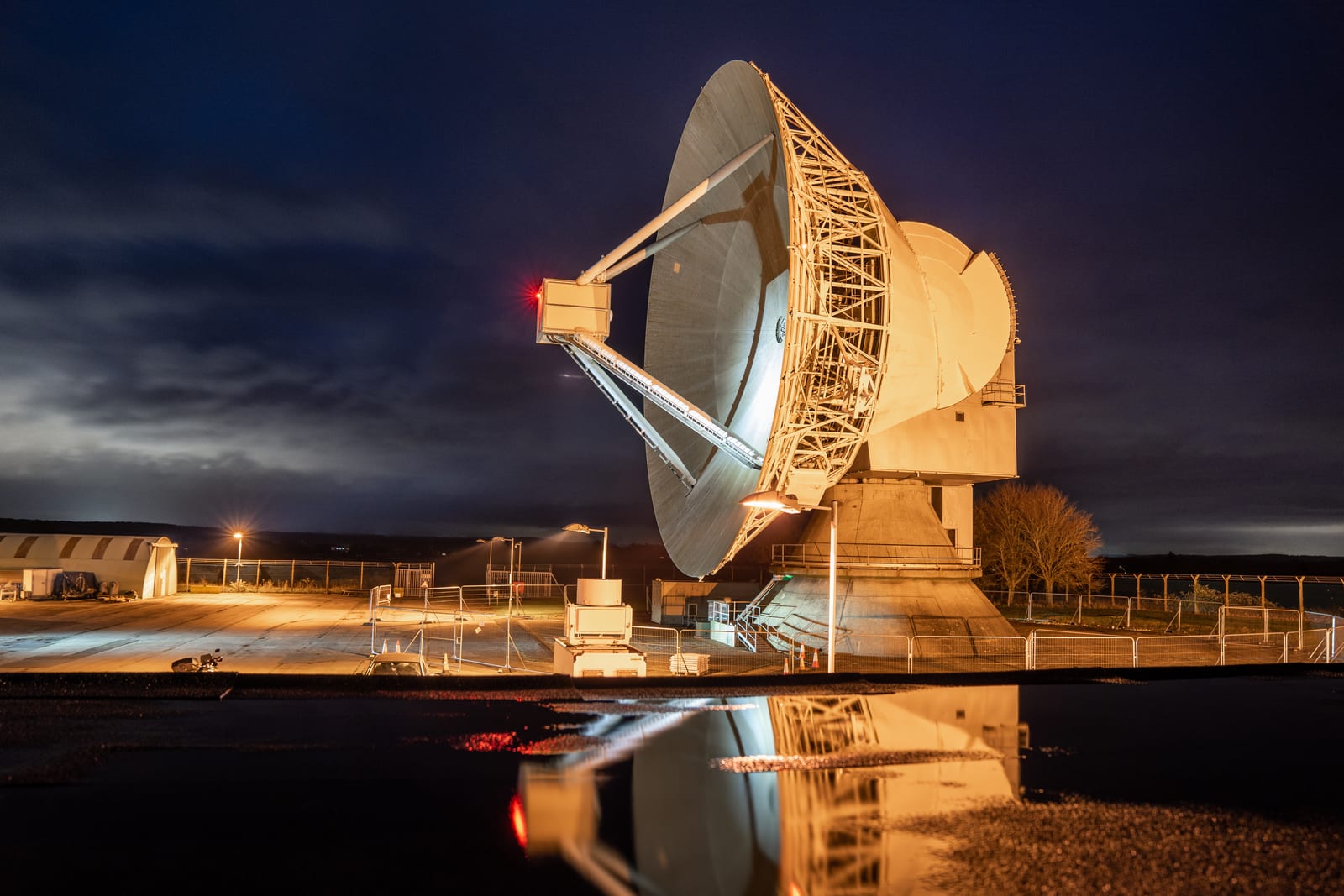
As of 2026-07-29 19:34 UTC, the UK’s National Space Operations Centre had published its June ledger: 1,436 collision-risk alerts involving UK-licensed satellites, up 12% from May but still below the 12-month rolling average. The same report counted 53 uncontrolled re-entries, a net 304-object increase in the US Satellite Catalogue and one rocket-body fragmentation event whose debris count was still being assessed.[1]
The numbers describe a busier month, not 1,436 narrowly avoided crashes. A collision alert is a forecast produced by comparing predicted paths. It starts an analysis process; it does not reveal, by itself, how close two objects ultimately came, how many warnings concerned the same pair, whether the probability rose or fell as new observations arrived, or whether an operator moved a satellite.
That distinction matters because the warning system is supposed to be noisy before space is dangerous. Screening must catch uncertain encounters early enough to leave time for better tracking, coordination and—only when necessary—a manoeuvre. The useful question is therefore not “Were there 1,436 near misses?” It is: How did those forecasts move through the operational queue?
The June record, with its boundaries attached
| Timestamp and record | Confirmed signal | Confidence boundary |
|---|---|---|
| NSpOC, July 28 | June produced 1,436 collision-risk alerts, versus 1,285 in May; the June total remained below the rolling 12-month average.[1] | High confidence in the published aggregate. NSpOC did not publish an event-level denominator, severity distribution or alert-to-manoeuvre count. |
| NSpOC, July 28 | The tracked catalogue ended June at 34,392 resident space objects, a net monthly addition of 304.[1] | High confidence in the stated snapshot. The agency warns that catalogue totals can be adjusted as tracking and classification improve. |
| NSpOC, July 28 | One rocket body fragmented in low Earth orbit; assessment of the number of released pieces was continuing.[1] | Confirmed event, incomplete consequence. The public report does not identify the object, orbit, fragment count or which UK assets, if any, received related alerts. |
| ESA, 2026 report | ESA defines a conjunction as a geometric close approach that triggers operator analysis but does not necessarily imply either a manoeuvre or a collision.[3] | Strong definition, different dataset. ESA’s modelled conjunction statistics cannot be used to infer the UK fleet’s June conversion rate. |
| NSpOC service record | The UK service primarily warns licensed operators about in-space collisions, fragmentations and re-entries; its first year produced just under 30,000 collision alerts.[2][7] | High confidence on service scope and scale. The public pages do not expose a common severity funnel across months. |
The last boundary is the most important. A monthly alert count combines astronomy, probability and operations into one total. To understand it, those layers have to be pulled apart.
Step one: turn observations into possible encounters
Radars and optical sensors observe objects, and analysts or automated systems estimate their orbits. Those estimates are then propagated forward: where will object A and object B probably be at a future time, and how uncertain is each predicted position?[10]
When two predicted paths pass within a screening boundary, the pairing becomes a conjunction. This is closer to a weather watch than a crash report. It says that the geometry deserves attention while time remains to refine it.[3][10]
ESA’s operational service shows how dynamic that process is. Its predictions cover roughly seven days, are updated several times daily and process hundreds of incoming messages. For each encounter, teams examine not just a nominal miss distance but also the collision probability, approach geometry and uncertainty around both orbits.[4] The UK’s public June total does not expose those fields, but they are the kind of information an operator needs before deciding what the alert means.
One consequence is that a single future encounter can generate a history of changing assessments. NSpOC says its UK manoeuvre-support view follows conjunction probability from identification to the time of closest approach while analysts review new data as it arrives.[9] A fresh observation may shrink the uncertainty region and show the objects passing safely apart. It can also sharpen a previously diffuse risk into a more serious one. Counting alerts without a published counting rule leaves open whether successive updates are one event, several notices or a mixture of both.
Step two: let uncertainty move the forecast
Miss distance sounds concrete, but a predicted point is not the whole forecast. Each orbit comes with uncertainty, and the two uncertainty regions evolve differently as observations age, atmospheric drag changes and sensors collect new data. A smaller nominal miss distance can sometimes carry a lower calculated collision probability than a wider-looking pass if the uncertainty geometry differs.
This is why operators should not treat a first probability as a stable score. They watch the trajectory of the assessment: time to closest approach, quality of the underlying orbit data, whether the probability is converging, and whether the other object can communicate or manoeuvre.
ESA’s 2026 environment report makes the escalation boundary explicit. Its analytical threshold of 10⁻⁶—one in a million—for representative low-Earth-orbit conjunctions is usually below operators’ reaction thresholds; events at that level may prompt closer monitoring without producing an avoidance burn.[3] Thresholds also differ among fleets. A large constellation with automated manoeuvring, a scientific satellite with limited fuel and an unpowered debris fragment do not face the same decision architecture.
The scale difference is visible in current reporting. SpaceX told the US Federal Communications Commission that Starlink performed 207,152 avoidance manoeuvres from December 2025 through May 2026, while ESA says its own missions average 12 such manoeuvres a year.[4][6] Those figures should not be divided into the UK alert total: they cover different fleets, policies, periods and operating models. Their value is to show why there is no universal conversion rate from “alert” to “move.”
Step three: decide who should move—and prevent a second problem
An alert becomes an operational decision only after triage.
If one object is dead debris and the other is an active satellite, only the satellite can move. If both are active, coordination matters: two operators reacting independently can choose incompatible manoeuvres. UK policy consultation material therefore treats operator contact, published manoeuvre thresholds and procedures for autonomous avoidance systems as evidence of responsible planning. It also warns that coordination reduces the chance of both operators moving in ways that create misunderstanding.[5]
Moving is not automatically safer. A burn consumes fuel, can interrupt a mission and changes the satellite’s future path. The proposed orbit must be screened again so that avoiding one conjunction does not create another. NSpOC’s civil-service description identifies this as part of the job, and ESA says its teams screen proposed manoeuvre files to confirm both the desired risk reduction and acceptable risk from other encounters.[2][4]
The decision chain therefore looks like this:
screening hit → updated tracking → risk trend → operator contact → candidate manoeuvre → re-screening → command → post-pass confirmation
Many alerts should leave that chain before the command stage. That is not evidence that the warning was false or wasted. It can mean the early screen bought time for better information. The operational failure would be a system unable to distinguish routine monitoring from a case that needs coordination or action before the decision window closes.
What the other June numbers add
The June ledger contains two different pressures on that chain.
First, the catalogue added a net 304 objects, reaching 34,392.[1] Catalogue growth expands the set of paths that can intersect, although a net monthly total alone cannot say where congestion changed or how many additions were operational spacecraft rather than debris. ESA’s 2026 environment report says more than 4,000 payloads were added during 2025 and notes that traffic growth is increasing the need for coordination in lower low Earth orbit.[3] More objects do not translate linearly into more dangerous encounters, but they do increase the screening and coordination workload in crowded shells.
Second, June’s rocket-body fragmentation is an uncertainty shock. A breakup can produce pieces before every fragment is detected, tracked repeatedly and assigned a stable catalogue identity. NSpOC’s fragmentation service models new debris and pushes related collision risks into the operator-warning system.[2] The public record currently stops before the fields needed to judge the incident’s operational weight: object identity, altitude, fragment population, persistence and alerts linked to the cloud.
The 53 re-entries are a separate risk channel. Forty-three were satellites, eight rocket bodies and two likely debris pieces.[1] They help explain catalogue turnover and the centre’s workload, but they should not be folded into the collision-alert total. NSpOC monitors both hazards; one concerns paths crossing in orbit, the other concerns uncontrolled descent through the atmosphere.
Decision impact: 24 hours, 7 days, 30 days
Next 24 hours — keep the language narrower than the number. Newsrooms and analysts should call the 1,436 figure collision-risk or collision-avoidance alerts, not near misses, evasive actions or almost-crashes. Operators should work from current event data and their own thresholds, not the retrospective monthly aggregate. NSpOC can immediately reduce ambiguity by stating whether the total counts unique conjunctions, notices, updated messages or another unit.
Next 7 days — close the fragmentation information gap. The most useful near-term update would identify the June rocket body, give a bounded fragment estimate and say whether the event generated alerts for UK-licensed spacecraft. If operational security prevents naming affected satellites, aggregate counts by orbit and severity would still distinguish a catalogue event from an operator workload event.
Next 30 days — publish the funnel, not just the intake. A decision-grade monthly dashboard would separate unique conjunction events, repeat updates, events entering enhanced monitoring, operator-to-operator coordination cases, proposed manoeuvres and executed manoeuvres. It should also show how many cases resolved because tracking uncertainty narrowed. That funnel would reveal workload and escalation without publishing satellite-specific vulnerabilities.
Three paths for the next ledger
Base path — a variable queue, no exceptional event. Alert totals continue to move with fleet activity, catalogue changes and observation quality; the June fragmentation is characterised without producing a sustained jump in high-severity cases. Triggers: July remains within the recent range, the fragment catalogue stabilises and no collision or major service disruption is reported.
Upside path — better observations collapse uncertainty earlier. More timely or precise tracking resolves a larger share of conjunctions before operator coordination or manoeuvre planning, even if the initial screening count stays high. Triggers: NSpOC publishes a stable event definition and a funnel showing fewer late-stage escalations or shorter time spent above enhanced-monitoring thresholds.
Downside path — one breakup creates a persistent operational tail. Newly tracked fragments generate repeated encounters in a congested orbital band, while uncertain identities or stale orbit data leave operators less time to coordinate. Triggers: a rising count of fragment-linked warnings, more late updates near time of closest approach, an unusual increase in manoeuvres, or a confirmed collision.
These are conditional operating paths, not predictions. The public aggregate is not detailed enough to assign probabilities to them.
Action checklist and invalidation conditions
- NSpOC: define the counting unit, preserve the 12-month series and add an aggregate escalation funnel.
- Satellite operators: keep ephemerides current, document decision thresholds, maintain counterpart contacts and re-screen every proposed burn.[2][4][5]
- Regulators: distinguish possession of an alert feed from demonstrated ability to evaluate, coordinate and act on it.
- Newsrooms: attach the fleet, period and metric to every comparison; do not compare UK alerts with another fleet’s manoeuvres as if they were the same unit.
- Readers: treat a changing probability as updated evidence, not proof that an earlier alert was either a hoax or an almost-collision.
Invalidation conditions: revise this explainer if NSpOC publishes a methodology showing that the 1,436 figure already represents unique, severity-filtered events or executed avoidance actions; if the June total is materially corrected; or if the unidentified rocket-body fragmentation is linked to a collision or a documented surge in actionable warnings. A published alert-to-manoeuvre funnel should replace the provisional process model used here.
The safest collision alert is one that arrives early, changes honestly as the evidence improves and disappears from the queue without a spacecraft moving. The June number shows that Britain’s warning machinery had work to do. It does not yet show how far that work travelled from forecast to command.
Sources
- National Space Operations Centre, “How we protected the UK and space in June 2026” (July 28, 2026) — official monthly totals for collision alerts, re-entries, catalogue growth, fragmentation and space weather, with revision boundaries.
- National Space Operations Centre, “Civil Space Protection Services” (May 16, 2024) — service architecture, operator support, fragmentation modelling and re-screening rationale.
- European Space Agency, ESA Space Environment Report 2026, issue 10 (May 1, 2026), especially sections 3.3–3.5 — conjunction definition, monitoring threshold, 2025 traffic and fragmentation context, and methodological limits.
- European Space Agency, “Reentry and collision avoidance” — operational forecast updates, event fields, manoeuvre threshold process, proposed-orbit screening and ESA’s average annual manoeuvre count.
- UK Department for Science, Innovation and Technology, “Consultation on Orbital Liabilities, Insurance, Charging and Space Sustainability” (October 2023) — policy treatment of operator coordination, manoeuvre thresholds and autonomous avoidance procedures.
- Tereza Pultarova, “Every SpaceX Starlink satellite has to dodge a collision almost weekly, and experts fear the worst.” Space.com, July 15, 2026 — independent reporting on current constellation manoeuvre scale, trajectory uncertainty and the limits of cross-fleet comparisons.
- UK Space Agency, “UK space safety centre marks one-year milestone” (July 11, 2025) — NSpOC’s first-year alert scale and provenance page for the National Centre for Atmospheric Science photograph of Chilbolton Observatory.
- UK Research and Innovation, “Chilbolton Observatory” (updated November 27, 2025) — official description of the 25-metre antenna’s space-surveillance and satellite-tracking role.
- National Space Operations Centre, “Monitor Space Hazards new feature: Satellite Manoeuvre Support” (August 1, 2024) — official explanation of how UK analysts update conjunction probability through time of closest approach and compare possible manoeuvres.
- NASA Conjunction Assessment Risk Analysis, “Step 1: Conjunction Event Prediction” (updated September 29, 2023) — independent operational explanation of screening volumes, predicted states, orbital uncertainty and proximity alerts.