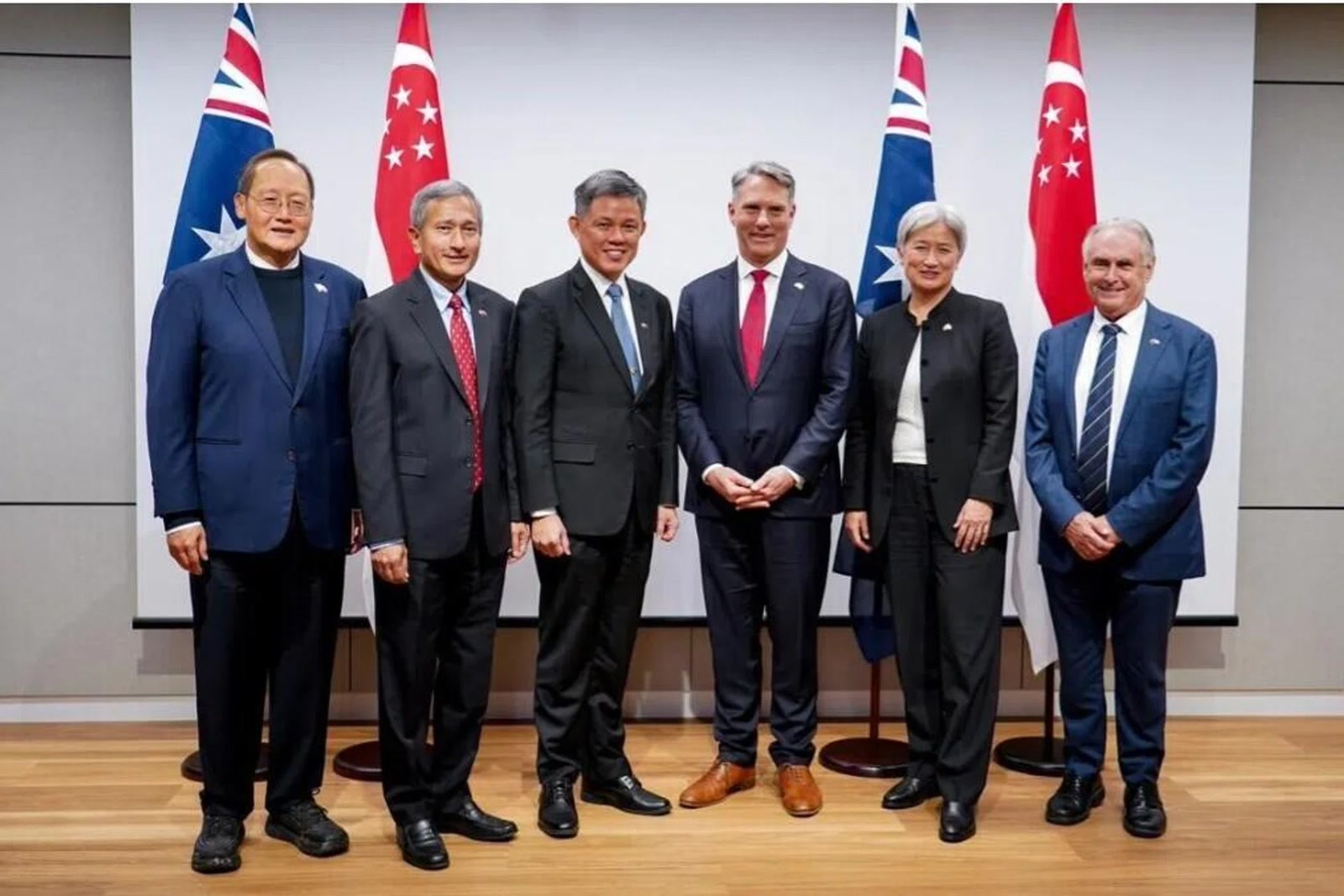
As of 2026-07-29 22:36 UTC, Australia and Singapore had signed a protocol meant to keep essential supplies moving through a disruption. It covers petroleum oils such as diesel, liquefied natural gas and other goods the two governments may mutually designate. It also creates advance-notice, emergency-consultation and review machinery.[1]
The agreement matters because the dependency runs both ways. Singapore supplies 55% of Australia’s petrol, 15% of its diesel and 23% of its aviation fuel, according to the Australian government; Australia imports about 90% of its fuel needs.[2] Singapore, meanwhile, produces about 95% of its electricity from imported natural gas and is exposed when global gas costs or access deteriorate.[5]
But “legally binding” and “fuel guaranteed” are not synonyms. Once in force, the protocol will bind the two countries to a process and to an effort. Its operative clause says each party “shall endeavour not to” impose the specified export restrictions. The next clause begins with the possibility that, despite that commitment, a restriction is proposed.[1]
That is not a drafting curiosity. It defines the agreement’s real value: less surprise, a named escalation route and pressure to limit a restriction—not a warehouse, a tanker or an unconditional cargo allocation.
What the public record establishes
| Timestamp and source | Confirmed fact | Confidence boundary |
|---|---|---|
| July 27, protocol text | Australia and Singapore signed the instrument in Adelaide. It becomes part of the Singapore–Australia Free Trade Agreement only when the parties exchange notes confirming completion of their domestic procedures.[1] | High confidence on legal status. At this cutoff, the official Singapore page said entry into force would follow those procedures; signing alone was not entry into force. |
| July 27, protocol text | “Essential supplies” expressly include petroleum oils, such as diesel, and LNG. Other goods can be added by mutual decision through a separate memorandum.[1] | High confidence on the named categories. The protocol itself does not enumerate the additional goods, volumes, grades, suppliers or delivery points. |
| July 27, protocol text | Each side shall endeavour not to adopt or maintain the covered export prohibitions or restrictions. If one is proposed, it must be limited to what is necessary, account for harm to the other side and be notified in advance.[1] | A qualified restraint, not an absolute ban. The text anticipates that a restriction may still occur. |
| July 27, protocol text | A country facing an actual or imminent disruption may request emergency consultations. The other side must respond and enter consultations within 30 days unless both agree otherwise.[1] | A mandatory channel, not a rapid-delivery service level. The protocol sets no minimum cargo, price, shipping time or refinery allocation. |
| July 27, Australian release | Singapore’s shares of Australian petrol, diesel and aviation-fuel supply are 55%, 15% and 23%; Australia imports around 90% of its fuel needs.[2] | Strong official exposure indicators, not live inventory data. They do not show current days of cover, cargo location or spare refining capacity. |
Ministers described the pact in broader language at their Adelaide press conference: keeping essential goods flowing, enabling early consultation and maintaining support during difficult periods.[3] Those statements explain the political intent. The signed text supplies the operational boundary.
The agreement converts trust into a procedure
The protocol’s most useful provisions are unglamorous.
It designates Australia’s Department of Foreign Affairs and Trade and Singapore’s Ministry of Trade and Industry as the primary contact points. It requires information about a disruptive measure—including its nature, start date, expected duration and rationale—to be shared before implementation where practicable, or as soon as possible afterward. It requires restrictions to be reviewed as conditions ease, with a view to withdrawal as soon as practicable.[1]
Those steps can reduce coordination latency. In a supply shock, a buyer needs to know whether a missing cargo reflects an upstream crude shortage, refinery trouble, unavailable shipping, a commercial allocation decision, a port problem or a government export control. Only the last of those is directly addressed by the protocol’s export-restriction clause, but an official contact and information channel can still help distinguish the causes before every actor plans for the worst.
The new Australia–Singapore Economic Resilience Dialogue gives that channel a standing home. It may coordinate energy, resources, agriculture, maritime shipping, ports, borders and other bilateral forums. Yet its ordinary timetable is deliberately broad: the first meeting is due no later than one year after entry into force, followed by a formal review within three years and at least every five years after that.[1] For a fast crisis, the emergency-consultation route—not the scheduled dialogue—is the relevant mechanism.
This is a meaningful change from April. Then, Prime Ministers Anthony Albanese and Lawrence Wong promised “maximum efforts” to meet each other’s energy needs and directed officials to produce a legally binding protocol. Independent reporting correctly left open whether the future instrument would actually prevent export restrictions.[6] The July text answers that question: it raises the procedural and diplomatic cost of a restriction, but does not make one impossible.
Warning time is only one layer of resilience
Australia’s exposure makes it tempting to treat the pact as a substitute for physical stocks. It is not.
In May, Canberra announced more than A$10 billion for fuel and fertiliser security, including a government-owned reserve of about one billion litres, an increase of roughly 10 days in minimum stockholding obligations and a goal of at least 50 days of supply for diesel and aviation fuel.[4] Those measures and the Singapore protocol solve different problems. Stocks buy time after supply is interrupted; diversified contracts and refining capacity reduce the chance of interruption; the protocol aims to make government action more predictable.
Singapore has the mirror-image vulnerability. Its electricity system depends overwhelmingly on imported gas, so an Australian LNG disruption can move through generation costs and household or business tariffs even if no lights go out.[5][6] The bilateral bargain is therefore not simply “Singapore helps Australia.” It formalises reciprocal exposure: refined petroleum moving south and east, LNG moving north and west.
Neither government can promise what does not physically exist. A protocol cannot produce crude feedstock, restore a damaged refinery, reopen a shipping lane, find a tanker or force a private counterparty to offer cargo on unchanged commercial terms. That does not make the agreement empty. It means its performance should be judged by whether it improves notice, information, restraint and recovery when physical supply is under pressure.
Decision impact: 24 hours, 7 days, 30 days
Next 24 hours — label the status correctly. Government, industry and media reporting should say the protocol has been signed, not that it is already in force. Fuel buyers should continue to manage inventory, contracts and alternate routes without counting the agreement as available stock. The immediate public-data gap is the date on which the two governments expect to exchange their entry-into-force notes.
Next 7 days — publish the crisis interface. DFAT and MTI should identify the operational contact path beneath the ministerial level, explain how a disruption notice will reach fuel and gas agencies, and disclose either the additional-goods list or the process for changing it. “Consult within 30 days” is an outer treaty deadline; an acute fuel problem needs an internal escalation clock measured in hours or days.
Next 30 days — test the mechanism before a shock does. A tabletop exercise should run three different cases: an export restriction, a refinery outage and a shipping interruption. Only the first squarely activates the export-control commitment, but all three test whether the contact points can identify the problem, protect commercially sensitive information and connect the right regulators, ports and suppliers. Publishing a bounded after-action note would show that the protocol is an operating system rather than a ceremonial attachment.
Three paths from signature to performance
Base case — a useful diplomatic circuit breaker. Domestic procedures finish, contact points are staffed and ordinary trade continues. During a disruption, notice arrives earlier and consultation prevents an initially broad measure from becoming broader or lasting longer than necessary. Triggers: an announced entry-into-force date, named implementing agencies, a convened resilience dialogue and a documented notification process.
Upside — procedure becomes practiced coordination. The countries add clearly defined goods, set a faster operational response target, drill port and shipping contingencies and use the mechanism to preserve flows without imposing restrictions. Triggers: a published implementation protocol, exercises with industry, evidence of advance warning and a measure narrowed or withdrawn after consultation.
Downside — the physical shock outruns the treaty clock. Upstream shortages, lost refining capacity or unavailable shipping cut supply even though neither government adopts an export restriction; alternatively, one country does restrict exports after giving notice, and consultations begin too late to prevent stockouts. Triggers: cancelled or deferred cargoes, emergency allocation rules, a formal export-control notice, falling stock cover or a consultation that starts near the 30-day deadline without an interim operating arrangement.
These are conditional paths, not forecasts. The public record does not support probabilities for them.
Action checklist and invalidation conditions
- Australian and Singaporean officials: publish the entry-into-force notice, implementing contacts, covered-goods update process and a response-time measure shorter than the treaty maximum.
- Fuel and gas buyers: keep contractual diversification, inventory and alternate logistics separate from the protocol in risk registers; a government consultation channel is not booked supply.
- Ports, refiners and system operators: exercise the information handoff for export controls, physical outages and shipping disruption as three distinct incidents.
- Analysts and newsrooms: distinguish the binding instrument from its qualified outcome. Quote “shall endeavour not to” together with the clauses governing what happens if a restriction is still proposed.
- Both governments: report whether a future use of the protocol produced earlier notice, a narrower measure or faster withdrawal—the outcomes that would demonstrate value.
Invalidation conditions: revise this analysis if the entry-into-force exchange or a supplementary memorandum creates an unconditional cargo commitment, a quantified allocation, a materially faster mandatory crisis response or a broader prohibition on restrictions than the published protocol contains. Revise it in the other direction if the first real disruption shows that notices arrive after commercial decisions are irreversible or that consultations do not alter the measure.
Australia and Singapore have moved from a handshake promise to treaty machinery. That is genuine progress. Its success will not be proved by the signature photograph, but by the first bad week in which officials warn sooner, restrict less and restore trade faster.
Sources
- Governments of Singapore and Australia, Protocol to the Singapore–Australia Free Trade Agreement on Economic Resilience and Essential Supplies (signed July 27, 2026) — official text for scope, entry into force, export restrictions, notice, consultation, review and dialogue machinery.
- Australian Minister for Trade and Tourism, “Australia and Singapore sign landmark Protocol on Economic Resilience and Essential Supplies” (July 27, 2026) — official signing record and Australian fuel-import exposure figures.
- Australian Minister for Foreign Affairs, “Australia–Singapore joint press conference” (July 27, 2026) — ministerial explanation of the protocol’s intent, energy-shock context and consultation function.
- Australian Minister for Trade and Tourism, “Government securing more fuel reserves: the Australian Fuel Security and Resilience package” (May 6, 2026) — official reserve, stockholding and funding measures used to distinguish physical resilience from treaty coordination.
- Singapore Energy Market Authority, “Middle East Conflict’s Impact on Prices of Electricity & Town Gas” (March 31, 2026) — official account of Singapore’s imported-natural-gas exposure and the transmission from fuel costs to electricity and town-gas prices.
- Jane Norman, “Anthony Albanese and Singapore’s prime minister talk trade, fuel in bilateral meeting.” ABC News, April 10, 2026 — independent reporting on the precursor leaders’ commitment, reciprocal LNG/refined-fuel exposure and the then-unresolved export-control question.
- Berita Harian, “S’pura, Australia kerjasama pastikan bekalan barangan penting, pertahanan tidak terjejas” (July 27, 2026) — current reporting and provenance page for the Singapore MINDEF photograph of the Adelaide ministerial meeting.