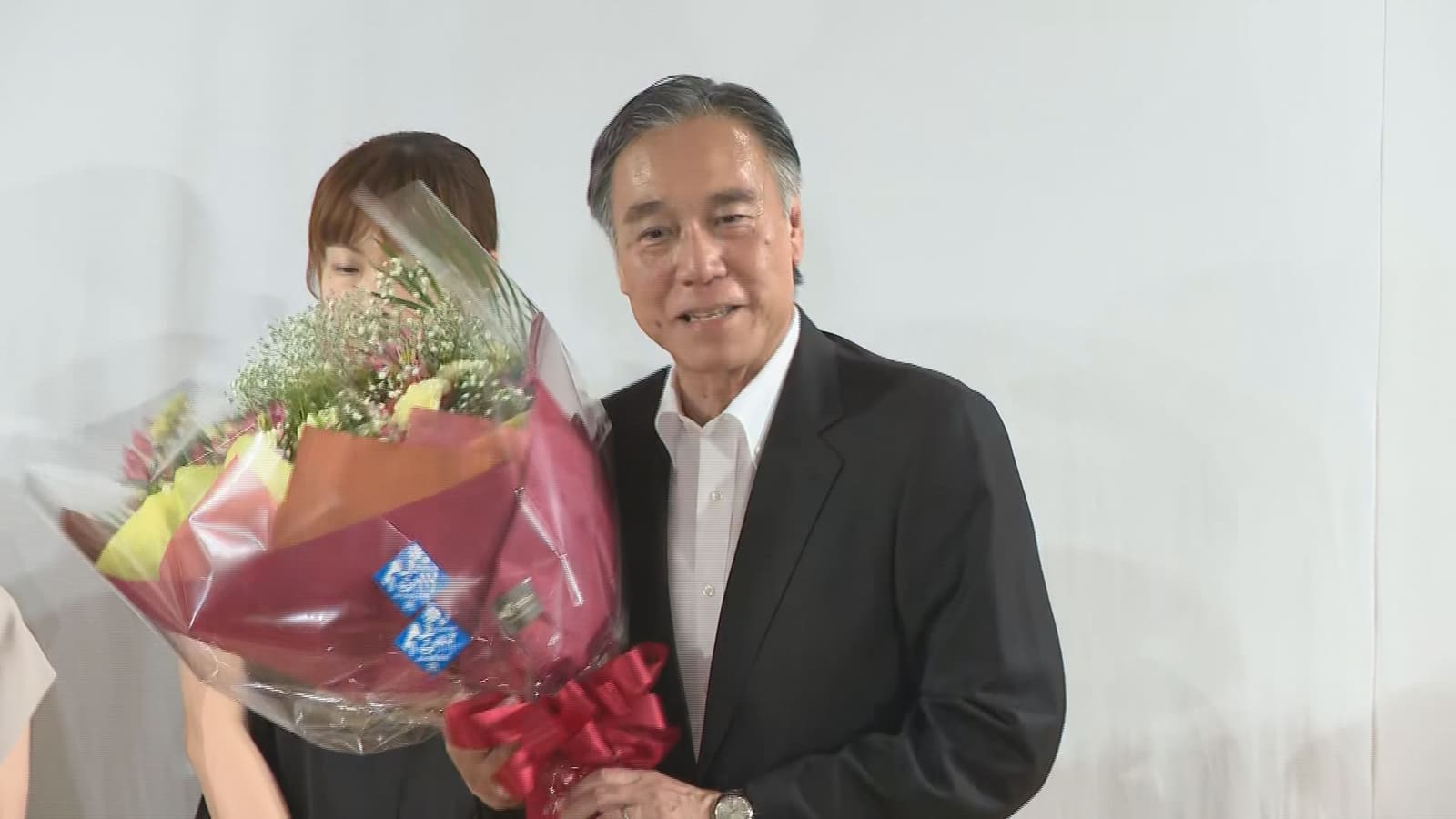
As of 2026-08-09 18:39 UTC, Nagano Prefecture's gubernatorial election had a final count. Incumbent Shuichi Abe won 573,742 votes; challenger Ryosuke Takeda won 92,366. The prefectural election commission completed the count at 22:52 Japan Standard Time, and local broadcaster NBS subsequently reported Abe's fifth victory.[1][4]
The outcome is not close. Its meaning still needs two denominators.
Abe received 86.13% of valid votes, an overwhelming choice among voters who cast a valid ballot. Yet turnout was 40.53%, the lowest recorded for a Nagano gubernatorial election and 0.41 percentage points below the previous low in 2022.[2][4] The first percentage establishes the scale of Abe's win. The second describes how much of the eligible electorate participated. Neither cancels the other, and neither can do the other's job.
What the final record says
| Checkpoint | Verified position at the cutoff | Confidence and boundary |
|---|---|---|
| Winner | Abe: 573,742 votes; Takeda: 92,366.[1] | Final, high confidence. The official count was 100% complete. |
| Valid-vote split | Of 666,108 valid ballots, Abe received 86.13% and Takeda 13.87%.[1] | High confidence. Percentages are calculated from the commission's final totals. |
| Participation | 672,045 of 1,658,282 eligible voters participated, for 40.53% turnout.[2] | Final, high confidence. This measures participation, not the preferences of nonvoters. |
| Ballot reconciliation | The count records 666,108 valid ballots, 5,932 invalid ballots and five ballots in the carried-away/other category.[1][2] | High confidence. Those categories reconcile the five-ballot difference between ballots counted at the tables and total voters. |
| Policy offer | Abe's official bulletin organized his platform around seven broad areas of investment; Takeda offered a contrasting change agenda focused heavily on household costs and public services.[3] | High confidence on what was offered. An election result cannot show which individual proposal motivated each vote. |
The arithmetic makes the distinction concrete. Abe's 573,742 votes equal 34.60% of the full eligible electorate. That figure is useful, but only if it is labeled correctly. It is not evidence that the other 65.40% opposed him. That remainder includes Takeda voters, invalid ballots and more than 986,000 eligible people who did not vote. The official record contains no reason for their absence.[1][2]
Calling 34.60% Abe's “support among all eligible voters” is arithmetically fair. Calling the remaining electorate an anti-Abe majority would be an unsupported inference.
A landslide answers the candidate question
On the question printed on the ballot—Abe or Takeda—the answer was decisive. The margin was 481,376 votes. It was not a narrow win produced by a fractured field, a recount boundary or a late coalition bargain. Nagano voters who cast valid ballots chose continuity by more than six votes to one.[1]
That matters because fifth terms bring a different burden from first terms. Abe has already spent almost four full terms shaping the prefectural administration. He cannot plausibly be judged only by the promise of future capacity; voters and the assembly can compare the fifth-term program with systems, budgets and outcomes built during those earlier terms. NBS reported that Abe himself described the new term as especially weighty and said it should not simply extend the existing line of government.[4]
His reach also extends beyond Nagano. Abe has served as president of Japan's National Governors' Association since September 2025, a role that gives him a platform in negotiations over demographic change, climate policy, technology and relations between prefectures and the national government.[6] Re-election preserves that institutional continuity. It does not guarantee that national ministries, the prefectural assembly or Nagano's municipalities will accept every proposal.
The safest reading is therefore strong but bounded: Abe has an unmistakable mandate to remain governor. The size of the win strengthens his authority to set an agenda. It does not convert a candidate election into a line-by-line referendum on everything his government may later do.
Record-low turnout answers the participation question
Turnout fell from 40.94% in 2022 to 40.53%. A decline of 0.41 percentage points is small, but crossing below an already record-low election gives it institutional weight.[2][4] Nearly three eligible voters in five did not participate.
There are many possible explanations: satisfaction with the expected result, dissatisfaction with the choices, weak competition, practical barriers, summer schedules, weather, low information or simple disengagement. None can be assigned from the count alone. A ballot ledger records participation and choice; it does not interview the absent.
That boundary prevents two opposite mistakes. Abe's supporters should not use the 86.13% valid-vote share as proof that almost nine in ten eligible residents endorsed every policy. His critics should not treat every nonvoter as a hidden opposition vote. Both claims turn missing information into convenient political evidence.
The turnout figure still matters. It tells the government that a large victory did not produce broad electoral activation. For a fifth-term administration, the practical response is not to relitigate the result. It is to make participation between elections more consequential: publish baselines, expose tradeoffs, show where consultation changed a decision and let residents evaluate delivery before the next campaign.
The platform now needs measurable verbs
Abe's official campaign bulletin grouped his “Shinshu 2030 vision” into seven investments: learning, prosperity, coexistence, reassurance, local communities, the planet, and Nagano's distinctive appeal.[3] It is a broad governing frame, not yet a performance ledger.
The conversion from campaign language to accountable government requires three additions.
First, each priority needs a baseline. “Investment in prosperity” becomes testable only when the administration specifies the starting measures—wages, labor shortages, business formation, productivity or another defined outcome. “Investment in communities” needs the same discipline for transport access, service reach or population retention.
Second, each priority needs a decision owner and date. A goal spanning the prefecture can fail because responsibility diffuses among the governor's office, departments, the assembly and municipalities. Naming the next formal decision is more useful than repeating the vision.
Third, the administration needs a feedback record. At a May press conference, Abe emphasized direct dialogue and participatory mechanisms while acknowledging the distance that can develop between a large prefectural government and residents.[5] After record-low turnout, the credibility test is whether those channels disclose who participated, what was heard and what changed—not merely how many meetings occurred.
What changes over the next 24 hours, 7 days and 30 days
Next 24 hours — the election uncertainty is over; operational government is not. NBS reported that Abe left his victory remarks to attend to disaster-response duties.[4] That sequence is a useful corrective to election-night symbolism: the first test of continuity is whether existing systems work under immediate pressure. Reporters should use the final commission totals and keep the valid-vote share separate from turnout.[1][2]
Next 7 days — watch priority order. A seven-part platform can support many policies, so the first meaningful signal will be which problems Abe names first, which officials own them and which existing programs he intends to change. A general promise of renewal is weaker evidence than a published sequence.
Next 30 days — watch the reset at the term boundary. The important transition evidence will be a small set of public milestones for the new term, together with baselines that distinguish a fifth-term reset from ordinary continuation.
Beyond that, the first budget and policy program will reveal whether the “seven investments” operate as priorities or as headings broad enough to contain almost anything. The election supplies political authority. Budgets, implementation dates and outcome reporting will show how that authority is used.
Three evidence-safe paths
Base path — continuity with a measurable reset. Abe keeps the administrative stability voters selected while translating a few campaign themes into dated programs. Trigger: published baselines, named owners and first-budget allocations. Meaning: the fifth term becomes an accountable extension rather than a victory lap.
Stronger path — Nagano gains leverage beyond the prefecture. Abe uses his National Governors' Association role to connect Nagano's demographic, climate and service-delivery priorities with national negotiations.[6] Trigger: specific joint proposals, funding agreements or regulatory changes that can be traced back to prefectural needs. Meaning: institutional continuity produces external leverage, not just a longer tenure.
Breakdown path — the margin is mistaken for a blank check. Broad platform language remains unmeasured, consultation produces no visible decision record and low participation is dismissed because the race was lopsided. Triggers: no baseline dashboard, no priority order and no explanation when implementation diverges from campaign claims. Meaning: the government retains legal authority but weakens the evidentiary case for a substantive mandate.
These are conditional paths, not forecasts. The result itself is final; the governing interpretation is what remains open.
How to read the mandate from here
- Use 86.13% when describing Abe's share of valid votes, and 40.53% when describing turnout. Do not swap their denominators.[1][2]
- Treat 34.60% of the eligible electorate as a participation-adjusted measure of recorded support, not as a referendum among nonvoters.
- Look for municipal and demographic analysis before claiming why turnout fell. The aggregate count does not supply motives.
- Test the seven-part platform against baselines, budgets, deadlines and named owners.[3]
- Separate Abe's clear mandate to govern from any later claim that voters pre-approved a specific implementation choice.
Revise this explainer if the election commission corrects its final totals, if a rigorous post-election study supplies evidence about nonvoter or voter motives, or if the formal term transition changes. None of those conditions was present at the cutoff. The durable conclusion is narrower: Nagano produced both a landslide and a participation low, and responsible coverage has to keep both facts visible at once.
Sources
- Nagano Prefectural Election Commission, “Final vote-count report for the 2026 Nagano gubernatorial election” (August 9, 2026) — official candidate totals, valid and invalid ballots, municipal results and completion time.
- Nagano Prefectural Election Commission, “Final turnout report for the 2026 Nagano gubernatorial election” (August 9, 2026) — official eligible-voter and participating-voter totals, 40.53% turnout and comparison with 2022.
- Nagano Prefectural Election Commission, “Official election bulletin for the 2026 Nagano gubernatorial election” (July 2026) — the two candidates' published campaign programs.
- NBS Nagano Broadcasting, “Incumbent Shuichi Abe wins a fifth term in the Nagano gubernatorial election” (August 9, 2026) — result, election-night remarks, record-low-turnout context and provenance for the article photograph.
- Nagano Prefecture, “Governor's press conference” (May 28, 2026) — Abe's pre-election discussion of social change, resident dialogue and participatory prefectural government.
- National Governors' Association of Japan, “Message from the President” — Abe's September 2025 accession to the association presidency and his stated national policy priorities.