As of 2026-06-11 17:31 UTC, the Artemis III headline is easy to misread. NASA did name a four-person crew this week, but the mission they are training for is no longer the first Artemis Moon landing. It is a 2027 crewed demonstration in low Earth orbit designed to test Orion operations with commercial lunar-lander hardware before Artemis IV attempts the lunar South Pole in 2028.[1][2]
That distinction matters because it changes what success looks like. Artemis III will not be judged mainly by a flag-and-footprints image. It will be judged by whether NASA can choreograph SLS, Orion, ESA's service module, Blue Origin's Blue Moon test article, SpaceX's Starship pathfinder, docking systems, software interfaces, propulsion, life support, communications, crew procedures, and recovery into one mission that lowers the risk of the next one.[1][3]
Verified Facts
| Point | What is verified | Confidence |
|---|---|---|
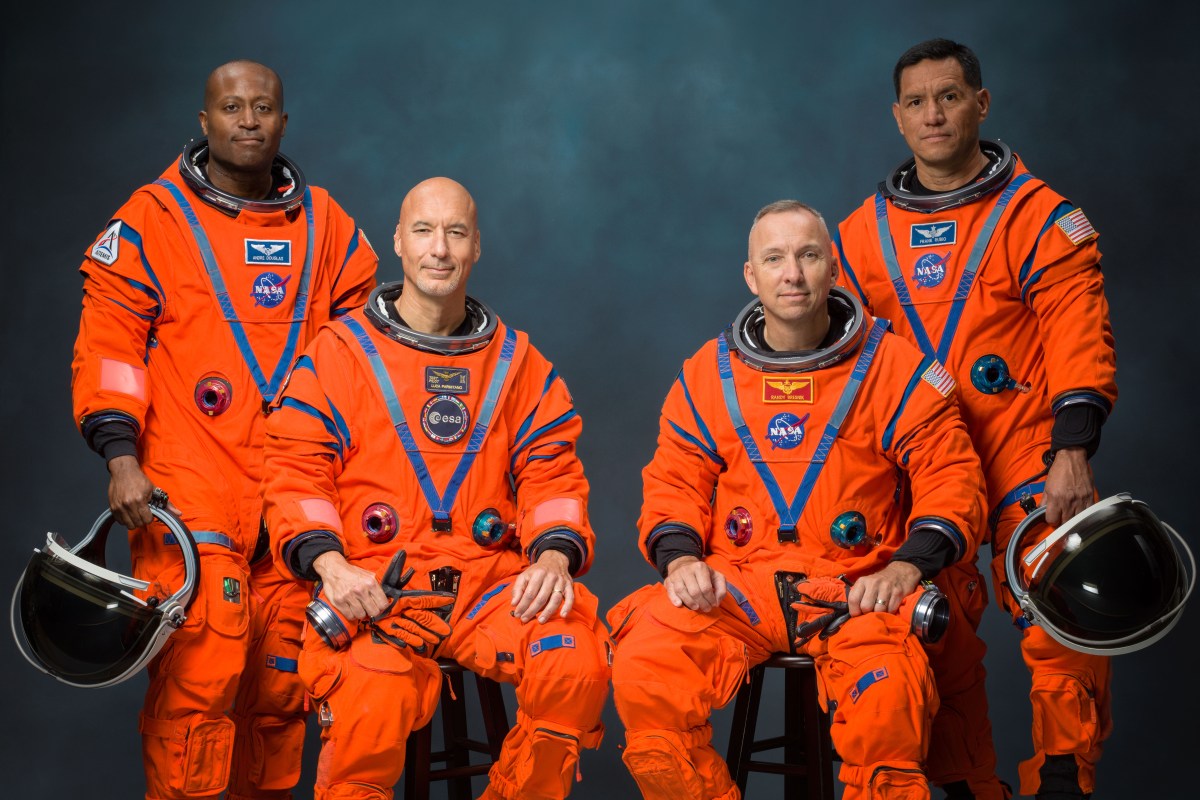
| Crew | NASA named Randy Bresnik as commander, Luca Parmitano as pilot, and Andre Douglas and Frank Rubio as mission specialists; Bob Hines is the backup crew member.[1] | High: direct NASA release. |
| Mission role | NASA describes Artemis III as a low Earth orbit flight test that will demonstrate critical systems for future lunar landings, beginning with Artemis IV.[2] | High: direct NASA mission page. |
| Timing | NASA currently lists Artemis III for 2027 and Artemis IV as the first planned crewed lunar South Pole mission in 2028.[1][2] | High for current plan; schedule remains conditional on hardware readiness. |
| Lander integration | NASA says Orion will demonstrate rendezvous and docking with test versions from one or both commercial human landing systems being developed by Blue Origin and SpaceX.[1][3] | High for plan; execution depends on provider readiness. |
| European role | ESA says Parmitano's assignment makes him the Artemis III pilot, while ESA's third European Service Module will support the crewed Earth-orbit test.[4] | High: direct ESA statement. |
| Public controversy | Spaceflight Now reported that NASA Administrator Jared Isaacman defended the all-male crew selection after criticism, saying the agency emphasized mission needs, expertise, training, and availability.[6] | Medium-high: credible spaceflight reporting; public reaction is not a formal NASA risk metric. |
What Changed
The crew announcement gives Artemis III a public face, but the deeper change happened earlier: NASA inserted a crewed Earth-orbit rehearsal between Artemis II's lunar flyby and the next landing attempt. In NASA's current plan, Artemis III becomes the link mission. It carries people, but its main job is to make the lander-and-Orion chain less theoretical before sending a crew toward the Moon's surface.[1][3]
The architecture is unusually dense. NASA says Blue Origin's lander pathfinder would launch first and wait in orbit. Orion would then launch on SLS with the Artemis III crew, rendezvous with Blue Origin's test article, dock for roughly two days of tests, detach, wait for SpaceX's Starship pathfinder, dock again for about a day of checkouts, and then return the crew to a Pacific splashdown.[1] Exact duration will be adjusted in real time, but NASA's current expectation is about two weeks in space.[1]
That is why the word "demonstration" is doing so much work. The mission is trying to prove operational behavior across vehicles that were not developed as one single spacecraft. Interfaces have to line up. Software has to behave across boundaries. Crews need procedures for entering or testing lander articles. Ground teams need to coordinate multiple launch windows and rendezvous events. Communications need to work without simply copying a lunar mission profile.[1][3]
Why Low Earth Orbit Helps
Low Earth orbit is not a retreat from ambition; it is a risk-control choice. NASA's preliminary mission plan says Earth orbit gives the program more launch opportunities for Orion, SpaceX's Starship human landing system pathfinder, and Blue Origin's Blue Moon Mark 2 pathfinder than a lunar mission would.[3] That matters when three large launch campaigns must be sequenced close enough to support docking tests.
The orbit also changes the failure envelope. A docking problem, software mismatch, missed launch window, life-support concern, or communications issue in Earth orbit is still serious, but it is easier to analyze, defer, repeat, or recover from than the same issue around the Moon. The point is not that low Earth orbit is easy. The point is that NASA can learn about multi-vehicle Artemis operations with less exposure than a direct lunar-landing attempt.
The mission also keeps pressure on Orion. NASA says Artemis III will have the crew spend more time aboard Orion than during Artemis II, demonstrate docking-system performance for the first time, and test an upgraded heat shield during return to Earth.[3] That makes Artemis III a lander rehearsal and an Orion maturity test at the same time.
Who Should Care
NASA program managers should care because Artemis III is now the practical gate between a successful flyby program and an operational landing program. Artemis II proved that a crew could fly around the Moon and return. Artemis III has to prove that the campaign can absorb commercial lander integration with people on board.[1][3]
Blue Origin and SpaceX should care because their hardware is no longer background procurement language. It is part of a crewed timeline. NASA says both companies are building test articles for Artemis III, with the agency sharing expertise through design, development, testing, and evaluation.[1] Spaceflight Now's reporting adds the schedule pressure: Blue Origin and SpaceX still have major vehicle-readiness questions before the 2027 test can work as planned.[5]
ESA should care because Parmitano's assignment is a visible political and operational milestone. NASA says this is the first time an ESA astronaut has been assigned to an Artemis mission, while ESA emphasizes that its European Service Module remains central to Orion's propulsion and power role.[1][4] In practical terms, Artemis III is also a partnership stress test.
The public should care because the crew announcement can make the mission sound simpler than it is. The important question is not just who is flying. It is whether the chosen crew profile, the all-male selection debate, the commercial integration plan, and the schedule are all being managed with enough transparency to keep confidence ahead of a higher-stakes lunar landing.[6]
Decision Impact
Next 24 hours: the crew list is settled unless NASA changes the assignment later. The immediate signal is that training starts around a mission built on Orion systems, docking operations, and lander-provider interfaces rather than surface geology or Moonwalk execution.[1]
Next 7 days: watch for how NASA, Blue Origin, SpaceX, and ESA describe readiness milestones. The key details are not slogans about returning to the Moon. They are hardware integration, docking adapters, mission simulations, launch sequencing, lander test articles, and recovery criteria.[1][3][4]
Next 30 days: the useful test is whether the 2027 schedule becomes more concrete. NASA's plan still depends on vehicle processing, service-module integration, heat-shield work, lander-provider progress, and the ability to coordinate multiple launch campaigns.[1][3][5]
Scenarios
Base case: Artemis III launches in 2027 as a low Earth orbit integration mission. The crew completes at least one meaningful docked-operation sequence, NASA gathers enough data to refine Artemis IV, and the program keeps a 2028 landing target alive, though still conditional.[1][2]
Upside case: both commercial pathfinders are ready, docking operations with Orion work cleanly, communications and life-support procedures mature, and NASA can say Artemis IV is no longer betting on first-time lander integration around the Moon.[1][3]
Downside case: one provider slips, a launch campaign cannot be sequenced, docking-system testing is deferred, or Orion return-system confidence remains incomplete. In that branch, Artemis III still may fly, but it would stop being a full rehearsal and could force NASA to decide whether Artemis IV needs another intermediate test.[3][5]
Action Checklist
Track test readiness, not only crew profiles: lander pathfinder status, docking-system milestones, Orion service-module integration, and SLS processing are now the live indicators.[1][3]
Separate public symbolism from mission success. The all-male crew debate is a legitimacy and representation issue, but it should not be confused with the engineering question of whether the mission can reduce lunar-landing risk.[6]
Watch whether NASA keeps explaining what Artemis III can and cannot prove. A low Earth orbit docking rehearsal can reduce integration risk; it cannot by itself prove lunar-surface operations, spacesuit performance, surface power, or south-pole landing conditions.[2][3]
The falsifier is clear: if Artemis III cannot test integrated Orion-and-lander operations with enough fidelity to change Artemis IV risk, then the mission becomes a symbolic bridge rather than an operational one.
Sources
- NASA, "NASA Marches Toward Artemis III Mission in 2027, Names Crew Members" (June 9, 2026).
- NASA, "Artemis III" mission page, current overview of mission type, launch year, crew size, and objective.
- NASA, "NASA Outlines Preliminary Artemis III Mission Plans" (May 13, 2026; updated May 19, 2026).
- European Space Agency, "Artemis III NASA announcement highlights: Luca Parmitano assigned as pilot" (June 9, 2026).
- William Harwood, "NASA names four-man crew to Artemis 3 mission," Spaceflight Now (June 9, 2026).
- William Harwood, "NASA chief defends selection of all-male Artemis 3 crew," Spaceflight Now (June 10, 2026).