As of 2026-04-08 22:05 UTC, EPA's March 27 Renewable Fuel Standard final rule is easy to misread as a simple record-volume victory. The official headline encourages that view: total applicable renewable fuel obligations rise to 26.81 billion RINs in 2026 and 27.02 billion RINs in 2027, while biomass-based diesel rises to 9.07 and 9.20 billion RINs after small-refinery-exemption reallocation.[1] Those are bigger numbers than EPA put on the table in June 2025, and the agency's final rule formally takes effect on June 15, 2026.[2][3]
The deeper policy choice sits underneath the volume banner. If you compare EPA's June proposal, its September supplemental notice, and the March final decision, the live question was not only how high the Renewable Volume Obligations should go. It was how much of the demand lost through small refinery exemptions (SREs) should be pushed back onto the rest of the system.[1][3][4] Inference from those sources: this is now a reallocation file first and a gallons file second.
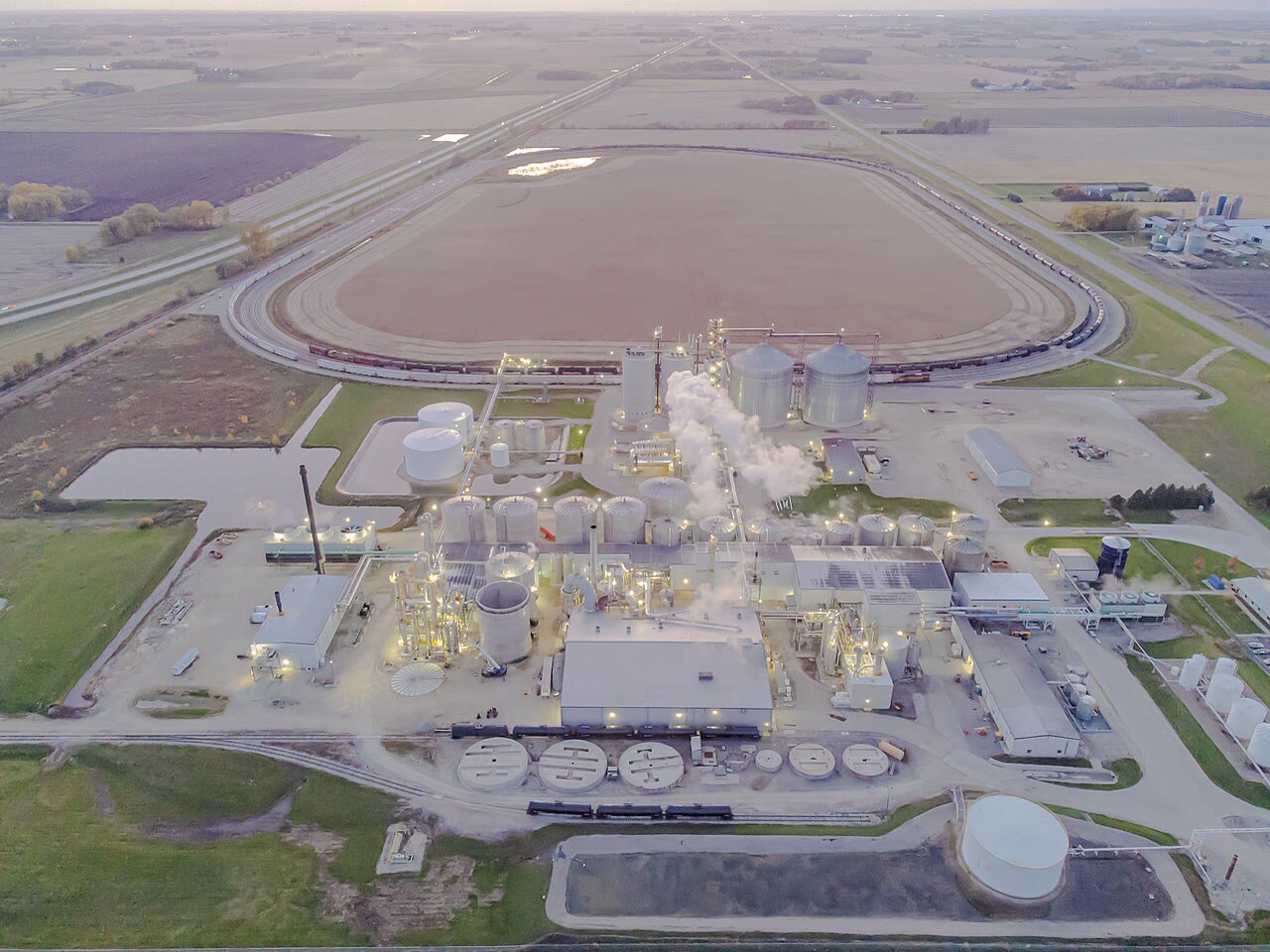
Image context: the cover image shows an ethanol plant in Minnesota. That documentary image works here because the rule is not about an abstract Washington scorecard. It is about whether real biofuel capacity gets pulled back into the compliance market and whether refiners that are not exempted must carry more of the obligation.[8]
The proposal-to-final sequence shows where the real movement happened
EPA's June 2025 proposal was already expansive by recent program standards. It proposed total renewable fuel obligations of 24.02 billion RINs for 2026 and 24.46 billion RINs for 2027, with biomass-based diesel at 7.12 and 7.50 billion RINs.[3] That was the first pass: bigger headline numbers, a partial waiver for the 2025 cellulosic requirement, and a set of program changes that also removed eRINs from the framework.[2][3]
The September supplemental notice changed the shape of the debate. After EPA's August 2025 SRE decisions, the agency explicitly reopened the rule to consider whether exempted volumes should be reallocated at 50 percent or 100 percent for 2023 through 2025, while also updating the way it projected future exemptions for 2026 and 2027.[4] That move is why the final outcome cannot be read as a straight-line continuation of the June proposal. By the time the rule was signed, EPA had turned a volume-setting exercise into a burden-sharing decision.
The final choice was 70 percent reallocation.[1] That pushed the total renewable obligation above the original proposal and added 0.99 billion RINs in 2026 and 1.04 billion RINs in 2027 on top of the base renewable volumes.[1] For biomass-based diesel, the reallocation component added 0.21 and 0.25 billion RINs in 2026 and 2027.[1] The important point is not just that the numbers went up. It is that EPA decided the non-exempt market should absorb much of the SRE leakage, but not all of it.
Why 70 percent matters more than the slogan about "historic" volumes
The political and industry reactions make the compromise legible. API said the rule's reallocation approach "distorts the marketplace" by rewarding exempted refineries while disadvantaging refiners that are not exempted.[5] Clean Fuels Alliance America took the opposite side, praising the final rule's biomass-based diesel volumes, highlighting the 210 million and 250 million RIN supplemental volumes for 2026 and 2027, and arguing that projected future SREs also needed to be accounted for so the volumes set on paper are actually realized.[6]
RFA's reaction is the clearest indicator that 70 percent is a midpoint rather than a clean ideological win. The association welcomed the final rule as the highest-ever set of obligations and a source of stability, but also said EPA stopped short of delivering the full market expansion Congress intended because it did not fully reallocate the renewable fuel volumes lost to SREs for 2023 through 2025.[7] Read together, those reactions show why the headline number is not the whole story. Everyone agrees the rule is bigger than the June proposal. Nobody agrees that EPA solved the allocation fight.
Inference from the official proposal, supplemental notice, and these reactions: EPA was trying to do three things at once. It wanted to raise obligations enough to signal growth, restore enough exempted volume to satisfy farm and biofuel constituencies, and still avoid the political and credit-market shock that a full 100 percent reallocation might have created.[1][3][4][5][6][7] That is the real operating logic of the final rule.
The decision impact now runs through credit-market burden and restart confidence
For obligated refiners, the effect is straightforward. The final rule means more compliance demand stays inside the non-exempt market than it would have under the June proposal, and API is already framing that as a cost and fairness problem.[5] The issue is no longer simply whether EPA picked a large or small number. It is whether refiners that remain in the program can absorb a compliance burden that used to leak out through exemptions.
For biodiesel and renewable diesel producers, the rule matters because certainty arrived after a weak 2025. Clean Fuels says some facilities shut down or ran well below prior-year production in 2025 and describes the final rule as the signal needed to bring existing capacity back toward use.[6] That does not mean every announced gallon will materialize immediately. It means the policy argument has shifted from "will EPA finalize the rule at all?" to "will the new obligation actually restart idled or underused capacity?"
For ethanol producers and farmers, the rule is supportive but not exhaustive. RFA treats the final volumes as a real gain for demand certainty and energy security, while also arguing that incomplete reallocation leaves some of the intended market expansion unrealized.[7] That is a narrower and more credible reading than calling the rule a complete reset. The final package improves the demand floor, but it does not close the SRE debate.
What matters next
Three checkpoints matter more than celebratory press lines.
First, watch whether the compliance market behaves as if EPA's 70 percent choice is durable. The final rule is published and effective in June, but later SRE decisions can still keep the allocation question alive if parties believe projected exemptions diverge from actual ones.[1][2][4]
Second, watch whether biomass-based diesel restarts show up in production and blending behavior rather than just in trade-group statements. Clean Fuels sees dormant capacity ready to return.[6] That can only become economically meaningful if physical gallons respond to the stronger obligation.
Third, watch whether Congress or courts reopen the structure of the program before the next volume-setting cycle. API is already using the final rule to argue for legislative reform, while biofuel groups are using it to argue the opposite case: that EPA should go further next time and fully restore demand lost to exemptions.[5][6][7]
Bottom line
The cleanest way to read EPA's March 2026 RFS rule is this: the headline numbers are real, but the decisive move was allocation.[1][2][3][4] EPA raised the base obligations from the June proposal, then chose a 70 percent rather than 50 percent or 100 percent answer to the SRE problem.[1][4] That makes the rule less a one-day triumph about record volumes and more a working compromise over who carries compliance demand, how much confidence biofuel producers can take into 2026 and 2027, and whether the next exemption round will reopen the same fight.[5][6][7]
Sources
- U.S. Environmental Protection Agency, "Final Renewable Fuel Standards for 2026 and 2027" (updated April 1, 2026).
- U.S. Environmental Protection Agency, Renewable Fuel Standard (RFS) Program: Standards for 2026 and 2027, Partial Waiver of 2025 Cellulosic Biofuel Volume Requirement, and Other Changes (Federal Register final rule PDF, published April 1, 2026).
- U.S. Environmental Protection Agency, "Proposed Renewable Fuel Standards for 2026 and 2027" (updated October 8, 2025).
- U.S. Environmental Protection Agency, "Proposed Renewable Fuel Standards for 2026 and 2027: Supplemental Notice" (updated October 3, 2025).
- American Petroleum Institute, "API Statement on EPA's Final RFS Volumes for 2026-2027" (March 27, 2026).
- Clean Fuels Alliance America, "Clean Fuels Applauds EPA's Final 2026-2027 RFS Rules" (March 27, 2026).
- Renewable Fuels Association, "RFA Welcomes 2026-27 RFS Volume Obligations" (March 27, 2026).
- Wikimedia Commons, "File:Ethanol plant in Minnesota.jpg" (image source).