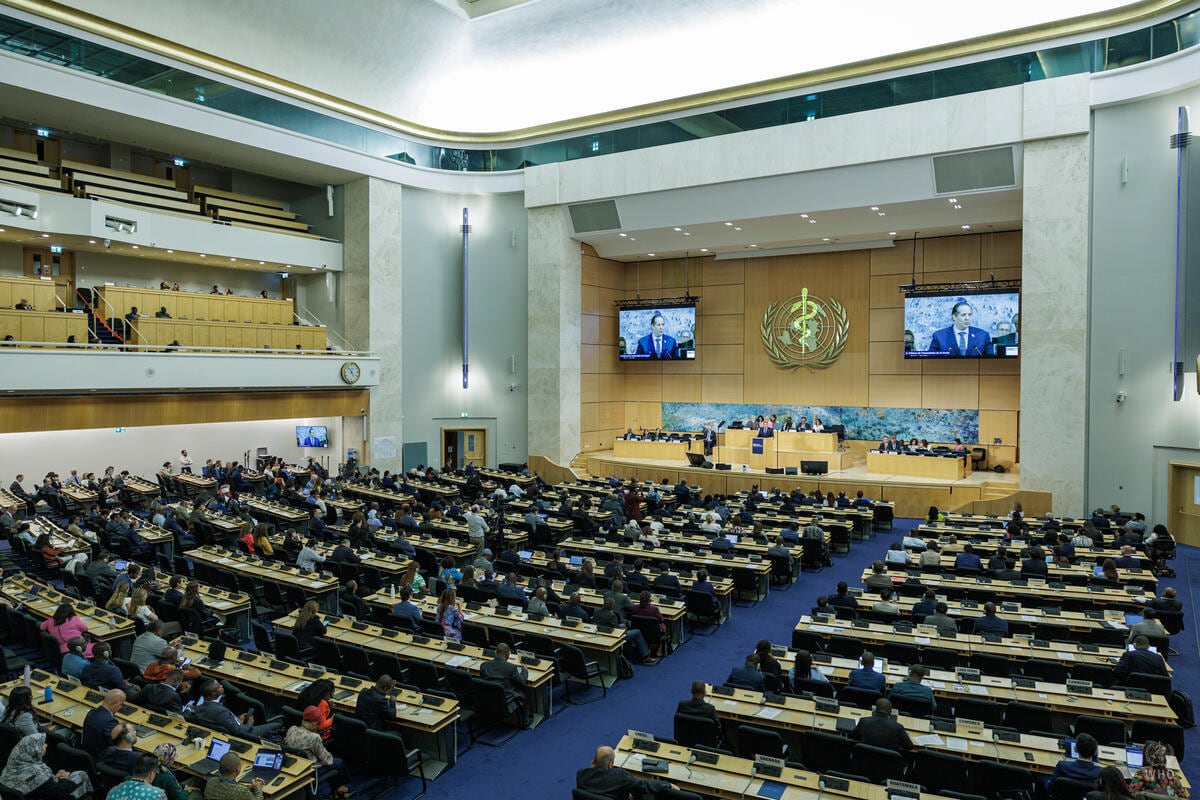
As of 2026-05-28 04:01 UTC, the World Health Assembly has adopted the updated Global Action Plan on Antimicrobial Resistance 2026-2036. The immediate headline is consensus at WHA79. The real news is narrower and harder: governments have converted a 2024 United Nations target into a ten-year delivery file that now has to show up in funded national plans, surveillance systems, agrifood policy, infection prevention, and environmental controls.[1][3][4]
This is a news brief, so the bottom line comes first. The plan is not a new antibiotic. It is not a binding treaty. It is a framework for making the 2030 goal of a 10% reduction in bacterial AMR-associated human deaths less rhetorical and more auditable.[1][3][4] That matters because the AMR burden is already large: WHO's WHA79 daily update cites estimates of 4.71 million deaths associated with bacterial AMR in 2021, while the Lancet forecasting study points to up to 39 million deaths attributable to bacterial AMR from 2025 to 2050 without stronger action.[2][5]
The adoption also changes the accountability question. Since the first global AMR plan in 2015, more than 170 countries have developed multisectoral national action plans, and 104 countries reported AMR data to WHO's GLASS surveillance system in 2025.[2][3][6] Those numbers show reach, but not yet execution. The updated plan's stress points are domestic financing, comparable data, appropriate antimicrobial use, prevention-first health systems, animal and plant health controls, and environmental monitoring that has historically lagged the human-health side.[2][3][6]
Fact File
| Item | What is confirmed now | Confidence note |
|---|---|---|
| Decision | WHO says member states adopted the updated GAP-AMR 2026-2036 at WHA79 on 23 May 2026.[1] | High; direct WHO departmental update and WHA daily update. |
| Policy target | The plan is designed to help achieve the 2024 UNGA target of reducing bacterial AMR-associated human deaths by 10% by 2030.[1][3][4] | High; UN and WHO documents align. |
| Burden baseline | WHO cites 4.71 million deaths associated with bacterial AMR in 2021 and warns of up to 39 million deaths by 2050 without urgent action.[2][5] | High for cited estimates; forecasts remain scenario-dependent. |
| National-plan footprint | WHO says more than 170 countries have developed multisectoral AMR national action plans.[2][3] | High; direct WHO/WHA documents. |
| Data gap | WHO says 104 countries reported AMR data to GLASS in 2025; the updated plan still calls for stronger cross-sector surveillance.[2][3][6] | High; direct WHO sources, but country-level data quality varies. |
| Main uncertainty | Adoption does not prove national financing, regulation, laboratory capacity, or agrifood implementation.[3] | Medium; this is an inference from the plan's own gap analysis. |
Why It Matters Now
The strongest signal in the new plan is its shift from awareness to operating capacity. AMR policy has often sounded like a general warning about "superbugs." WHA79's updated plan is more concrete. It links human medicine, animal health, plant health, food systems, and environmental pollution under a One Health frame, then asks countries to update national action plans, improve laboratory and surveillance networks, protect access to effective antimicrobials, and reduce the need for antimicrobials through prevention.[1][3]
That is a difficult mix because the incentives do not sit in one ministry. Hospitals care about stewardship and infection control. Agriculture ministries care about animal production, biosecurity, and food security. Environmental regulators care about wastewater, manufacturing discharge, and residues. Finance ministries decide whether national plans stay paper commitments or become budget lines. The plan's practical test is whether those actors can share enough data and money to make national AMR work measurable before 2030.[3][6]
The document also keeps the access problem in view. "Use fewer antibiotics" is too simple if it means people in low-resource settings cannot get quality-assured treatment when they need it. The plan pairs responsible use with equitable access to antimicrobials, vaccines, and diagnostics.[1][3] That pairing is important: stewardship without access can become rationing; access without stewardship can accelerate resistance.
Decision Impact
For governments, the next question is whether national AMR plans get costed, funded, and reported against a small set of useful indicators rather than refreshed as broad strategy documents. Countries that already have plans will need to show where surveillance, laboratory networks, infection prevention, agrifood stewardship, and environmental controls sit in the budget.[2][3]
For health systems, the near-term effect should be pressure to make infection prevention and antimicrobial stewardship less optional. The updated plan puts water, sanitation and hygiene, vaccination, reliable diagnostics, quality treatment guidance, and healthcare-associated infection prevention into the same prevention-first chain.[1][3] If those pieces do not improve, the 2030 mortality target has little chance of becoming more than a diplomatic line.
For food and environmental systems, the plan raises the floor for reporting. WHO's draft says surveillance should cover humans, food-producing animals, food, and the environment where country capacity allows, and it calls for data to flow into GLASS, InFARM, and ANIMUSE.[3][6] That is where implementation may slow: environmental AMR monitoring is explicitly described as limited, and cross-sector data is harder than hospital reporting alone.[3]
Scenarios
Base case: the plan becomes a practical update cycle. Countries revise national action plans through 2026-2027, report better surveillance data, and use the coming operational and monitoring framework to make AMR financing more visible.[1][2][3] Progress is uneven, but WHA reporting can separate countries with funded plans from countries with strategy documents only.
Upside case: the One Health framing becomes budget reality. AMR interventions get embedded in health-system strengthening, animal-health policy, vaccination, diagnostics, WASH, and environmental regulation rather than sitting as a separate campaign.[1][3] In that case, the 2030 death-reduction target becomes at least trackable.
Downside case: the plan is adopted but underfinanced. Surveillance expands slowly, environmental data remains thin, agrifood reporting is patchy, and countries avoid hard choices on stewardship, procurement, and laboratory capacity.[3][6] The warning sign would be a 2028 review that celebrates plan updates but cannot show better cross-sector data or domestic funding.
Action Checklist
Watch for the promised operational and monitoring framework that will sit beside the plan; that document should reveal whether accountability is specific enough to matter.[2][3]
Track whether countries publish costed AMR national action-plan updates, not just endorsements of the global text.[3]
Look for GLASS participation and data-quality improvements through 2026-2028, especially whether reporting becomes more comparable across human health, animal health, food, and environmental channels.[2][3][6]
Treat the 2030 mortality target as unproven until financing and surveillance move together. The plan's adoption is the starting gun, not the outcome.[1][3][4]
Sources
- World Health Organization, "The World Health Assembly adopts updated Global Action Plan on Antimicrobial Resistance (2026-2036)" (25 May 2026).
- World Health Organization, "Seventy-ninth World Health Assembly - Daily update: 23 May 2026" (23 May 2026).
- World Health Assembly, Draft updated global action plan on antimicrobial resistance 2026-2036, A79/5 Add.2 (13 May 2026).
- United Nations, "General Assembly Adopts Political Declaration on Antimicrobial Resistance..." GA/12642 (7 October 2024).
- GBD 2021 Antimicrobial Resistance Collaborators, "Global burden of bacterial antimicrobial resistance 1990-2021: a systematic analysis with forecasts to 2050," The Lancet record in PubMed (2024).
- World Health Organization, "Global Antimicrobial Resistance and Use Surveillance System (GLASS)" initiative page.