As of 2026-05-28T01:31:11Z (UTC), the United States-Mexico-Canada Agreement review has moved from paperwork into the negotiating room. The Office of the U.S. Trade Representative says U.S. and Mexican officials will hold the first bilateral negotiating round of the 2026 USMCA joint review in Mexico City on May 28-29, followed by a second round in Washington on June 16-17 and a third round in Mexico City during the week of July 20.[1]
That timing matters because USMCA was built with a formal six-year review mechanism. Article 34.7 requires the Free Trade Commission to meet on the sixth anniversary of entry into force, review the agreement's operation, consider recommendations, and decide whether to extend the agreement's term beyond its current sunset structure.[2] What begins this week is therefore not a routine trade consultation. It is the opening practical phase of a treaty survival test.
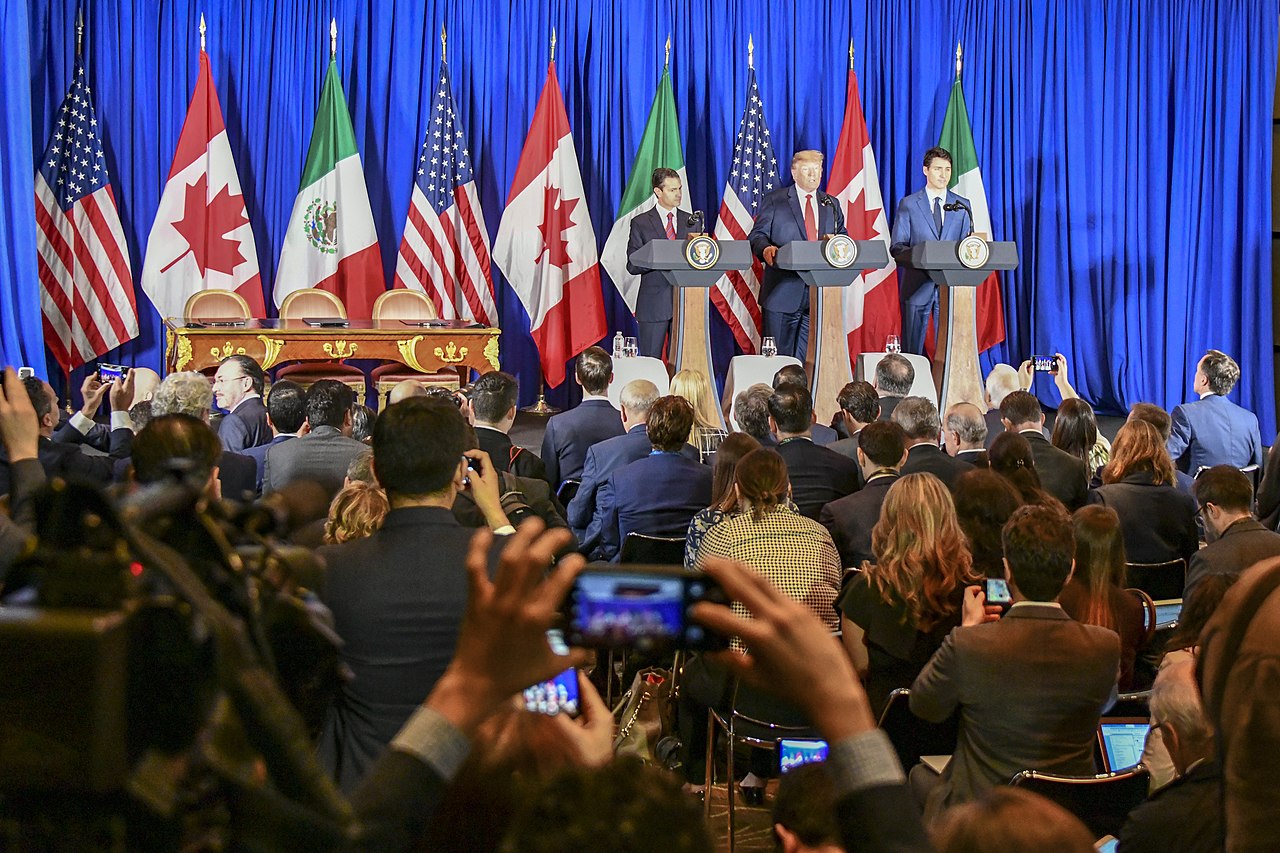
Image context: the cover photograph shows the 2018 USMCA signing ceremony, not a generic trade illustration. The contrast is the point: the agreement entered public life as a high-level political replacement for NAFTA, but the 2026 review is a lower, more technical fight over origin rules, enforcement, tariffs, and whether North American integration still has a shared operating model.[6]
Fact file
| Item | What is known | Confidence note |
|---|---|---|
| Immediate event | USTR announced U.S.-Mexico bilateral negotiating rounds beginning May 28-29, 2026, in Mexico City, with later rounds in June and July.[1] | High; direct USTR release. |
| Legal trigger | USMCA Article 34.7 sets a six-year joint review process and links review outcomes to the agreement's term extension.[2] | High; treaty text. |
| U.S. preparation | USTR opened a public comment process in 2025 for the 2026 review, asking for input on USMCA's operation and possible recommendations.[4] | High; Federal Register notice. |
| Core policy frame | USTR's April joint statement with Mexico identified economic security, rules of origin, critical minerals, and bilateral trade irritants as pre-review discussion areas.[5] | High for U.S.-Mexico agenda signals; not a final negotiating outcome. |
| Uncertainty frame | CSIS analysis warns that failure to extend the agreement during the 2026 review could push the region into annual review cycles and weaken planning confidence.[3] | Medium-high; expert analysis, not a government decision. |
| Visual record | The image is a White House photograph of the 2018 USMCA signing ceremony hosted on Wikimedia Commons.[6] | High for provenance and relevance. |
What changed
For months, the 2026 review was mostly a docket, a calendar, and a risk factor. Companies could file comments, lawyers could map treaty language, and trade associations could warn clients that the agreement's six-year review would arrive soon. USTR's May 27 announcement changes the mode: the first announced bilateral negotiating rounds with Mexico now have dates and a location.[1][4]
The distinction is important. Public comments help governments sort complaints and priorities, but they do not force choices. Negotiating rounds do. Once officials sit down, broad arguments about "North American competitiveness" turn into specific questions: which origin rules are too loose or too costly, which enforcement tools are working, whether critical-mineral and industrial supply chains need new treatment, and how much policy space each government wants for industrial strategy.[1][4][5]
The review also lands in a more confrontational trade environment than the one that existed when USMCA entered into force. The original deal replaced NAFTA with a more demanding operating model for regional trade, especially around origin compliance and the treatment of industrial supply chains.[2][5] Six years later, the live question is not just whether those rules are written well. It is whether they still coordinate behavior in a region where tariffs, subsidy policy, nearshoring, China exposure, and border politics all pull on the same supply chains.
Why Article 34.7 raises the stakes
USMCA's review clause is unusual because it does not simply ask ministers to talk. Article 34.7 creates a structured renewal mechanism. On the sixth anniversary, the Free Trade Commission must review the agreement, consider recommendations, and decide whether to extend the term. If all three parties confirm they want to extend, the agreement can continue for a new 16-year term; if they do not, annual reviews continue until an extension decision or eventual expiration under the treaty clock.[2]
That makes this review different from a normal implementation meeting. It gives each government leverage, because failure to extend would not immediately kill USMCA, but it would keep the agreement under recurring uncertainty. CSIS describes serial annual reviews as one plausible path if the parties do not reach an extension decision, and that is the business problem: investment decisions with multi-year paybacks depend on whether regional rules are durable enough to plan around.[2][3]
The first bilateral rounds with Mexico are therefore a signal about process discipline. If the parties can identify issues that are negotiable, separate them from domestic political theater, and preserve a path to trilateral extension, the review can function as maintenance. If the talks turn into a rolling threat to the agreement's term, USMCA becomes less a stable trade platform than a recurring political option.
What each side is likely to test
The U.S. side is likely to press on enforcement and industrial alignment. USTR's review preparation invited comments on the agreement's operation and on possible recommendations for action, which gives the agency a channel to carry industry, labor, agriculture, and digital-policy complaints into the formal review.[4] USTR's April joint statement with Mexico points to a narrower early agenda as well: economic security, complementary trade actions, stronger rules of origin for key industrial goods, critical minerals, and unresolved bilateral trade irritants.[5]
Mexico's agenda is likely to be defensive as well as opportunistic. The country has benefited from nearshoring attention and deep integration with U.S. manufacturing, but that does not mean Mexico wants the review to become a one-way compliance exercise. Mexican officials have incentives to defend export access, resist rules that would make regional manufacturing more expensive, and keep any dispute over energy, labor, or origin treatment from turning into a broader confidence shock. The staged USTR calendar itself fits that picture: three bilateral rounds spread across May, June, and July imply an opening sequence, not a one-meeting settlement.[1]
Canada is not in this week's bilateral room, but it is structurally present. USMCA is trilateral, and Article 34.7 ultimately requires the parties to meet through the Free Trade Commission process.[2] A U.S.-Mexico round can narrow issues, but it cannot by itself resolve the review. That is why the sequencing matters: bilateral talks can speed up technical work, but they also risk hardening positions before the three-country bargain is reconstructed.
Decision impact
For manufacturers, the next 30 days are about scenario mapping rather than immediate operational change. No rule of origin changes because officials meet in Mexico City. But procurement, compliance, and government-affairs teams should identify which inputs, finished goods, and certification processes would be exposed if the review tightens content requirements or changes enforcement priorities.[1][4][5]
For investors and executives, the key signal is not whether each side sounds tough in public. The key signal is whether negotiators describe the process as a path to extension. A constructive review can still include hard bargaining. A dangerous review is one where governments treat non-extension uncertainty as leverage and businesses start delaying North American capacity decisions because the treaty clock feels unstable.[2]
For policymakers, the danger is overloading the review. USMCA can carry trade rules, enforcement procedures, and dispute mechanisms, but it cannot solve every border, migration, China, fentanyl, energy, labor, and election problem at once. The more unrelated pressure gets pushed into the review, the harder it becomes to preserve the agreement's core function: making cross-border production legally predictable.
What remains uncertain
The first uncertainty is the real U.S. priority stack. Public-comment processes collect many demands, but negotiating capital is finite.[4] Tightening auto content rules, strengthening labor enforcement, revisiting digital obligations, pressing agriculture access, and resolving energy disputes are not all equally easy to trade off.
The second uncertainty is whether the May-July bilateral sequence narrows issues or expands them. If each round adds new subjects faster than it resolves old ones, the review could drift from technical maintenance into a broader renegotiation cycle.[1][5]
The third uncertainty is political timing. USMCA's text gives the parties a mechanism for review and extension, but it does not remove domestic politics from the process.[2] If officials can keep the review technical, the agreement remains a platform. If each government uses it as a stage for domestic signaling, the annual-review path becomes more plausible.
What to watch next
- Whether USTR, Mexico, or Canada issues a joint or parallel statement after the May 28-29 rounds that names working groups, issue categories, or a timetable.[1]
- Whether the review language shifts from "consultation" to "extension," because extension is the core Article 34.7 question.[2]
- Whether rules of origin and economic security dominate the first phase, or whether agriculture, labor, energy, and digital trade compete for equal attention.[4][5]
- Whether business groups begin warning publicly about delayed investment, which would indicate that review uncertainty is already affecting behavior.
Falsifier: if the parties quickly publish a trilateral timetable focused on extension and technical chapter updates, the risk case weakens. The review would then look less like a treaty-stability test and more like scheduled maintenance of a still-functioning North American trade system.
Sources
- Office of the U.S. Trade Representative, "The United States and Mexico Announce Series of Bilateral Negotiating Rounds Related to the First Joint Review of the USMCA" (May 27, 2026).
- Office of the U.S. Trade Representative, United States-Mexico-Canada Agreement, Chapter 34: Final Provisions, Article 34.7.
- Center for Strategic and International Studies, "Inside the Mechanics of the 2026 USMCA Review" (Oct. 21, 2025).
- Federal Register, "Request for Comments and Notice of Public Hearing Concerning the Operation of the United States-Mexico-Canada Agreement With Respect to Trade in Goods, Services, and Investment" (Sept. 17, 2025).
- Office of the U.S. Trade Representative, "Joint Statement from Ambassador Jamieson Greer and Mexican Secretary of Economy Marcelo Ebrard" (April 2026).
- Wikimedia Commons, "File:President Trump Participates in the USMCA Signing Ceremony (45392094974).jpg" - photographic file page for the 2018 USMCA signing image used in this article.