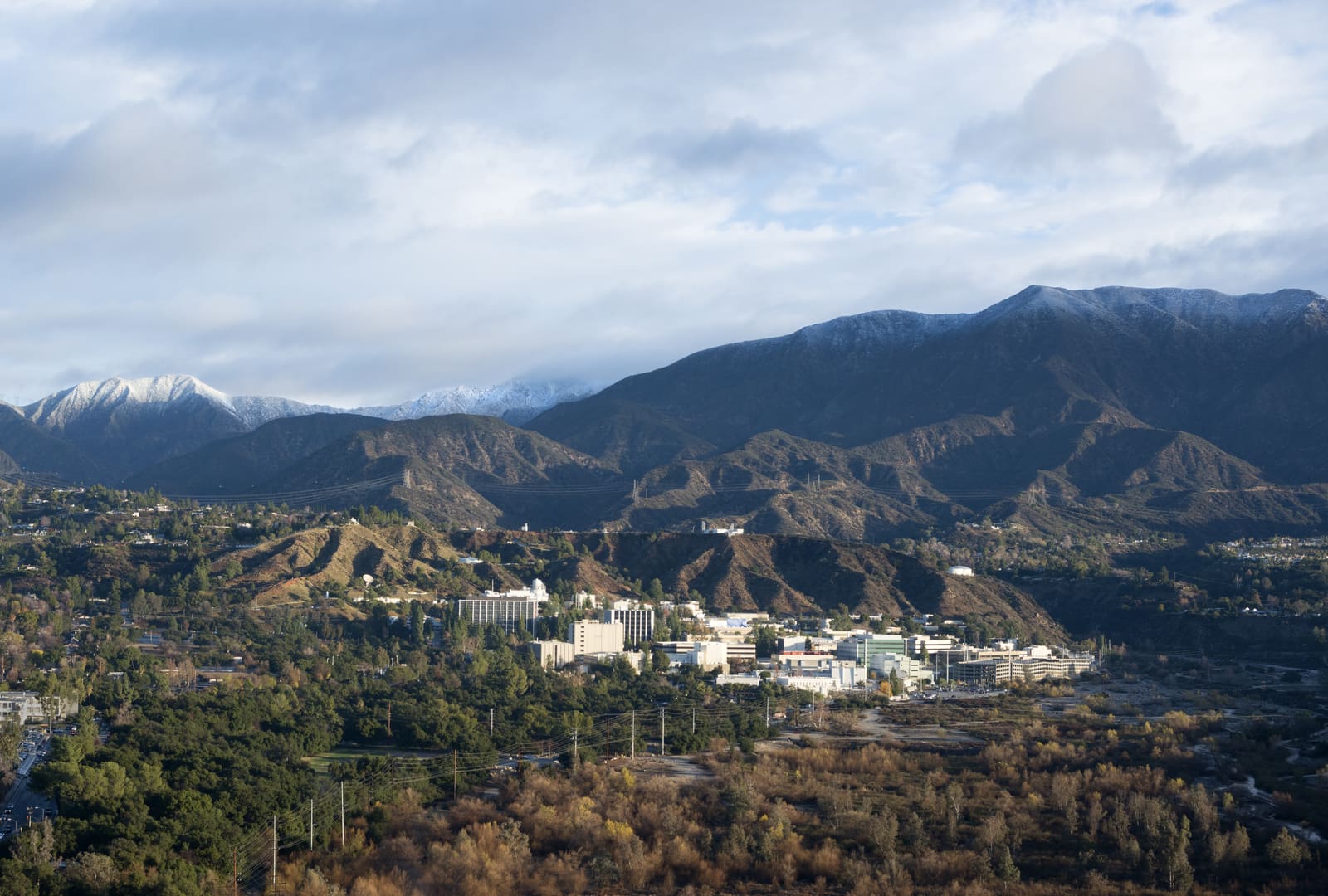
As of 2026-05-28 10:00 UTC, NASA's plan to compete the next Jet Propulsion Laboratory management contract is not, on the current record, a story about moving JPL out of Southern California or shutting down missions.[1] It is a story about whether one of NASA's most famous science-and-engineering institutions can be put through a modern procurement contest without losing the continuity that made it valuable in the first place.
NASA announced on May 22, 2026 that it has begun the process to compete the next contract for managing and operating JPL, a federally funded research and development center in Southern California.[1] Caltech has managed the laboratory since NASA inherited JPL from the U.S. Army in 1958, and the current Caltech contract runs through Sept. 30, 2028, with a potential maximum value of $30 billion if all options are exercised.[1][4] The decision is therefore a governance break more than an immediate operational break: the incumbent remains in place, the new award cycle has time to run, and NASA says it is committed to continuity for active and future missions.[1]
The uncertainty is real but bounded. NASA has not yet named bidders, released a final request for proposals in the public materials cited here, or said Caltech will lose the work.[1][2] Caltech and JPL leadership, in their message to the community, said they welcome a fair competition and will respond once the RFP is released.[2] The live question is not "who runs JPL tomorrow?" The live question is whether NASA can use competition to test cost, performance, and management alternatives while preserving the lab's mission culture, technical memory, and project delivery chain.
Fact file
| Item | Current state | Confidence note |
|---|---|---|
| Trigger event | NASA announced on May 22, 2026 that it will compete the next JPL management and operations contract.[1] | Direct NASA release. |
| Incumbent | Caltech has managed JPL since NASA was established in 1958 and had founded the lab's predecessor work in the 1930s.[1][2] | Direct NASA and Caltech/JPL statements. |
| Current contract window | NASA's 2018 award began Oct. 1, 2018 and can extend through Sept. 30, 2028.[1][4] | Direct NASA contract release and current NASA update. |
| Potential value | NASA cites a maximum value of $30 billion if all contract options are exercised.[1][4] | Direct NASA releases. |
| Location | NASA says it is committed to maintaining JPL's existing physical location.[1] | Strong, but future contract terms are not yet public. |
| Broader context | NASA announced an agencywide realignment the same day, emphasizing faster delivery, mission-directorate access to the administrator, and center specialization.[3] | Direct NASA release. |
| Local stakes | LAist notes JPL's regional role, its recent layoffs, and its importance as a Southern California science employer.[5] | Local reporting; useful for context, not contract authority. |
What changed
The practical change is that NASA is no longer treating Caltech's JPL role as a sole-source renewal by default.[1] NASA's release frames the decision around the growth of the U.S. space economy and the possibility that there is now a viable competitive market for parts of FFRDC operation.[1] It also points to Department of Energy practice, noting that DOE has held full and open competitions for five of its 16 FFRDC management-and-operations contracts over the past 10 years.[1]
That comparison matters because JPL is not a normal contractor facility. FFRDCs sit in a special relationship with the federal government: they are meant to operate in the public interest, hold sensitive access, and provide objective technical capacity rather than simply sell commercial products. NASA's own historical contract language for JPL describes the sponsoring agreement as the relationship that establishes JPL as an FFRDC and requires objectivity, independence, disclosure, and limits on competing with the private sector.[1][4] In plainer terms, NASA is not just buying janitorial services for a campus. It is selecting the management wrapper around a national space-science capability.
The 2018 contract also shows why the decision has a wider blast radius than a headline about Caltech. Under that award, Caltech was to continue sustaining core competencies for Earth and planetary sciences, heliophysics, astrophysics, aeronautics, spacecraft and instrument development, peer-reviewed research programs, partnerships, and the Deep Space Network.[4] Those are not easily separable from the people, review habits, engineering standards, and institutional memory inside JPL.
Why now
NASA's explanation has two layers. The first is procurement logic: the agency says the space economy has grown enough that it should test whether alternative management approaches could improve mission performance, innovation, cost, and operational efficiency.[1] Caltech's community message says NASA conducted market research through a Sources Sought Notice and held an Industry Engagement Day in July 2025 to gauge interest and broaden possible competition.[2]
The second layer is agency strategy. On the same day as the JPL contract announcement, NASA released an agencywide realignment tied to the National Space Policy and a push for faster delivery.[3] The realignment says mission directorates will report directly to the administrator, center directors will remain under the associate administrator, and the associate administrator will also serve as NASA chief engineer.[3] That does not prove the JPL procurement outcome, but it clarifies the management atmosphere around it: NASA leadership is trying to shorten delivery lines, concentrate technical authority, and test whether old institutional arrangements still fit the current mission calendar.
For JPL, that timing is sensitive. Caltech and JPL's statement says several launches are approaching in the near term, including as many as five in 2028.[2] Even if the competition ends with Caltech retaining the contract, the process will run alongside active mission work. If a new manager wins, the transition would have to protect engineering continuity while changing the administrative owner.
What is not known yet
The biggest unknown is the bidder field. NASA has said it has initiated the procurement process, but the cited public release does not list competitors or specify the final evaluation weights.[1] The possible field could include universities, nonprofit research organizations, or consortia with space-sector experience, but that is inference, not an announced NASA fact.
It is also not yet clear how much of JPL's current operating model would be preserved under a different manager. NASA says it intends to maintain mission continuity and the existing physical location.[1] Caltech says it is prepared to compete and has been planning since last summer.[2] Those statements reduce the probability of abrupt disruption, but they do not eliminate transition risk. Institutional knowledge is not stored only in contract files; it lives in project managers, test engineers, science teams, safety boards, procurement staff, and the quiet habits that decide whether a mission problem is escalated early enough.
The strongest counterweight is that a competition can still end with continuity. NASA can test the market and still decide that the incumbent offers the best value. Caltech's message treats the process as a government procurement step rather than an immediate rejection, and NASA's current contract has more than two years left.[1][2] The event is therefore best read as a high-stakes option exercise, not as a completed transfer.
What to watch
First, watch for the formal RFP. The actual evaluation criteria will matter more than the announcement rhetoric. If NASA weights cost heavily without equal attention to mission assurance, technical culture, and continuity, the risk profile changes. If it emphasizes transition discipline and FFRDC independence, the process will look more like a governance test than a cost-cutting race.
Second, watch whether NASA names continuity guardrails before bids are due. The important details are phase-in duration, treatment of active mission teams, Deep Space Network responsibilities, intellectual-property and data controls, workforce retention expectations, and how NASA will prevent organizational conflicts inside any proposed management team.[1][4]
Third, watch Caltech's response. The university and JPL leadership have already said they will compete once the RFP is released and described operational changes made over the past year, including restructuring, cost-reduction work, and new mechanisms for reimbursable and philanthropic work.[2] That signals Caltech will argue it can modernize the model without breaking the institution.
The bottom line is narrower than the most dramatic version of the story. NASA has not announced that JPL is leaving Pasadena, that Caltech is out, or that active missions are being paused.[1] It has announced that a nearly seven-decade management pattern will face competition before the current contract expires in 2028.[1][2][4] That is still a major news event. JPL's value comes from a rare compound: public-interest independence, deep technical staff, robotic exploration history, science credibility, and mission operations discipline. NASA's procurement test will be judged by whether it can improve stewardship without damaging that compound.
Sources
- NASA, "NASA to Compete Contract for Jet Propulsion Laboratory Management" (May 22, 2026).
- California Institute of Technology, "Management of the JPL Contract" (May 22, 2026).
- NASA, "NASA Announces Realignment to Accelerate Mission Delivery" (May 22, 2026).
- NASA, "NASA Awards Contract for Continued Operations of its Jet Propulsion Laboratory" (June 29, 2018).
- LAist, "Caltech could lose management of JPL when contract is opened to competitive bidding" (May 22, 2026).
- NASA/JPL-Caltech, "Jet Propulsion Laboratory Nestled in Hillside" original photograph file (PIA22555, June 29, 2018).