As of 2026-08-18 04:35 UTC (1:35 p.m. KST), the annual U.S.–South Korean exercise Ulchi Freedom Shield was in its second day—but its final shape was still not public. President Donald Trump had ordered the Pentagon to “substantially reduce” the drills shortly before they began. The scheduled 11-day exercise started on Monday with about 18,000 South Korean personnel expected to participate, yet neither government had identified which events, units or objectives were being cut.[1][2][6]
That missing cut list is the story. Starting an exercise does not prove that its high-value work survived, and reducing one does not by itself prove that deterrence has collapsed. The near-term test is observable: whether the allies preserve the command-post coordination, field maneuver, logistics rehearsal and evaluation work that make a combined force function under stress.
The political rationale is also explicit. Trump linked the reduction to his relationship with North Korean leader Kim Jong Un, described the drills as an unnecessarily hostile signal, and criticized Seoul for declining to join the U.S. war against Iran.[1][2][6] South Korea's presidential office responded by expressing hope that Trump's relationship with Kim could reopen dialogue, while the exercise itself continued.[1] The order may become a diplomatic signal, a material readiness change, or both. Public evidence is not yet sufficient to choose among those readings.
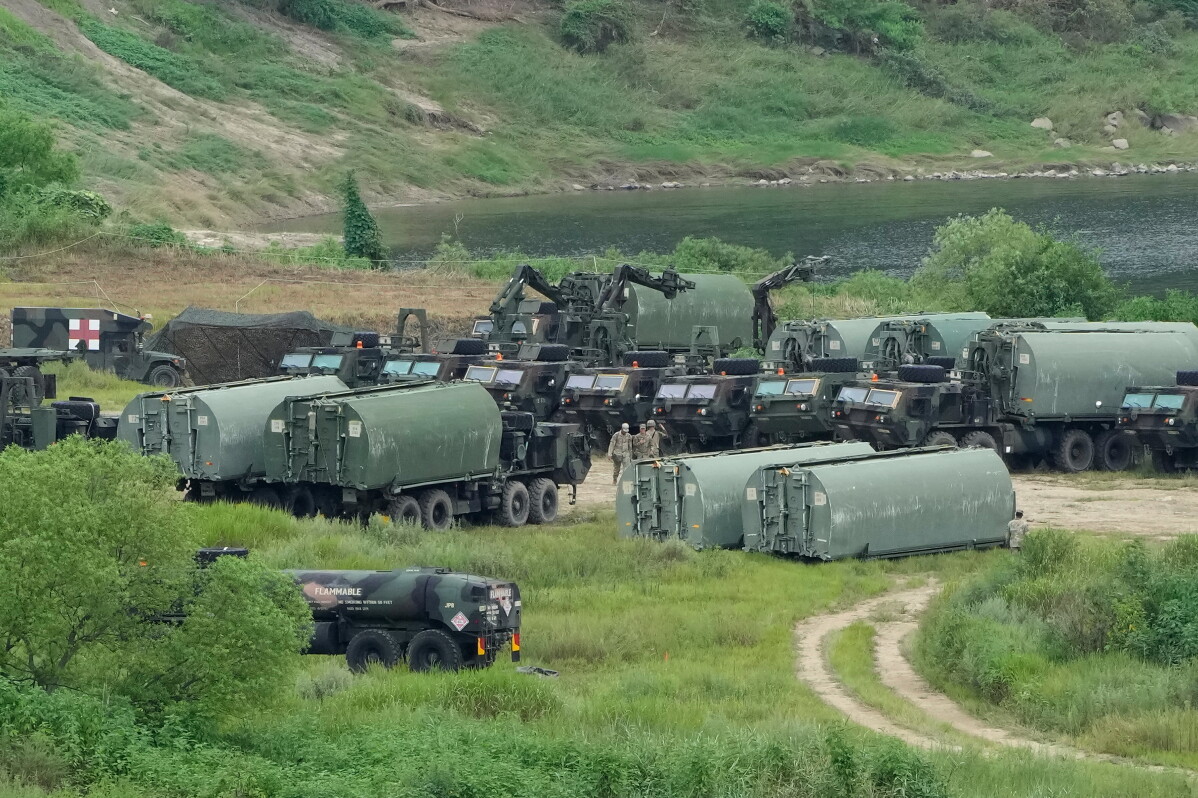
Image context: the cover is an on-scene photograph from Yeoncheon on August 17, the exercise's opening day. It shows U.S. armored vehicles assembled for a river-crossing event near the North Korean border—not a generic military illustration. The image confirms that field activity occurred; it cannot show whether the event retained its planned scale, participants or objectives.[1]
What is verified—and what remains open
| Timestamp and source | Verified signal | Confidence boundary |
|---|---|---|
| August 16, Trump order reported by AP, BBC and Axios | Trump instructed Defense Secretary Pete Hegseth to substantially reduce the joint exercises and tied the decision to cost, signaling toward North Korea and South Korea's position on Iran.[1][2][6] | High on the public instruction and stated rationale; low on its operational meaning until an execution order or cut list is released. |
| August 17, exercise opening | Ulchi Freedom Shield began as scheduled. AP reported an 11-day plan and about 18,000 participating South Korean troops.[1] | High that the exercise started; the planned headcount is not proof that every person, day or event remained unchanged. |
| Published exercise design | U.S. Forces Korea defines Ulchi Freedom Shield as combined, joint, all-domain and interagency training using live, virtual, constructive and field-based elements.[3] | High on the exercise's standing design; the page does not identify the August 2026 reductions. |
| Planned 2026 field work | Public reporting said the plan included live-fire precision targeting and maneuver, a wet-gap crossing and distribution of pre-positioned equipment.[1] | Medium-high on the pre-order plan; no cited source confirms that every named event will be completed at its original scale. |
| Seoul's initial response | South Korea's presidential office welcomed the possibility of renewed U.S.–North Korean dialogue and said it would pursue diplomatic efforts.[1] | High on the reported statement; it does not establish that Pyongyang will answer or that Seoul endorses every operational cut. |
No cited source supplies the percentage reduction, a revised participant count, a list of canceled events or a joint military explanation of which training objectives remain. Claims that the exercise is essentially unchanged—or effectively hollowed out—therefore run ahead of the available record.
The order landed after the machinery was moving
Large exercises are not single events that can be turned down like a volume knob. They combine headquarters work, communications, movements, ranges, fuel, medical support, simulations, civilian coordination and after-action evaluation. Personnel and equipment begin moving before the formal opening day. A last-minute political instruction therefore has to be translated into many smaller decisions: what stops, what shrinks, what becomes simulated, what moves to another date, and what continues because changing it would create more risk than finishing it.
That is why the timing matters. AP reported that the exercise began Monday morning and that it was still unknown which portions had been downsized.[1] A reduction decided before planning could have been designed around explicit diplomatic and military tradeoffs. A reduction ordered as execution begins adds a second problem: units must preserve safety and command clarity while leaders are redefining the training package.
The public should resist an easy proxy. Headcount alone is insufficient. Eighteen thousand people can participate in a thinner exercise if the most demanding combined events disappear. A smaller number can still produce useful training if the allies protect the objectives that cannot be rehearsed separately. The better questions concern functions:
- Did the combined command-post exercise run through its planned decision cycles?
- Were U.S. and South Korean units still required to communicate, maneuver and sustain one another under realistic friction?
- Did the wet-gap, live-fire and pre-positioned-equipment events occur, and at what scale?
- Were evaluation activities tied to South Korea's conditions-based transition of wartime operational control preserved?
- Will the allies publish a joint after-action account using the same definitions of “reduced,” “completed” and “deferred”?
These questions do not demand sensitive tactics. They ask for enough aggregate information to distinguish a political gesture from a change in military capability.
The cut list matters more than the adjective
U.S. Forces Korea says Ulchi Freedom Shield is meant to improve understanding among the Combined Forces Command, U.S. Forces Korea, the United Nations Command, South Korea's Joint Chiefs of Staff and government agencies. It mixes live, virtual, constructive and field training.[3] That design offers several ways to reduce visibility without deleting every readiness benefit—but those substitutions are not equivalent.
A field event can be narrowed geographically, involve fewer units, or move activity into simulation. That may reduce cost and political visibility. It may also remove the physical friction the event was built to expose: vehicles that do not arrive on time, incompatible procedures, congested routes, broken communications, fuel demand or a safety decision made under pressure. Command-post work tests a different layer—how headquarters share information and make decisions—and cannot fully replace field execution. Field training, in turn, cannot replace the higher-level command problem.
Logistics deserves special attention because it is easy to describe as support rather than substance. AP's pre-order plan included distributing pre-positioned equipment, while U.S. Forces Korea describes a broader design that combines live, virtual, constructive and field-based elements.[1][3] If the revised package preserves visible maneuver but removes sustainment objectives, it may retain spectacle while losing one of the harder tests.
The relevant measure is therefore not whether officials later say the exercise was “successful.” It is whether the revised package still connected command, movement, sustainment and evaluation. A credible public account could name objectives completed, events reduced or deferred, and the method for recovering missed training without disclosing operational vulnerabilities.
A diplomatic signal needs a military boundary
Reducing exercises to make room for diplomacy has precedent. The Congressional Research Service notes that bilateral drills improve readiness and operational cohesion but can also raise tensions; after Trump's 2018 summit with Kim, the United States canceled large-scale exercises, and large in-person drills resumed in 2022.[4] The lesson is not that reduction always works or always fails. It is that training policy has long carried both military and diplomatic effects.
The current context makes consultation especially important. Only three months ago, Hegseth publicly praised South Korea for increasing defense spending, assuming more responsibility for peninsula security and contributing to alliance burden-sharing.[5] The August order arrived with a different message: Seoul's refusal to join the Iran conflict was presented as one reason to cut a Korea-focused exercise.[1][2][6] Those statements can coexist as policy, but allies still need to know whether exercise design is being set by conditions on the peninsula, by a diplomatic opening with Pyongyang, by bargaining over unrelated theaters, or by some combination.
South Korea's first response kept the diplomatic door open rather than publicly escalating the dispute.[1] That creates an upside only if the signal produces an answer. North Korea had criticized the exercise and recently resumed ballistic-missile testing, while no cited source at this timestamp reported a new commitment to talks.[1][6] A concession without reciprocal movement may still be defensible for other reasons, but it should not be booked as diplomatic progress in advance.
Decision impact by horizon
Next 24 hours — establish one executable version. U.S. and South Korean commanders need a shared written direction that identifies changed events, safety implications, reporting lines and protected objectives. Publicly, the useful signal is a joint statement that moves beyond “started” and “reduced.” A revised schedule or objective-level summary would sharply reduce speculation.
Next seven days — compare performance with the original design. Watch whether command-post phases, live-fire maneuver, wet-gap work, pre-positioned-equipment distribution and combined logistics appear in official releases or on-scene reporting. Absence from a press feed does not prove cancellation, but a pattern of missing events plus no joint explanation would lower confidence. North Korea's response also matters: contact, a testing pause or calibrated rhetoric would support the diplomatic interpretation; new launches or escalation without talks would weaken it.
Next 30 days — recover, evaluate and consult. The allies should determine what training value was lost, which objectives need a replacement event, and whether the order affected milestones for combined-command development or wartime-control transition. Lawmakers and alliance officials should also ask whether the decision process used established consultation channels. The durable issue is not one August schedule; it is whether both militaries can plan against guidance that may change at the starting line.
Three conditional paths
Base path — visible field activity shrinks, core integration continues. The allies reduce selected high-profile or resource-heavy events while preserving command-post work, essential combined maneuver and logistics objectives. Trigger: a joint account names what changed, the main functional areas still train, and deferred objectives receive dates or recovery plans.
Upside — a bounded reduction opens a diplomatic channel. Washington and Seoul define the change as reversible, protect readiness essentials, and receive a concrete response from Pyongyang such as direct contact, working-level talks or a sustained pause in provocative testing. Trigger: reciprocal movement is announced by the parties—not inferred from quieter rhetoric alone.
Downside — improvisation hollows out training without buying dialogue. Broad cancellations remove linked command, field and sustainment work; the allies give conflicting explanations; replacement training is not scheduled; and North Korea continues testing or raises demands before talks. Trigger: official or on-scene evidence shows multiple core objectives canceled while no reciprocal diplomatic step appears.
These are observable branches, not probability estimates. The base case should not be upgraded merely because vehicles and troops remain visible, and the downside should not be declared from the president's adjective alone.
Action checklist and invalidation conditions
- U.S. and South Korean defense officials: publish one non-sensitive list of completed, reduced, deferred and canceled objective categories; identify who approved the revised package.
- Exercise leaders: protect the connection between headquarters decisions, field execution, logistics and evaluation; schedule recovery training for any link removed.
- Diplomats: define the reduction as a conditional signal only if there is a clear channel, requested response and review date.
- Lawmakers and oversight bodies: ask what consultation occurred, what costs were actually avoided and whether any readiness or wartime-control evaluation milestone moved.
- Journalists and readers: separate the public order, the exercise's visible start, the final training content and any diplomatic response. None substitutes for the others.
Invalidate the central assessment if the two governments release a detailed joint record showing that the order did not materially change planned objectives. In that case, execution ambiguity—not readiness loss—was the short-lived problem. Revise the assessment in the other direction if official records show broad cancellation of command, field and sustainment work; the article's neutral “wait for the cut list” boundary would then be too cautious. Finally, do not label the reduction a diplomatic success unless North Korea takes a verifiable reciprocal step.
Sources
- Hyung-Jin Kim, Associated Press, “South Korea hopes for talks between US and North Korea after Trump downsizes military drills” (August 17, 2026) — exercise status, planned activities, South Korean response, uncertainty over the cuts and source page for Ahn Young-joon's Yeoncheon photograph.
- BBC News, “Trump says US to reduce military drills with South Korea after it stayed out of Iran war” (August 17, 2026) — independent report on the order and its stated rationale.
- United States Forces Korea, “Ulchi Freedom Shield” — official description of the exercise's combined, joint, all-domain and interagency design and its live, virtual, constructive and field-based components.
- Congressional Research Service, “U.S.-South Korea Alliance: Issues for Congress” — alliance background, the readiness-and-tension tradeoff in joint exercises and the 2018–2022 reduction-and-resumption precedent.
- U.S. Department of War, “Secretary of War Pete Hegseth Hosted Bilateral Meeting With the Republic of Korea Minister of National Defense Ahn Gyu-back at the Pentagon” (May 11, 2026) — official pre-order statement on combined readiness, South Korean defense responsibility and burden-sharing.
- Rebecca Falconer, Axios, “Trump tells Hegseth to cut back U.S.-South Korea drills” (updated August 16, 2026) — contemporaneous account of the instruction, timing, rationale and wider regional-force context.