As of 2026-08-20 21:34 UTC, South Sudan had lost at least 36 humanitarian staff and contractors in the line of duty since January, according to the country's UN humanitarian coordinator. That is already more than the 31 killed during all of 2025.[1][2]
The accompanying incident claim needs a qualification. The coordinator's August 19 statement described more than 450 incidents of violence against humanitarian workers and assets from January through July, over twice the comparable 2025 number.[2] OCHA's detailed July access snapshot instead records 456 total humanitarian access incidents, up 51% year on year, across categories that include both violence and nonviolent barriers.[8] The totals are numerically close, but the labels and growth rates are not. Until OCHA reconciles them, they should not be reported as one clean series.
The figures arrived on World Humanitarian Day, but they describe more than a commemorative toll. Renewed conflict has forced aid organizations to leave some operational areas. At the same time, the national response plan is only 35% funded and food pipelines face possible disruption from October. South Sudan's aid system is being compressed from two directions: people and routes are becoming less secure while the money and supplies available to use those routes are running down.[2]
There is an important reporting limit. The UN statement publishes an aggregate, not an incident-by-incident register. It does not name all 36 people, locate every death, identify alleged perpetrators or state how many cases have produced an investigation. Those gaps do not erase OCHA's current operational total; they define what the public record can—and cannot yet—support.
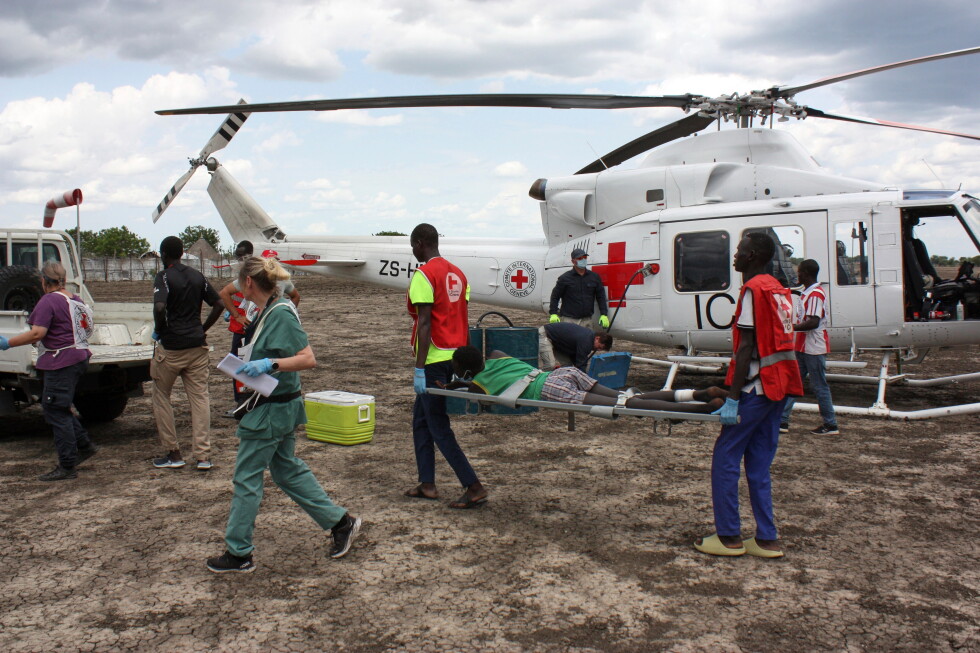
Image context: the cover photograph is an AP file image from Akobo in May 2025. It shows ICRC and South Sudan Red Cross medical staff carrying a wounded patient on a stretcher beside an ICRC helicopter. It is direct documentary evidence of humanitarian work in South Sudan, not a photograph of a specific 2026 attack.[1]
The record at the cutoff
| Measure | Verified status | Boundary |
|---|---|---|
| 36 humanitarian staff and contractors killed in 2026 | Reported by the UN humanitarian coordinator for South Sudan on August 19; the total had passed the 31 deaths reported for all of 2025.[2] | The statement says those killed were overwhelmingly South Sudanese nationals, but it does not publish a case-level ledger. |
| 456 reported access incidents, January–July | OCHA's July snapshot says the total was 51% above the comparable 2025 period; July alone accounted for 65 incidents.[8] | The snapshot includes violence, hostilities, operational interference, movement restrictions and physical constraints. It also warns that unreported incidents are absent. |
| “More than 450” violent incidents | The August 19 coordinator's statement uses this description and says the count more than doubled year on year.[2] | OCHA does not reconcile that wording or rate with its 456-incident access snapshot; this report does not treat them as equivalent. |
| 2.6 million people reached, January–June | Humanitarian partners reported reaching 2.6 million of the 4.3 million people targeted.[2] | “Reached” does not mean that every need was met or that assistance continued at the same level afterward. |
| 35% of the response plan funded | The humanitarian coordinator reported the funding share on August 19 and warned of food-pipeline disruption beginning in October without more resources.[2] | A funding percentage does not reveal which route, warehouse or program will fail first. |
| 650,000 refugees and asylum seekers at risk of losing further support | WFP and UNHCR issued the warning on August 14; September was expected to be the final assistance month for the most vulnerable 240,000 without new funding.[4] | This is a refugee-response warning, not a count of every food-insecure person in South Sudan. |
Thirty-six deaths, without a public case file
The headline comparison is stark because the periods are unequal: less than eight months of 2026 have produced a higher reported toll than the previous full year. Associated Press reported the coordinator's figures from Juba and noted that the violence has unfolded as renewed fighting between government and opposition forces has pushed organizations out of some areas.[1]
The wider conflict record shows where pressure is rising, but it does not assign responsibility for the 36 deaths. In an August 6 Security Council briefing, the head of the UN Mission in South Sudan described armed confrontation particularly in Jonglei, cycles of community violence in Warrap and Lakes, and more than 420,000 people displaced by violence between January and June. She also reported 391 humanitarian access incidents at that earlier cutoff.[3]
The July snapshot supplies the clearer next point: 456 reported access incidents from January through July, including 65 during July itself. It says six aid workers were killed, three were abducted and ten humanitarian personnel were relocated during that month.[8] Even so, 391 should not simply be subtracted from 456. The Security Council remarks do not define their cutoff as precisely as the snapshot, and the later coordinator's statement changes both the category label and year-on-year rate.
An obstruction at a checkpoint, a bureaucratic delay, an assault on a staff member and damage to a vehicle can overlap in operational effect without belonging to the same category. The firm conclusion is that reported access constraints rose. The public record does not support calling all 456 incidents violent or claiming that the difference between two aggregate remarks is a one-month surge.
The same caution applies to global comparisons. Humanitarian Outcomes' Aid Worker Security Database recorded 350 aid workers killed worldwide in 2025, alongside 322 wounded and 235 kidnapped.[5] Its published boundary is specific: it covers employees and associated personnel of not-for-profit aid groups providing material or technical assistance in humanitarian contexts, and it excludes groups such as peacekeepers, election monitors and purely advocacy organizations.[6]
The database's public South Sudan records, last updated August 10, show 12 people killed across 30 major incidents in 2026 and 16 killed across 97 major incidents in 2025.[9] Those lower figures do not disprove OCHA's operational count. AWSD verifies a narrower set of major deliberate-violence incidents, can lag and revise, while OCHA explicitly includes staff and contractors killed in the line of duty. The gap does establish one boundary: OCHA's 36-versus-31 comparison is not a universally reconciled series and should not be described as independently confirmed by AWSD.
When a team relocates, the route changes
Aid access is a chain rather than a single permission. Staff must remain in place; vehicles and aircraft must be available; roads, rivers or airstrips must be usable; local authorities and armed actors must allow passage; and a clinic or distribution point must still be able to receive what arrives. The AP photograph captures one end of that chain: several medical workers are needed to move one patient between air transport and ground care.[1]
The humanitarian coordinator confirmed that organizations have relocated from some operational areas because of renewed conflict. The statement also names access restrictions and bureaucratic impediments as obstacles to reaching people.[2] It does not say which organizations moved, from where, for how long or which deliveries were missed. That missing operational map matters. A national total can show that risk is worsening while concealing whether a particular county has lost a clinic team, a nutrition route or a reliable resupply window.
The immediate effect of insecurity is not limited to the staff member under threat. A vehicle taken off a road, a team pulled from a base or a suspended field visit removes capacity from communities that may have no substitute provider. Yet the cited record does not quantify that downstream loss, so it would be wrong to convert 456 access incidents into a guessed number of patients or meals denied. The supported conclusion is narrower: violence has already triggered relocation, and relocation further restricts access.[2][8]
Insecurity is meeting a funding cliff
Even routes that remain physically usable need stock and staff. The August 19 UN statement says about 10 million people require humanitarian assistance in South Sudan this year and more than 7.5 million face high levels of acute food insecurity. Against that need, partners reached 2.6 million of a 4.3 million target in the first half of the year, while the response plan stood at 35% funded.[2]
A separate WFP–UNHCR warning makes the approaching break more concrete. More than 650,000 refugees and asylum seekers risk losing further access to food, nutrition and other assistance. The agencies said the last food and nutrition support for the most vulnerable 240,000 would be delivered in September without urgent funding. WFP reported an immediate $37 million gap for its refugee response and a $258 million shortfall for the remainder of its 2026 country operation; UNHCR had secured 28% of the $286 million it said it needed. Refugee families still receiving aid were already getting half rations.[4]
The security and funding figures belong in the same report because they act on the same delivery system, but they should not be collapsed into one cause. The cited sources do not show that a funding cut caused any of the 36 deaths, or that every relocation followed a direct attack. They show two simultaneous constraints with different remedies: protection and access require conduct, investigation and enforcement by authorities and parties to conflict; the food pipeline requires money, procurement and deliverable routes.
This distinction also prevents a false comfort. Fully funding a program does not make a dangerous road safe. Securing a road does not fill an empty warehouse.
Protection is already a rule
International humanitarian law does not treat the safety of relief personnel as optional goodwill. The ICRC's customary-law Rule 31 states that humanitarian relief personnel must be respected and protected in both international and non-international armed conflicts. It also explains that intentionally directing an attack at protected personnel involved in a humanitarian assistance mission can constitute a war crime under the applicable conditions.[7]
That legal rule does not automatically classify every one of the 36 deaths. A legal finding requires facts about the victim's role, the circumstances, the actor, intent and the connection to armed conflict. The current aggregate statement does not supply those facts case by case. What it does supply is a direct demand to South Sudan's government and all parties to the 2018 peace agreement: protect humanitarian personnel and assets, investigate attacks, hold perpetrators accountable and permit safe, sustained and unhindered access.[2]
The accountability gap is therefore measurable in records, not rhetoric. A stronger next update would show, without exposing survivors or operations, how many fatal incidents were referred for investigation, which authority has jurisdiction, how many cases have named suspects, and whether any proceeding has reached a decision. It would also separate violent incidents from administrative and physical access constraints, so the public can see whether the operating environment is improving or merely being described with a different denominator.
The evidence clock
Next 24 hours — preserve the baseline. The useful immediate update is not another broad expression of alarm. It is confirmation from OCHA or UNMISS of the 36-person fatality total and a reconciliation of “more than 450 incidents of violence, more than double” with “456 access incidents, up 51%.” Agencies can acknowledge relocations without publishing live staff positions or routes.[2][8]
Next seven days — show the operational change. Watch for a breakdown of violent versus bureaucratic constraints, notification that any relocated team has returned, and case-status information from South Sudanese authorities. On the funding side, a named contribution matters only when WFP or UNHCR says which part of the September or October pipeline it preserves.[2][4]
Next 30 days — test delivery against the cutoff. By late September, the question should be answerable: did the most vulnerable 240,000 refugees receive a funded continuation beyond their expected final distribution, and did the wider food pipeline avoid the disruption forecast for October? A pledge announcement without an updated distribution plan would not settle either question.[2][4]
Three conditional paths
Base path — constrained delivery continues. Organizations keep operating where they can, but relocations remain partly unresolved, incident reporting stays aggregate and new money covers only fragments of the pipeline. Trigger: OCHA continues to report restricted access while WFP and UNHCR announce partial rather than full continuity.
Improvement path — routes reopen and the cutoff moves. Authorities and parties to conflict produce safer access in affected areas, organizations confirm that teams have returned, investigations acquire public case numbers, and funding extends food assistance beyond September and October. Trigger: operational-restoration notices and agency-confirmed pipeline coverage appear together; one without the other is incomplete.
Deterioration path — violence and scarcity compound each other. More staff or assets are attacked, additional teams relocate, and the threatened food suspensions begin while arrivals from Sudan continue. Trigger: a rising comparable incident series plus WFP or UNHCR confirmation that scheduled distributions have stopped or rations have been cut again.
These are observable branches, not probability estimates. The current sources do not support assigning odds to them.
Action checklist and invalidation condition
- South Sudan's government and parties to the peace agreement: protect humanitarian personnel and assets, permit sustained access and publish investigation status without exposing witnesses or survivors.[2]
- OCHA and UNMISS: reconcile the 391 access-incident remark, the 456-incident snapshot and the 450-plus violence wording by publishing their definitions, coverage periods and any overlap.[2][3][8]
- WFP, UNHCR and donors: identify which contribution funds which distribution month, population and ration level; report continuity rather than pledges alone.[4]
- Journalists and monitors: keep three ledgers separate—a human ledger for deaths and cases, an access ledger for obstruction and restoration, and a delivery ledger for funded assistance.
Invalidate the report's central “access is narrowing” assessment if comparable OCHA or UNMISS records show that relocated operations have been restored, violence and access incidents have fallen below the prior-year rate, and the threatened food pipelines are fully financed beyond October. Revise it in the other direction if new fatalities, relocations or confirmed distribution suspensions appear. The already reported deaths would remain historical facts; what would change is the assessment of the system's current direction.
Until those records appear, the safest conclusion is also the most serious one. South Sudan's 2026 humanitarian death toll has already exceeded last year's, violence has forced operational retreats, and funding is approaching specific cutoffs. What remains uncertain is not whether the system is under strain, but where the next loss of access will occur and whether any of the deaths will produce public accountability.
Sources
- Deng Machol, Associated Press, “Deadly attacks on aid workers and contractors surge in South Sudan as UN urges protection” (August 19, 2026) — secondary current report and source page for Joseph Falzetta's archival Akobo photograph.
- UN Office for the Coordination of Humanitarian Affairs via ReliefWeb, “Statement by the Humanitarian Coordinator for South Sudan, Mr. Ramanathan Balakrishnan, for World Humanitarian Day 2026” (August 19, 2026) — primary source for deaths, violent incidents, relocations, response reach and funding status.
- United Nations Mission in South Sudan, “Remarks by Anita Kiki Gbeho, Special Representative of the Secretary-General and Head of UNMISS, to the United Nations Security Council” (August 6, 2026) — conflict, displacement and earlier access-incident context.
- World Food Programme and UNHCR, “Refugees in South Sudan Face Extreme Hunger as Funds Run Out” (August 14, 2026) — refugee-assistance cutoff, ration level and agency funding gaps.
- Aid Worker Security Database, “Major attacks on aid workers: Summary statistics” — verified global 2025 totals for aid workers killed, wounded and kidnapped.
- Aid Worker Security Database, “About the data” — collection method and definition of who is and is not counted as an aid worker.
- International Committee of the Red Cross, Customary IHL Rule 31, “Humanitarian Relief Personnel” — protection rule and legal boundary for attacks on humanitarian personnel.
- UN Office for the Coordination of Humanitarian Affairs via ReliefWeb, “South Sudan: Humanitarian Access Snapshot — July 2026” — detailed monthly and January–July access-incident counts, categories, year-on-year comparison and reporting caveat.
- Aid Worker Security Database, detailed South Sudan incident records for 2025–2026 — filtered public data used to distinguish AWSD's verified major-incident series from OCHA's operational fatality count.