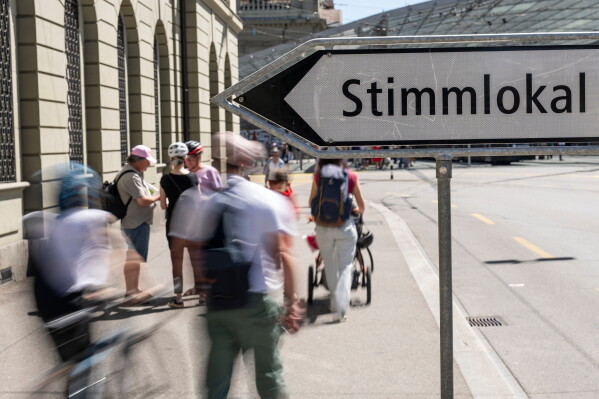
As of 2026-06-14 19:31 UTC, Swiss voters had rejected the popular initiative known as "No to a Switzerland with 10 million!" Early and provisional reporting put the "no" side at roughly 55%, with the proposal defeated after a campaign that turned a demographic ceiling into a test of Switzerland's relationship with immigration, labor supply, public services, and the European Union.[1][3][4]
The result is clear enough for a news brief, but the policy signal is not simple. The Swiss People's Party-backed initiative failed because enough voters judged the proposed remedy too risky, especially for EU free movement and the broader bilateral relationship. It did not fail because population pressure, housing strain, infrastructure crowding, or migration politics disappeared overnight.[2][4]
Facts Now
| Item | Current read | Confidence note |
|---|---|---|
| Vote result | AP reported that nearly 55% of voters rejected the initiative, while Swissinfo described the rejection as a 55% "no" outcome in its June 14 coverage.[1][3] | High for direction; some early reports described results as preliminary or provisional. |
| Turnout | AP said preliminary federal results showed nationwide turnout of almost 59%.[1] | Medium-high; early-result figure, subject to final official certification. |
| Proposal | The Federal Council's official explainer says the initiative sought to keep the permanent resident population below 10 million until 2050.[2] | High; official Swiss government description. |
| Trigger design | The official explainer says that if the permanent resident population exceeded 9.5 million before 2050, the Federal Council and Parliament would need to take measures, especially on asylum and family reunification.[2] | High; official Swiss government description. |
| EU risk | The same official explainer says that if the 10 million threshold were exceeded, Switzerland would have to terminate agreements contributing to population growth, including the EU free-movement agreement, after two years; it also says the Bilateral Agreements I package would become null and void.[2] | High for legal-policy framing; real-world negotiation behavior would have depended on subsequent politics. |
| Broader backdrop | The Guardian reported that Switzerland's population had grown 23% since the free-movement agreement took effect in 2002, while economic output rose about 24% over the same period and about 27% of residents were not Swiss citizens.[5] | Medium-high; reported from government and official data, but still an interpretive news synthesis. |
What Changed Today
The rejected initiative would have moved Switzerland from managing immigration through law, labor-market rules, asylum policy, and bilateral agreements into a constitutional population-ceiling model. That is why the campaign was about more than a number. The Federal Council's official page says Switzerland had about 9.1 million residents at the end of 2025 and that population had grown by about 1.7 million since free movement of persons began in 2002, mainly because of immigration tied to labor demand.[2]
Supporters framed the cap as a sustainability and control measure. Opponents framed it as an economic and diplomatic risk. AP noted the Swiss People's Party's argument that demographic growth strains infrastructure, housing, social programs, natural resources, and Swiss life; it also noted opposition from the federal government, Parliament, and EconomieSuisse.[1] Al Jazeera, drawing on Reuters and AP, reported the core voter tradeoff in similar terms: economic stability and EU ties won out over the cap, even though worries about migration and public services remained visible.[4]
That makes the result a rejection of a mechanism, not a cancellation of the underlying dispute. A "no" vote preserves room for incremental policy: housing supply, transport capacity, sector-specific labor planning, asylum processing, family reunification rules, and integration budgets. A "yes" vote would have forced these questions through a hard ceiling that could have collided with free movement and the bilateral architecture Switzerland uses with the EU.[2][4]
Decision Impact
Next 24 hours: the immediate market and diplomatic read is stability. Switzerland has avoided an automatic path toward reopening or terminating the EU free-movement settlement. The uncertainty boundary is that final certified figures and canton-level patterns still matter for political interpretation, even if the national direction is set.[1][3]
Next 7 days: the important question is how the Federal Council, Parliament, business groups, and the SVP frame the aftermath. If the "no" camp treats the vote as a mandate to ignore population pressure, the initiative's support level becomes a standing warning. If the government treats it as a mandate to address housing, infrastructure, and labor bottlenecks without breaking EU ties, the result becomes more durable.[2][4]
Next 30 days: watch whether migration policy shifts toward smaller, administratively plausible measures: faster permitting in shortage sectors, more visible housing and transport plans, tighter asylum-process management, or new integration funding. The underlying numbers matter because Switzerland's migration system is not only a border question; it is also a labor-market and growth model, with population and output both rising sharply since the 2002 free-movement baseline.[2][5]
Scenarios
Base case: the rejection holds as a stability vote. Switzerland keeps EU free movement intact, and mainstream parties try to absorb the pressure through housing, infrastructure, and labor-policy adjustments rather than another sweeping constitutional initiative.[2][5]
Upside case: the result forces a more honest governing package. The "no" side acknowledges that a 55-45 split is not a blank check, while the "yes" side channels its pressure into specific constraints that do not threaten the bilateral framework.[1][3]
Downside case: both sides overread the result. If opponents of the cap treat the vote as an endorsement of the status quo, the SVP can argue that legitimate crowding and cost-of-living complaints were dismissed. If supporters treat defeat as proof that only harder confrontation works, Switzerland may face another EU-linked migration fight before the practical bottlenecks have been addressed.[4]
Action Checklist
- Swiss policymakers should separate two questions: whether a constitutional population cap was too blunt, and where voters are still experiencing real capacity strain.
- Business groups should make the labor-demand case concretely, especially in healthcare, care homes, technology, finance, pharmaceuticals, and hospitality, rather than relying on abstract pro-growth language.[1][2]
- EU-facing officials should keep the free-movement issue quiet but explicit: the vote reduces immediate treaty risk, but it does not eliminate Swiss domestic pressure around the bilateral model.[2]
- Reporters should avoid calling the result an uncomplicated pro-immigration mandate. The better read is narrower: voters rejected the cap's side effects more than they endorsed every feature of the current system.[3][4]
- The key invalidation condition is a rapid follow-up surge in polling for another hard migration initiative. That would suggest today's "no" was less a settlement than a delay.
The cleanest interpretation is therefore restrained. Switzerland did not vote to stop debating immigration. It voted against making 10 million the constitutional tripwire for the whole debate.[1][2]
Sources
- Associated Press, "Swiss voters reject right-wing's bid to cap population at 10 million, early results show" (June 14, 2026) - result, turnout, campaign arguments, voter context, and AP/Keystone image used in this article.
- The Federal Council, "Popular initiative: 'No to a Switzerland with 10 million! (Sustainability Initiative)'" - official Swiss government explainer on the proposal, thresholds, EU free-movement consequences, and population backdrop.
- SWI swissinfo.ch, "June 14 votes: results from across Switzerland" (June 14, 2026) - national vote-results hub and related provisional coverage of the population-cap rejection.
- Al Jazeera, "Switzerland rejects right-wing bid to cap country's population" (June 14, 2026) - Reuters/AP synthesis of the vote, campaign rationale, economic concerns, and EU-link framing.
- The Guardian, "Swiss voters appear to reject proposal to cap population at 10 million" (June 14, 2026) - independent context on SRF projections, population and output growth, citizenship share, and EU free-movement risks.