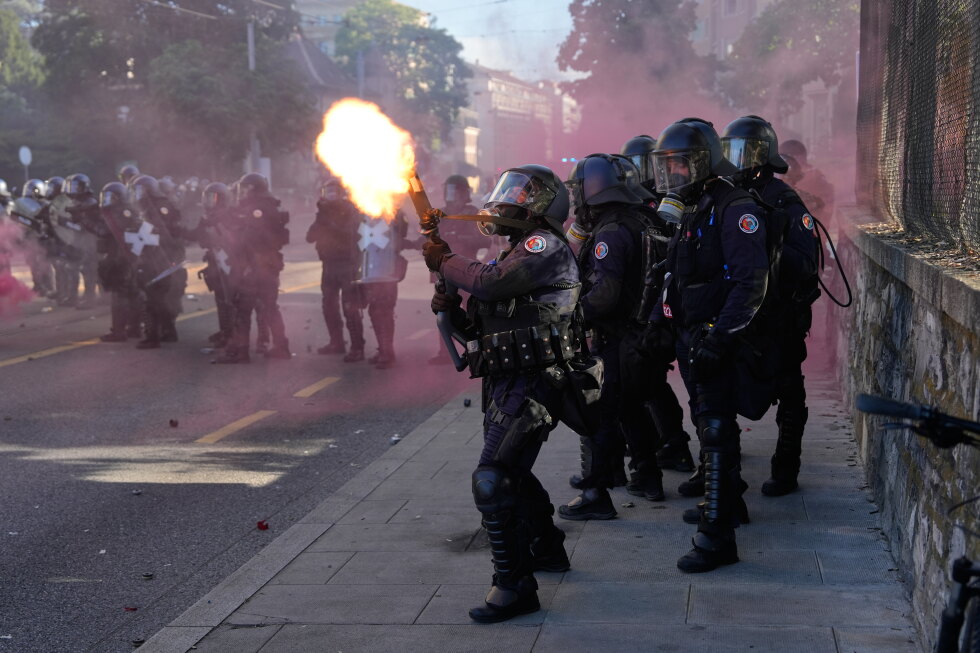
As of 2026-06-14 22:32 UTC, the G7 summit has not formally opened in Evian, but its operating problem is already visible across the lake. In Geneva, an authorized anti-G7 march turned into clashes between riot police and groups of stone-throwing youths; AP reported tear gas, water cannons, a burned car, smashed bank windows, and police figures of roughly 20,000 demonstrators, including about 600 Black Bloc militants.[1]
The easy version of the story is protest disorder before a leaders' summit. The more useful reading is narrower: the Evian G7 is a cross-border security event whose pressure is landing first on Geneva's streets, transport network, border crossings, shops, visitors, and police staffing. France hosts the meeting. Switzerland absorbs much of the perimeter.
Facts Now
| Item | What matters | Confidence note |
|---|---|---|
| Summit timing | The Elysee page says Evian returns to the center of international news from June 15 to 17, 23 years after the 2003 Evian G8 summit.[2] | High; official French presidency page. |
| Security perimeter | The French government Pass G7 page says Haute-Savoie authorities will establish security perimeters around the summit venues and manage access through registration and supporting documents.[3] | High for access framework; operational decisions can still change. |
| Geneva protest | AP reports clashes during the June 14 Geneva march and cites police figures of about 20,000 protesters and 600 Black Bloc militants.[1] | High for AP reporting; casualty, arrest, and damage totals may change after publication. |
| Border controls | Geneva's official FAQ says only seven Geneva-France road crossing points are authorized from June 12 to 18, with other land and lake crossings barred.[5] | High; official cantonal information, but operational openings can evolve. |
| Transit disruption | TPG said its Geneva-area network was being heavily adjusted from 12:00 on June 14, with multiple trolleybus, tram, and bus lines stopped or shortened during the demonstration.[6] | High for published service plan; real-time operations can change. |
The Perimeter Is The Story
Summits usually sell themselves through communiques: security language, economic language, trade language, and the diplomatic choreography of who meets whom. The Evian meeting will have all of that. The French presidency is presenting the city as the center of G7 attention from June 15 to 17, while the dedicated Pass G7 system shows the less theatrical side of the same event: controlled access, registration, supporting documents, and security perimeters around summit venues.[2][3]
But the first concrete test is not rhetorical. It is whether two neighboring states can run a security perimeter without making the host region feel shut down. Geneva's official tourism page warns visitors to allow extra travel time, check flight and transport status, avoid the demonstration area, and expect disruptions around airport access, city-center roads, border crossings, guided tours, boutiques, parks, and public transport.[4] That is not decorative travel advice. It is the public-facing version of the summit's risk map.
The geography makes this more complicated than an ordinary national event. The summit venue is in France, but Geneva is the major international gateway. Geneva's FAQ explains why the canton is affected even though the summit is across the border: delegations may use Geneva airport, security effects extend around the Lake Geneva region, and Swiss, cantonal, and French authorities have to coordinate the movement of protected people, commuters, residents, demonstrators, and visitors.[5]
That means the summit has two clocks. The first is the formal leaders' clock, beginning June 15 in Evian. The second is the regional operating clock, which began earlier: summit access registration, temporary border controls from June 10 to 19, airspace restrictions over the Lake Geneva region, cross-border transport changes, closed or controlled routes, and a June 14 protest whose route was negotiated and authorized before portions of it turned violent.[3][5][6]
What Geneva's Clashes Change
The clashes do not prove the summit will fail. They do make the margin thinner. Before leaders arrive, officials now have to handle three simultaneous narratives: legitimate protest rights, visible property damage, and the daily-life disruption imposed on a city that is not formally hosting the summit.
AP's account is careful on this point. It describes the demonstration as organized by a mix of activist groups after weeks of negotiation with local authorities, and says it was otherwise peaceful outside the violent standoff.[1] That matters because the policy question is not whether all protest equals disorder. It is whether authorities can separate a large political march from smaller groups willing to smash windows, burn vehicles, or force police escalation.
Geneva's own pre-event language anticipated that distinction. The canton said an authorized march on the right bank was preferable to multiple unauthorized demonstrations because it gave officials a stricter framework for public expression and security planning, while still acknowledging that authorization cannot guarantee the absence of people seeking damage or confrontation.[5] The events of June 14 now turn that planning claim into a live audit.
The transit data gives the same story in operational form. TPG's line-by-line notice did not simply say "expect delays." It listed suspended trolleybus lines, altered tram sections, shortened bus routes, border-related changes, and a warning that the duration of measures would depend on how the demonstration developed in real time.[6] In a summit week, transport becomes part of public order. If people cannot move predictably, even a contained protest can widen into citywide stress.
Decision Impact
Next 24 hours: the main question is whether authorities can restore a credible baseline before the leaders' sessions begin. Watch for updated police figures, arrest or injury reports, damage estimates, and whether border and transport restrictions tighten further after the June 14 clashes.[1][5][6]
Next 7 days: the summit's diplomatic agenda will compete with the perimeter story. If the formal meetings in Evian produce tangible outcomes, the protests may become background. If more disruption follows, the story can flip: a summit about global coordination becomes evidence of how hard coordination is at street level.[2][3]
Next 30 days: Geneva and France will be judged on whether the controls looked proportionate after the fact. The open question is not only "were leaders safe?" It is also whether residents, commuters, businesses, protesters, and visitors experienced the week as a managed exception or as an overextended security lockdown.
Scenarios
Base case: the June 14 violence remains the peak event. Authorities keep the authorized protest framework, transport slowly normalizes after the demonstration, border controls stay disruptive but predictable, and the summit's main story shifts to the leaders' agenda once sessions start.[2][3][5][6]
Upside case: the clashes sharpen coordination without prompting a broad crackdown. Police isolate small violent groups, most protesters remain able to demonstrate, businesses avoid wider damage, and Geneva's visitor and transport channels provide clear enough instructions that the region absorbs the summit as a temporary strain.[4][5]
Downside case: officials respond to the clashes by expanding restrictions, unauthorized demonstrations multiply, or damage spreads into additional commercial areas. In that case the G7's opening coverage could become less about diplomatic outcomes and more about whether a cross-border host model displaced too much cost onto Geneva.[1][5]
Action Checklist
- Travelers should treat official local channels as live infrastructure, not background reading: Geneva Tourism, TPG, airport and airline notices, and cantonal updates can diverge from normal map-app assumptions during the summit period.[4][6]
- Geneva-area commuters should assume border crossings, tram links, and bus routes can change faster than normal schedules, especially around the seven authorized road crossings and any demonstration-related police decisions.[5][6]
- Editors should keep protest scale and violent incidents separate in copy. AP's reporting supports both facts: a large march and a smaller violent standoff within or around it.[1]
- Diplomacy watchers should not ignore the city operations. If the G7 produces statements on stability while the host region feels unstable, the perimeter will shape how the summit is received.[2][3]
- Officials should publish post-event metrics quickly: arrests, injuries, damage claims, closed crossing hours, transport interruption windows, and complaint channels. Those numbers will determine whether the security model looks proportionate after June 17.[5][6]
The immediate lesson from Geneva is that elite diplomacy now arrives as an urban systems test. The G7 agenda is global, but the first proof point is local: which borders stay open, which trams run, which shops board up, which protest routes hold, and whether the public can still tell the difference between necessary security and generalized shutdown.[1][4][5][6]
Sources
- Jamey Keaten, Associated Press, "Protesters clash with police in Geneva ahead of G7 summit" (June 14, 2026) - live protest reporting and lead AP photograph used for the article image.
- Elysee, "G7 Evian 2026" - official French presidency page for the summit and host-city framing.
- French Government, "About - Pass G7 Evian 2026" - official access, registration, and security-perimeter information for the summit.
- Geneva Tourism, "Visiting Geneva During the G7 Summit: Practical Information for Visitors" - visitor guidance, demonstration route, travel disruption, closures, and hotline details.
- Etat de Geneve, "G7 - FAQ" - official cantonal FAQ on security, border controls, transport, protest authorization, police support, and business-impact measures.
- Transports publics genevois, "Special Event: G7 Summit" - June 14 transit adjustments and line-by-line service measures during the demonstration.