As of 2026-05-09 02:33 UTC, NASA's new Mars-helicopter milestone is easy to read as a catchy aerospace headline: rotor blades inside a JPL test chamber have now gone past Mach 1.[1] The more useful reading sits one layer lower. NASA says the tips of a next-generation rotor reached Mach 1.08 during March tests in Mars-like conditions, across 137 runs, producing a 30% lift boost without the blades breaking apart.[1] For Mars exploration, that is not spectacle. It is evidence about whether future aircraft can carry more battery, more sensors, and more science than Ingenuity ever could.
That distinction matters because Ingenuity already proved one part of the case and left the harder part open. NASA's first Mars helicopter became the first aircraft to make a powered, controlled flight on another planet on April 19, 2021, then stretched a five-flight technology demonstration into 72 historic flights before its final flight in January 2024.[2][3] But Ingenuity did not carry science instruments.[1][2] The live engineering question after Ingenuity has been whether Mars rotorcraft can become useful field vehicles rather than brilliant one-off demonstrations. JPL's new test result pushes that question closer to a practical answer.
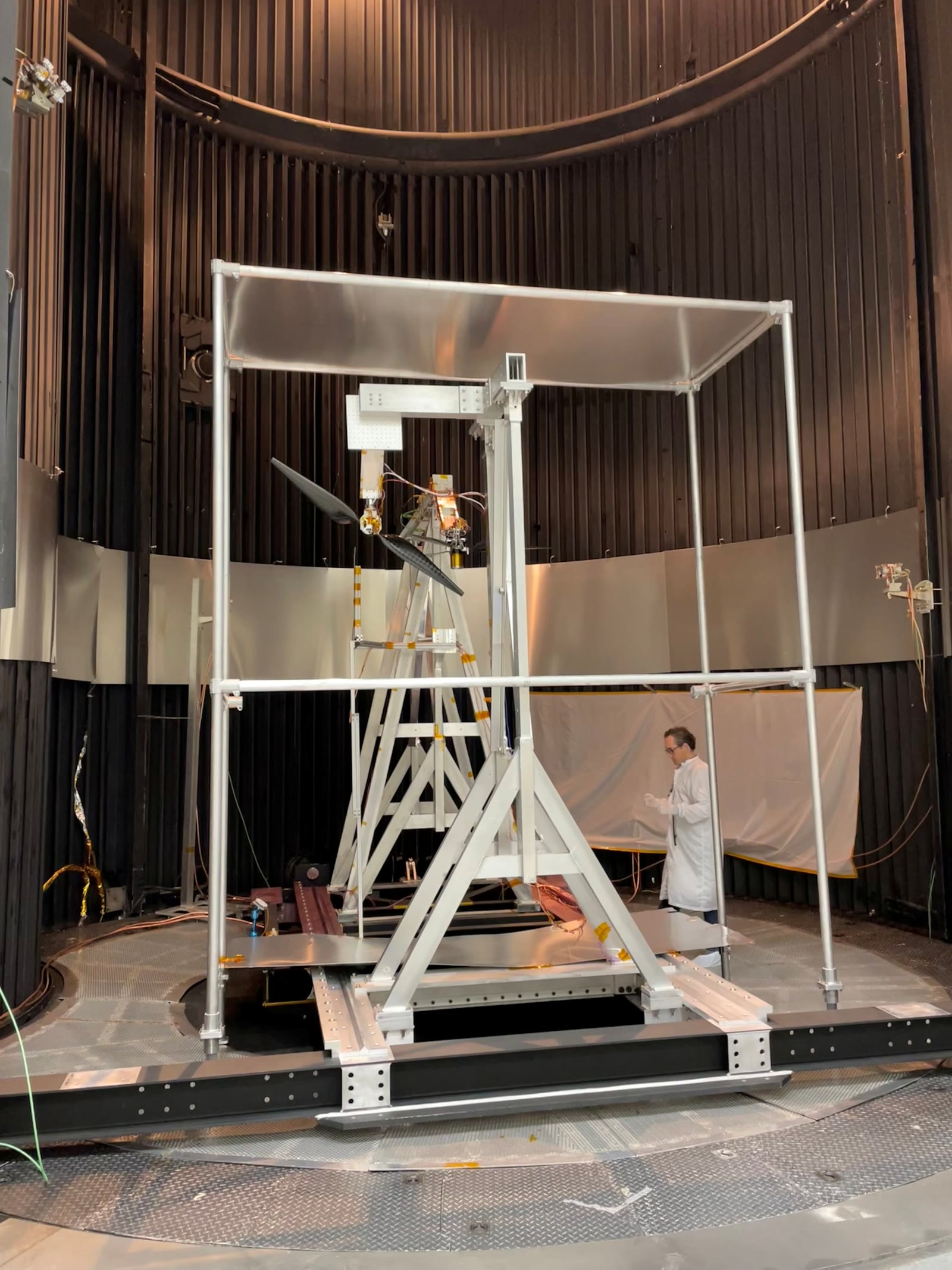
Image context: the cover uses JPL's event-specific chamber photograph showing engineer Fernando Mier-Hicks inspecting the rotor test stand inside the 25-Foot Space Simulator.[6] That is the right visual here because the file has entered a hardware-and-test phase. A concept illustration would describe the ambition; this photo documents the actual engineering step.
Fact file
| Item | What is live now | Confidence note |
|---|---|---|
| New rotor-test result | JPL said on May 7, 2026 that next-generation Mars-helicopter rotor tips reached Mach 1.08 during March chamber tests.[1] | High; direct from the current JPL release. |
| Test scale | NASA says the team gathered data from 137 test runs in Mars-like conditions inside the 25-Foot Space Simulator.[1] | High; direct source. |
| Lift effect | JPL says the supersonic-tip test increased the vehicle's lift capability by 30%.[1] | High; direct source. |
| Prior baseline | In 2023, JPL said earlier next-generation blade tests had reached about Mach 0.95 and 3,500 rpm.[4] | High; direct prior JPL report. |
| Ingenuity ceiling | JPL says Ingenuity's team kept its rotor speed at or below 2,700 rpm to avoid sonic-edge physics and preserve gust margin.[1] | High; current release. |
| Why the chamber matters | NASA says the 25-Foot Space Simulator was built in 1961, is 25 feet wide and 85 feet tall, and can reproduce Mars-like conditions including an atmosphere less than 1% as dense as Earth's.[4][5] | High; JPL and NASA facility pages align. |
| Payload relevance | NASA's Mars Science Helicopter concept describes a follow-on rotorcraft able to carry 2 to 5 kilograms of payload as an aerial scout.[2] | High; direct NASA concept page. |
Why Mach 1 matters on Mars
Mars does not let engineers solve the lift problem cheaply. JPL's current explainer is blunt: more thrust comes from spinning faster or going larger in diameter, and Mars' atmosphere is only about 1% as dense as Earth's.[1] That forces rotorcraft designers toward the edge of the acoustic envelope. On Earth, many small rotors never need to flirt with the sound barrier because there are far more air molecules to push around.[1] On Mars, designers do not have that luxury.
That is why the current result changes the discussion. The 2023 JPL update had already shown that next-generation carbon-fiber blades, longer and stronger than Ingenuity's, could run near Mach 0.95 in the same chamber.[4] The May 2026 result moves beyond "near" and into a tested supersonic regime, with headwinds added inside the chamber and peak rotor speeds climbing to 3,750 rpm for one design.[1] The value is not that future Mars helicopters get to boast about breaking Mach 1. The value is that engineers now have stronger empirical footing for mission studies that ask for heavier science payloads, larger batteries, and longer low-altitude scouting runs.
NASA's own concept material shows why that matters. The six-rotor Mars Science Helicopter concept is framed as a more capable follow-on to Ingenuity, with 2 to 5 kilograms of payload capacity for instruments and scouting over terrain that rovers cannot easily reach.[2] Once a rotor system can generate more lift margin, those concept studies stop depending quite so heavily on optimistic assumptions. They begin to lean on measured hardware behavior.
What this still does not prove
The result is meaningful, but it is still a chamber result. JPL says the team is continuing to dig through the data, and the work mainly proves that the blades can survive and produce more thrust at the tested speeds under simulated Martian conditions.[1] That is a major step, yet it is not the same as proving a full aircraft can navigate dust, land repeatedly, manage power, preserve thermal margins, and keep its guidance stable across real Martian terrain.
Ingenuity itself is the reminder. NASA's mission page shows how much off-world learning had to happen after the first flight: what began as a short demonstration kept expanding its speed, altitude, and operational role over dozens of flights.[3][4] In other words, Mars aviation does not end at rotor performance. Rotor performance is one gate in a much longer chain.
There is also still a mission-definition gap. NASA's Mars Science Helicopter remains a concept page, not an approved flagship with a fixed payload manifest and launch slot.[2] JPL's May 7 release says the new data have already been fed into performance specifications for future designs, including the recently announced SkyFall project.[1] That is important because it ties the test to actual planning work. It is still planning work.
Decision impact by horizon
Next 24 hours
The immediate adjustment is analytical. After this test, the question around Mars rotorcraft shifts away from whether supersonic blade-tip speeds are automatically disqualifying and toward what new lift margin buys mission designers.[1][2]
Next 30 days
Watch whether NASA or JPL publishes deeper performance detail on efficiency, control limits, or payload tradeoffs. The hardware milestone is real; the next useful layer is how much of the added thrust survives into a full mission architecture.[1]
Into the 2028 planning window
The real policy-and-program question is whether rotorcraft stay in the concept lane or attach to a concrete Mars mission with named instruments, mass budgets, and schedule protection. This test strengthens the case for the latter. It does not settle it.[1][2]
Scenarios
- Base case: NASA uses the new rotor data to harden the performance assumptions behind future Mars-aircraft studies, making rotorcraft a more credible payload carrier without yet committing a flight mission.[1][2]
- Upside case: the Mach-1.08 result translates into a formally defined Mars helicopter mission with clearer payload scope and a firm place in a late-2020s architecture.[1][2]
- Downside case: the blades have passed one key chamber test, but integration, autonomy, power, or mission-priority tradeoffs keep rotorcraft in the concept-and-demonstration lane longer than advocates hope.[1][3][5]
Action checklist
- For space-policy watchers: update the frame from "Mars helicopters are possible" to "NASA is now testing whether they can become genuinely useful payload carriers."[1][2][3]
- For mission and science readers: separate rotor success from mission approval. The test improves the engineering case; it does not by itself create a launch commitment.[1][2]
- For anyone tracking Mars architecture: watch for the next documents that attach instrument mass, power budgets, and route-planning roles to these higher-performance rotor assumptions.[1][2][5]
- Invalidation condition: if later data show the thrust gains create unacceptable control, vibration, or systems-level penalties, the headline value of the Mach-1 result narrows quickly.[1][4]
Sources
- NASA Jet Propulsion Laboratory, "NASA Pushes Next-Gen Mars Helicopter Rotor Blades Past Mach 1" (May 7, 2026).
- NASA Science, "Model of Proposed Mars Science Helicopter" (December 12, 2022).
- NASA Science, "Ingenuity Mars Helicopter" mission page (accessed May 9, 2026).
- NASA Jet Propulsion Laboratory, "NASA Uses Two Worlds to Test Future Mars Helicopter Designs" (November 22, 2023).
- NASA, "25-Foot Space Simulator" facility page (accessed May 9, 2026).
- NASA Jet Propulsion Laboratory, "NASA Sends Mars Helicopter Blades Beyond Mach 1" image page (May 6, 2026).