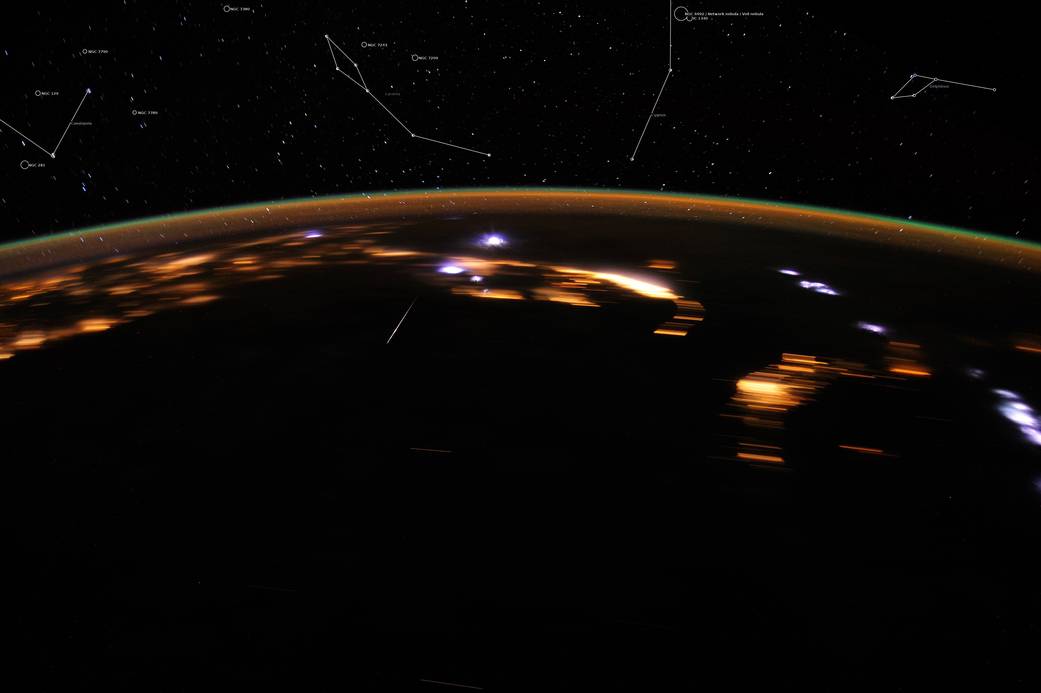
As of 2026-04-21 16:31 UTC, the 2026 Lyrid meteor shower was moving into its practical viewing window. NASA's monthly skywatching guide points observers east from about 10 p.m. local time on April 21 and through the night into April 22, while the American Meteor Society and International Meteor Organization put the ideal maximum near 19:40 UTC on April 22.[1][2][3]
That timing creates the central news value: the astronomical peak falls in daylight for much of North America, so the useful opportunity is not "watch all night and expect a storm." It is a narrower dark-sky bet around the predawn hours, after the radiant climbs, after the crescent Moon sets, and only where local cloud cover cooperates.[2][4][5]
Fast Facts
| Item | What is known | Confidence note |
|---|---|---|
| Peak period | NASA highlights April 21-22; AMS and IMO put the ideal maximum near 19:40 UTC on April 22.[1][2][3] | High for the predicted window; meteor-shower maxima can shift by hours. |
| Expected rate | IMO lists ZHR 18 for the April Lyrids, with variability; AMS frames a normal dark-sky peak around 10-15 meteors per hour plus background meteors.[2][3] | Medium for what casual viewers will see, because ZHR is an idealized dark-sky measure. |
| Viewing direction | NASA says look east near Vega in Lyra; AMS says meteors can appear across the sky and longer streaks often show away from the radiant.[1][2] | High for radiant guidance; exact meteor positions cannot be predicted. |
| Moon factor | AMS says the 2026 crescent Moon sets during the early morning as the radiant reaches useful elevation.[2] | High for broad moonlight conditions; local moonset varies by location. |
| Parent body | NASA, AP, Space.com, and IMO identify the source as debris from comet C/1861 G1 Thatcher.[1][3][4][5] | High for shower identity. |
What Changes Tonight
The Lyrids are a modest annual shower with an unusually clean 2026 setup. They do not carry the rate expectations of the Perseids or Geminids, and the IMO calendar says there are no modeled predictions for a special 2026 outburst from Comet Thatcher's trail.[3] The advantage this year is simpler: moonlight is less of a spoiler than it was in 2025, and the radiant rises high enough before dawn for northern observers to have a real observing window.[2]
The practical takeaway is to treat the shower as a timing problem. A viewer stepping outside at 10 p.m. may catch a few upward-moving meteors from a low northeastern radiant, but the geometry improves later. AMS recommends viewing as late as possible, with 4-5 a.m. local daylight time best when the radiant is highest.[2] NASA's simpler public guidance starts the watch in the east around 10 p.m. and carries it through the night into April 22.[1]
The rate number needs care. IMO's ZHR 18 does not mean every backyard viewer gets 18 meteors each hour. Zenithal hourly rate assumes a dark sky, a high radiant, and good visibility across the sky.[3] AP's public-facing summary puts the likely show in the 10-20 shooting-stars-per-hour range under favorable skies, while Space.com repeats the ZHR 18 figure and stresses the predawn geometry: the radiant climbs, but sunrise eventually brightens the sky.[4][5] City light, haze, nearby buildings, phone glare, and short viewing sessions all cut into the real count.
Who Should Care
Casual skywatchers should care because the 2026 Lyrids offer a relatively low-friction spring target: no telescope, no binoculars, and no special gear. The better move is basic discipline. Get away from city lights, let eyes adjust for at least 15-30 minutes, keep the phone down, and scan a wide stretch of sky rather than staring straight at Vega.[2][4][5]
Astrophotographers should care because AMS says Lyrids tend to produce bright meteors and occasional fireballs, while warning that the shower is not especially photogenic unless cameras run time exposures during maximum activity.[2] NASA's 2012 ISS image captures the appeal and the limitation at once: a probable Lyrid can be spectacular, but it is still one brief streak in a large sky.[6]
Citizen-science observers have a different reason to watch. IMO says timing and rate data help refine knowledge of meteoroid streams, and AMS gives a concrete observing discipline: record session times, meteor times, magnitude, color, velocity, persistent trains, and fireballs.[2][3] A quiet session still has scientific value when reported carefully, especially for a shower whose peak timing and duration vary from year to year.[3]
Next 24 Hours
The base case is a modest, watchable shower: a handful to perhaps a dozen-plus Lyrids per hour for patient observers under dark skies, with better odds after midnight and before dawn. The upside case is a brief above-normal patch, since the Lyrids have a history of variability and the IMO notes past outbursts, including a short-lived ZHR near 90 in 1982.[3] There is no 2026 model signal for that outcome, so it belongs in the surprise bucket, not the forecast.
The downside case is ordinary spring weather and light pollution. Space.com's viewing guide shows why local conditions can dominate the global headline: the radiant geometry improves toward morning, but sunrise, clouds, buildings, and skyglow all reduce the actual result.[5] A cloudy sky invalidates the plan immediately; a hazy suburban sky lowers the count even if the shower itself performs on schedule.
Action Checklist
Go out late, not early. Use 10 p.m. as the earliest reasonable start, then prioritize midnight to dawn if sleep and weather allow.[1][2]
Face generally east or northeast, then widen your gaze. Vega and Lyra help orient the radiant, but the longer trails can show farther away from that point.[1][2]
Choose darkness over convenience. AP and Space.com both emphasize getting away from city lights and giving your eyes time to adjust.[4][5]
Set expectations before you go. Under good conditions, the forecast is a modest spring meteor shower, not a continuous sky show. The plan fails if clouds arrive, if the local horizon is blocked, or if the site is too bright to show faint streaks.
Sources
- NASA Science, "What's Up: April 2026 Skywatching Tips from NASA" (March 26, 2026).
- American Meteor Society, "Viewing the Lyrids in 2026" (April 2026).
- International Meteor Organization, 2026 Meteor Shower Calendar, edited by Jurgen Rendtel, April Lyrids section.
- Associated Press, "Where and when to see the Lyrid meteor shower peak" (April 18, 2026).
- Space.com, "Lyrid meteor shower 2026: When, where & how to see it" (last updated April 16, 2026).
- NASA, "Stunning Lyrids Over Earth at Night" (May 18, 2012), image article and photo credit.