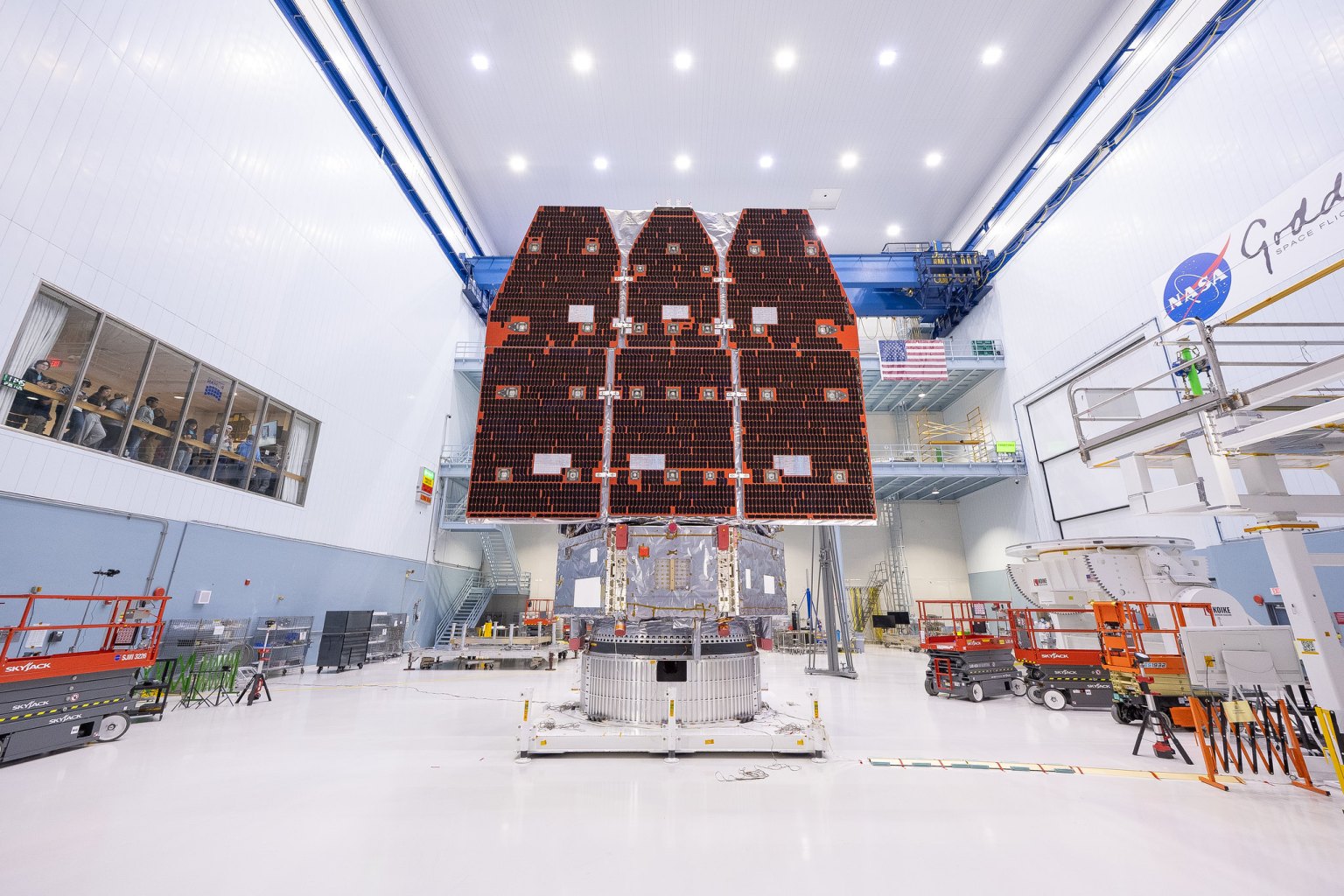
As of 2026-04-21 01:31 UTC, NASA was preparing to open Goddard Space Flight Center's largest clean room to media for one of the last public looks at the fully integrated Nancy Grace Roman Space Telescope before shipment to Kennedy Space Center. The scheduled April 21 briefing is framed as an unveiling, but its sharper meaning is operational: Roman has entered the short, unforgiving phase where a flagship telescope becomes a launch campaign rather than a development program.[1]
That distinction matters. NASA says Roman completed construction after technicians joined its two major segments at Goddard in November 2025, then passed major environmental checks in early 2026: electromagnetic interference, vibration, and acoustic testing. The agency is still carrying a formal commitment to launch no later than May 2027, while saying the team is working toward a launch as early as fall 2026.[1][2][3]
Fast Facts
| Item | What is known | Confidence note |
|---|---|---|
| Live event | NASA invited media to Goddard for Tuesday, April 21, with a 4 p.m. EDT briefing streamed by the agency.[1] | High for schedule and participants; article published before the briefing occurred. |
| Hardware status | Roman is fully assembled after integration of its inner and outer portions at Goddard.[2] | High for construction milestone; flight readiness still depends on remaining launch-site work. |
| Test status | NASA reported that Roman passed electromagnetic interference, vibration, and acoustic assessments, including sound levels up to 138 decibels during acoustic testing.[3] | High for NASA-reported test sequence; final launch readiness remains a later program decision. |
| Launch path | NASA awarded SpaceX a launch services contract for Falcon Heavy from Launch Complex 39A, with launch service and related mission costs listed at about $255 million.[6] | High for contract baseline; launch date can still move with spacecraft and range schedules. |
| Science payload | Roman carries a Wide Field Instrument and a Coronagraph Instrument technology demonstration.[4] | High for payload description. |
| Survey model | NASA says three core surveys will use up to 75% of the five-year primary mission, with remaining time available through broader community programs.[5] | High for published survey design; execution depends on commissioning and on-orbit performance. |
Why the clean-room moment matters
The Roman telescope has always been sold through a scale comparison: Hubble-like sharpness across a much wider patch of sky. NASA's public mission page describes a 2.4-meter primary mirror, the same diameter as Hubble's, paired with a Wide Field Instrument that can image at least 100 times Hubble's field of view.[4] That is a communications-friendly line, but the April 21 event is about a harder question: can a survey machine this large survive launch, reach operations, and deliver data at the tempo its science case assumes?
Roman's value is not one spectacular first image. It is repeatable coverage. NASA's construction update says the mission is expected over its first five years to reveal more than 100,000 distant worlds, hundreds of millions of stars, and billions of galaxies, while its Wide Field Instrument could produce about 20 petabytes of data over the primary mission.[2] Numbers that large change the management problem. The limiting issue becomes less "can one team point a telescope at one famous object?" and more "can the observatory, archive, and science community turn a flood of uniform observations into reliable public data products?"
That is why the test news is central. The vibration and acoustic checks are not ceremonial engineering theater. A telescope built for faint infrared signals has to tolerate the violence of launch without introducing damage, contamination, misalignment, or electronic noise that later shows up as bad science. NASA's March report makes that chain explicit: engineers powered on electronics to check emissions, shook the observatory on a large table to simulate launch vibration, then exposed it to acoustic loads meant to stand in for the rocket environment.[3] Passing those tests does not guarantee a smooth launch, but failing them would have changed the calendar immediately.
The science clock is already running
Roman's program is unusually dependent on decisions made before launch because its core science is survey architecture. NASA's 2025 survey-design announcement says the three core surveys are intended to cover no more than 75% of the primary mission. The High-Latitude Wide-Area Survey alone includes a design spanning more than 5,000 square degrees in just under a year and a half, with a main component around 2,500 square degrees.[5] Those are not decorative specs. They describe the production logic of the mission.
For dark energy and dark matter work, Roman needs wide, repeated, statistically useful measurements across cosmic time. For exoplanets, its microlensing campaign depends on dense monitoring of the Milky Way's center, where background stars can briefly brighten as an intervening object bends their light.[2][4][5] In both cases, the telescope's promise comes from cadence, field size, calibration, and public comparability. A single heroic pointing cannot substitute for the planned survey fabric.
The Coronagraph Instrument adds a different kind of risk and reward. NASA describes it as a technology demonstration for directly imaging planets around nearby stars by suppressing starlight.[4] In the construction update, NASA says coronagraph observations are planned for three months spread across the first year and a half of operations.[2] That makes the coronagraph less like the main production engine and more like a bridge to future habitable-world missions. If it performs well, Roman changes the technology baseline for later exoplanet imaging. If it underperforms, the wide-field survey mission can still be scientifically decisive.
What changes after April 21
The base case is administrative momentum. After the media event, the useful signals are shipment timing to Kennedy, completion of launch-site processing, confirmation of the launch readiness review path, and whether the earliest fall 2026 target remains credible.[1][2][3] The telescope is close enough to launch that schedule language now carries more information than ceremonial language.
The upside case is that Roman reaches Kennedy with the major environmental-risk items retired, preserves the fall 2026 opportunity, and begins commissioning soon enough for early survey operations to become a 2027 science story rather than a late-2027 schedule story. That would matter beyond NASA public affairs. The astronomy community has already organized survey designs, data expectations, and general-investigator pathways around Roman's open-data model.[2][5]
The downside case is narrower but real: remaining integration, transport, contamination control, launch-vehicle scheduling, or commissioning issues could push the mission toward the May 2027 commitment date. That would not invalidate Roman. It would change the timing of when astronomers get a new wide-field infrared survey platform and when technology lessons from the coronagraph can feed future mission design.
Watch Items
Watch first for NASA's post-briefing wording. If officials continue to emphasize fall 2026 without adding new caveats, the event will read as a genuine readiness signal. If the language shifts back toward "by May 2027," the clean-room reveal will look more like a morale marker than a schedule marker.[1][2]
Watch second for shipment to Kennedy. Roman's next public milestone is not another beauty shot; it is the move from Goddard testing culture to launch-site processing culture.[2]
Watch third for how NASA describes data access as launch nears. Roman's no-exclusive-use data policy means the mission's political and scientific value depends on broad community uptake, not just one internal science team.[2][5]
The falsifier for the optimistic reading is concrete: if Roman clears the public unveiling but then stalls before Kennedy shipment or launch-site readiness, April 21 will have marked the end of assembly publicity rather than the beginning of a launch campaign. If the next milestones arrive on time, the photo from Goddard will deserve to be read differently: as the moment NASA began handing a finished survey machine from engineers to the calendar.
Sources
- NASA, "NASA to Unveil Complete Roman Telescope, Host Media Briefing" (March 26, 2026; last updated March 27, 2026).
- NASA, "NASA Completes Nancy Grace Roman Space Telescope Construction" (December 4, 2025; last updated December 11, 2025).
- NASA, "NASA's Roman Observatory Passes Final Major Prelaunch Tests" (March 19, 2026).
- NASA Science, "About the Roman Space Telescope," mission overview and instrument description.
- NASA, "NASA's Roman Mission Shares Detailed Plans to Scour Skies" (April 24, 2025).
- NASA, "NASA Awards Launch Services Contract for Roman Space Telescope" (July 19, 2022; last updated September 29, 2023).