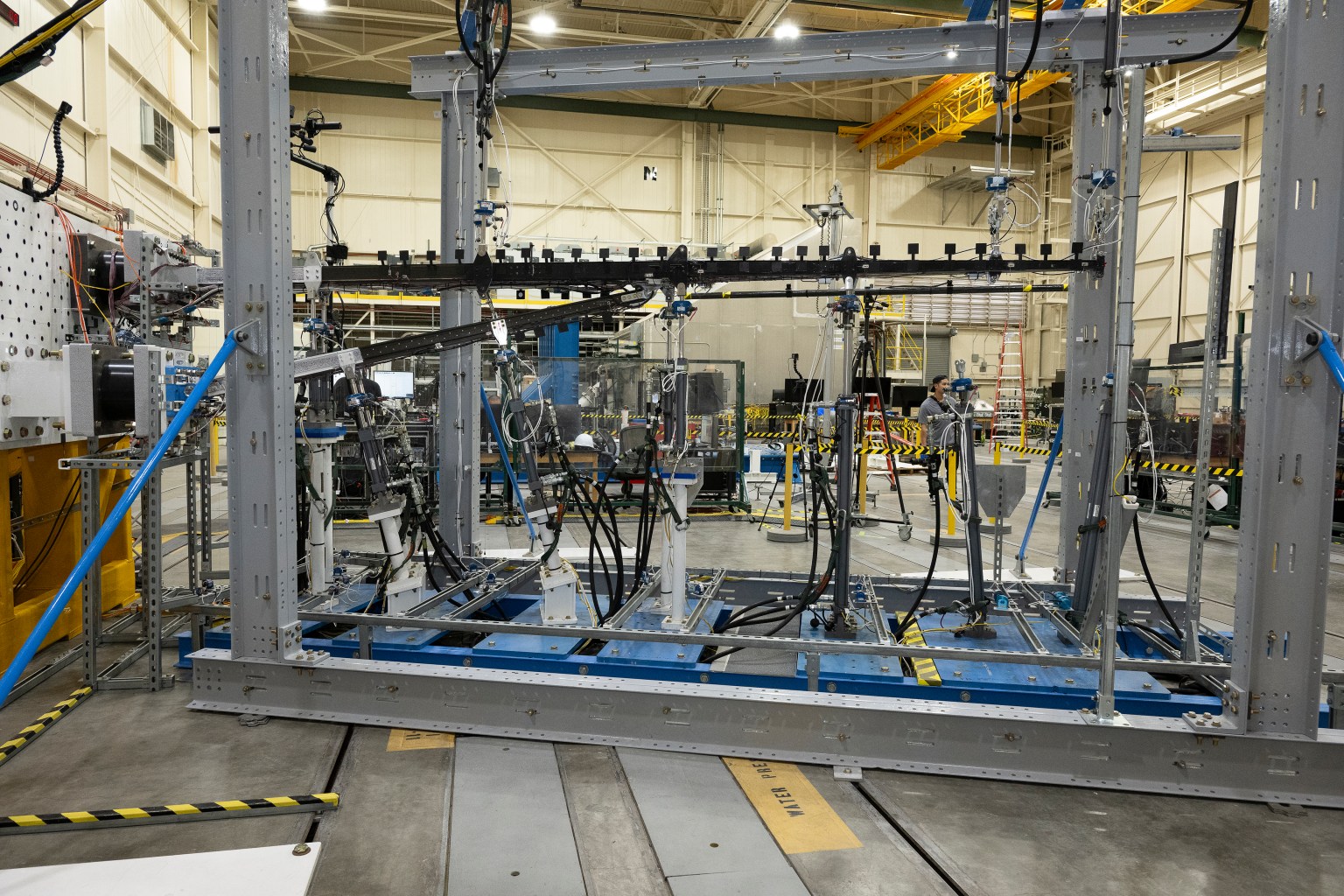
As of 2026-07-18 09:37 UTC, NASA says a 15-foot composite truss-braced wing called SWEET-15 carried its anticipated in-flight loads without issue, tracked the agency's computer predictions, and reached reported failure at roughly 127% of its design limit load. Visible damage appeared near the wing's trailing edge and upper cover during a deliberate test to failure.[1]
That is an encouraging structural experiment. It is not a certification result, proof of a 27% safety cushion, or evidence that a production airliner is ready. NASA's public release does not identify the governing load case behind the percentage, publish the load-versus-strain curves, or define whether “failure” means first visible damage, local loss of stiffness, or loss of load-carrying capability.[1]
The useful news is narrower and more interesting: a representative composite truss-braced configuration has now been bent beyond its expected flight envelope, and its measured behavior reportedly matched the model well enough to give the team confidence in unfamiliar joints and manufacturing methods. The next decision turns on whether the detailed record supports that summary.
What The Public Record Establishes
| Timestamp / record | Verified signal | Confidence boundary |
|---|---|---|
| NASA release, July 17 | SWEET-15 is a 15-foot composite wing article supported by a main strut and a smaller jury strut. NASA says it withstood anticipated flight forces and that sensor data confirmed computer-model predictions.[1] | High confidence that NASA reported this outcome. The release contains no raw measurements or uncertainty bands for independent review. |
| Test-to-failure result | NASA reports failure at roughly 127% of design limit load, with visible damage near the trailing edge and upper wing cover.[1] | High confidence in the published percentage; lower confidence in what readers should infer because the release does not name the normalized load case or the test's formal failure criterion. |
| Pre-test design record | A NASA technical presentation describes SWEET-15 as an 18.6%-scale article designed around +2.5-g and -1.0-g maneuver loads, with a 1.5 factor of safety under strength and buckling constraints.[2] | High confidence in the design study. It is a pre-test description and does not show that its 1.5 factor and the release's 127% use the same baseline, load distribution, boundary condition, or stopping rule. |
| Manufacturing claim | NASA says five advanced composite manufacturing and assembly technologies were combined in the article. The earlier design study reports a 6.4% upper-cover-panel weight reduction from tow steering.[1][2] | Directionally strong for the test article. No production-rate, recurring-cost, repairability, or airline-service result follows from it yet. |
| Aerodynamic programme | NASA and Boeing separately completed high-lift wind-tunnel work on a related truss-braced-wing concept; full analysis was still under way in April.[3] | Structural and aerodynamic tests reduce different risks. Success in one cannot stand in for success in the other. |
Why 127% Is Not A Standalone Verdict
Aircraft structures use several load concepts that headlines can flatten into one number. FAA guidance for transport-category airplanes distinguishes limit loads—the maximum expected in service—from ultimate loads, which ordinarily apply a 1.5 factor of safety. The structure must avoid detrimental permanent deformation at limit load and support ultimate load without failure for the required test interval.[5] Proof of structure can combine analysis and testing, but the analytical method has to be shown reliable and substantiating tests must be sufficient to verify the relevant behavior.[6]
SWEET-15 is a research article, not an applicant's complete certification demonstration. That boundary matters twice.
First, the NASA technical record says the article was designed with a factor of safety of 1.5, while the new public release says failure occurred at roughly 1.27 times “design limit load.”[1][2] Those statements look comparable, but the available pages do not prove that they are. The reported failure could refer to first local damage rather than ultimate collapse; the applied laboratory pattern may represent one structural case rather than the paper's maneuver-load envelope; or “design limit” may be normalized differently in the public summary. Without the test plan and curves, declaring either a shortfall or a 27% success margin would be an inference beyond the evidence.
Second, a long, thin truss-braced wing is a coupled system. Its promise comes from aerodynamic efficiency and lightweight structure working together. Its development burden includes low-speed lift, transonic flow, aeroelasticity, gust response, fatigue, icing, joints, manufacturing consistency, inspection, repair, airport geometry, and integration with an aircraft. NASA's April wind-tunnel report explicitly treats high-lift aerodynamic testing as another step in a larger evidence stack, not as a finished answer.[3]
The most defensible reading of 127% is therefore procedural: engineers reached a controlled damage event, measured where it began, and can now compare the observed load path with their predictions. The percentage becomes decision-grade only when NASA says precisely what was loaded, how the article was restrained, which signal triggered “failure,” and how the result compares with each pre-test prediction.
The Real Experiment Is The Load Path
The truss is not decoration. A very long wing can reduce induced drag, but slenderness makes structural weight and bending harder to manage. The main strut and jury strut create alternate paths for carrying those forces. Their joints also become places where complex geometry, composite layups, fasteners or bonded interfaces, and concentrated loads meet.
NASA says the destructive phase supplied evidence about the joints linking the wing, main strut, and jury strut.[1] That is more useful than a spectacle of a wing breaking. A credible model should predict not only the headline load but the sequence: where strain accumulates, when stiffness changes, where local damage initiates, and whether load redistributes as intended.
SWEET-15's manufacturing route makes that comparison especially consequential. The design study used curved fiber paths, or tow steering, to put composite material where the loads required it and reported a lighter upper-cover design.[2] NASA says the article combined five composite processes and used the ISAAC robotic system developed at Langley for lighter, stronger composite structures.[1][8] If the measured failure sequence matches the model, that supports both the structural idea and the ability to manufacture the intended fiber architecture. If it does not, engineers need to know whether the miss came from analysis, fabrication variability, assembly, or the test fixture.
The sensor system is part of that evidence chain. NASA describes its Fiber Optic Sensing System as a way to gather thousands of distributed measurements along a very thin optical fiber and to infer wing shape and structural stress.[7] Distributed sensing can reveal a changing strain field that a few conventional gauges might miss. The new release says SWEET-15 used fiber-optic strain sensors, but it does not yet publish what they saw.[1]
What Changes Over 24 Hours, 7 Days, And 30 Days
Next 24 hours: editors, analysts, and programme stakeholders should preserve the experiment's actual boundary. The accurate line is that NASA reports model-consistent behavior through anticipated flight loads and damage at about 127% of a stated design limit. “The wing passed certification,” “the design has a 27% safety margin,” and “the wing failed below its required ultimate load” are all unsupported by the public record.[1][2][5]
Next 7 days: the highest-value release would be a technical note identifying the critical load case, fixture and boundary conditions, loading rate, first-damage definition, peak load, residual capacity, strain-field comparison, and model error. Photographs of the damaged trailing edge would help, but plots and definitions would do more analytical work.
Next 30 days: the Subsonic Flight Demonstrator programme should show how SWEET-15 changes the next test article or airframe trade. NASA defines the programme's purpose as maturing technologies with a high probability of moving into a next-generation single-aisle airliner.[4] A useful update would connect this subscale structural result to larger integrated tests and explain how it joins the separate aerodynamic work.[3][4]
Three Paths From The Test Rig
Base path — a model-validation milestone. Detailed analysis confirms that the measured strain field and damage location broadly matched predictions, while local design changes are carried into the next article. Trigger: NASA publishes correlation results with bounded model error and no major surprise in the primary load path.
Upside path — manufacturing and analysis mature together. Tow-steered covers and truss joints repeat their predicted behavior across additional load cases and specimens, supporting a larger integrated demonstration without a large weight penalty. Trigger: repeat tests show consistent initiation sites, strain patterns, and manufacturing quality, followed by a dated larger-scale test plan.[1][2]
Downside path — the percentage hides a transfer problem. Detailed inspection finds earlier-than-predicted local damage, an unexpected joint failure, or strong sensitivity to fixture, scale, or manufacturing variation. That would not make the truss-braced concept impossible, but it would weaken the claim that the present model and process are ready to scale. Trigger: a redesign materially changes the load path, or the programme adds unplanned structural tests before integration.
The Checklist That Keeps The Claim Honest
- Ask “127% of which load case?” before repeating the number.
- Separate first visible damage, loss of stiffness, peak supported load, and complete structural failure.
- Compare measured strain and deflection with pre-test predictions, not only the final load.
- Keep structural strength separate from fatigue, aeroelastic, aerodynamic, icing, manufacturing-rate, repair, and certification evidence.
- Treat fuel and operating-cost benefits as the concept's potential; SWEET-15 did not measure airline fuel burn.[1][3]
- Invalidation condition: revise this report's cautious assessment if NASA publishes a test definition and correlation package showing that 127% maps directly to a named requirement and that all governing predictions and acceptance criteria were met. Revise it in the other direction if the detailed record shows an unpredicted or premature critical failure.
SWEET-15 matters because NASA did something more valuable than preserve a pristine prototype: it loaded an unfamiliar structure until the model had to meet the material world. The public result says that meeting was encouraging. The load-case key will show exactly how encouraging.
Sources
- Sarah Mann, NASA Armstrong Flight Research Center, “NASA Pushes New Wing Design to Find Structural Limits” (July 17, 2026) — primary test report, 127% result, damage location, sensors, manufacturing summary, and source page for Carla Escamilla's documentary cover photograph.
- Brian H. Mason et al., NASA Technical Reports Server, “Structural Sizing of a Tow-Steered Truss-Braced Wing Box Test Article” (AIAA SciTech 2025) — scale, maneuver-load assumptions, safety factor, structural optimization, and tow-steered weight result.
- NASA, “NASA, Boeing Advance Truss-Braced Wing Research in Test” (April 29, 2026) — related high-lift wind-tunnel programme, aerodynamic evidence boundary, and continuing analysis.
- NASA, “Subsonic Flight Demonstrator Project” (updated March 10, 2026) — programme purpose, leadership, and intended transition toward next-generation single-aisle aircraft.
- Federal Aviation Administration, AC 25-21: Certification of Transport Category Airplanes — guidance on 14 CFR 25.303 and 25.305, including limit loads, the ordinary 1.5 factor of safety, ultimate loads, and strength/deformation requirements.
- Federal Aviation Administration, AC 25.307-1: Proof of Structure (active advisory circular, October 7, 2014) — how analysis and substantiating tests support transport-airplane structural compliance.
- NASA, “Fiber Optic Sensing System Readied for Space Use” (June 22, 2020) — distributed fiber-optic measurement of wing shape, strain, and structural stress.
- NASA Langley Research Center, “NASA Langley Debuts ISAAC — an ‘Impressive Machine’” (January 26, 2015) — primary background on the robotic advanced-composites manufacturing system used in the SWEET-15 process.