As of 2026-10-27 09:34 UTC, Europe's CRISTAL ice-monitoring satellite has passed its first solar-panel deployment test and launch-adapter checks, ESA reported on October 26. Assembly finished in September at Airbus in Friedrichshafen, Germany. Launch remains targeted for late 2027 to early 2028, with environmental testing still ahead.[1]
The milestone brings a new polar measuring system closer to flight. Its scientific promise rests on a deceptively difficult task: telling how much snow sits on sea ice, so researchers can better estimate the thickness of the ice underneath.[4][5]
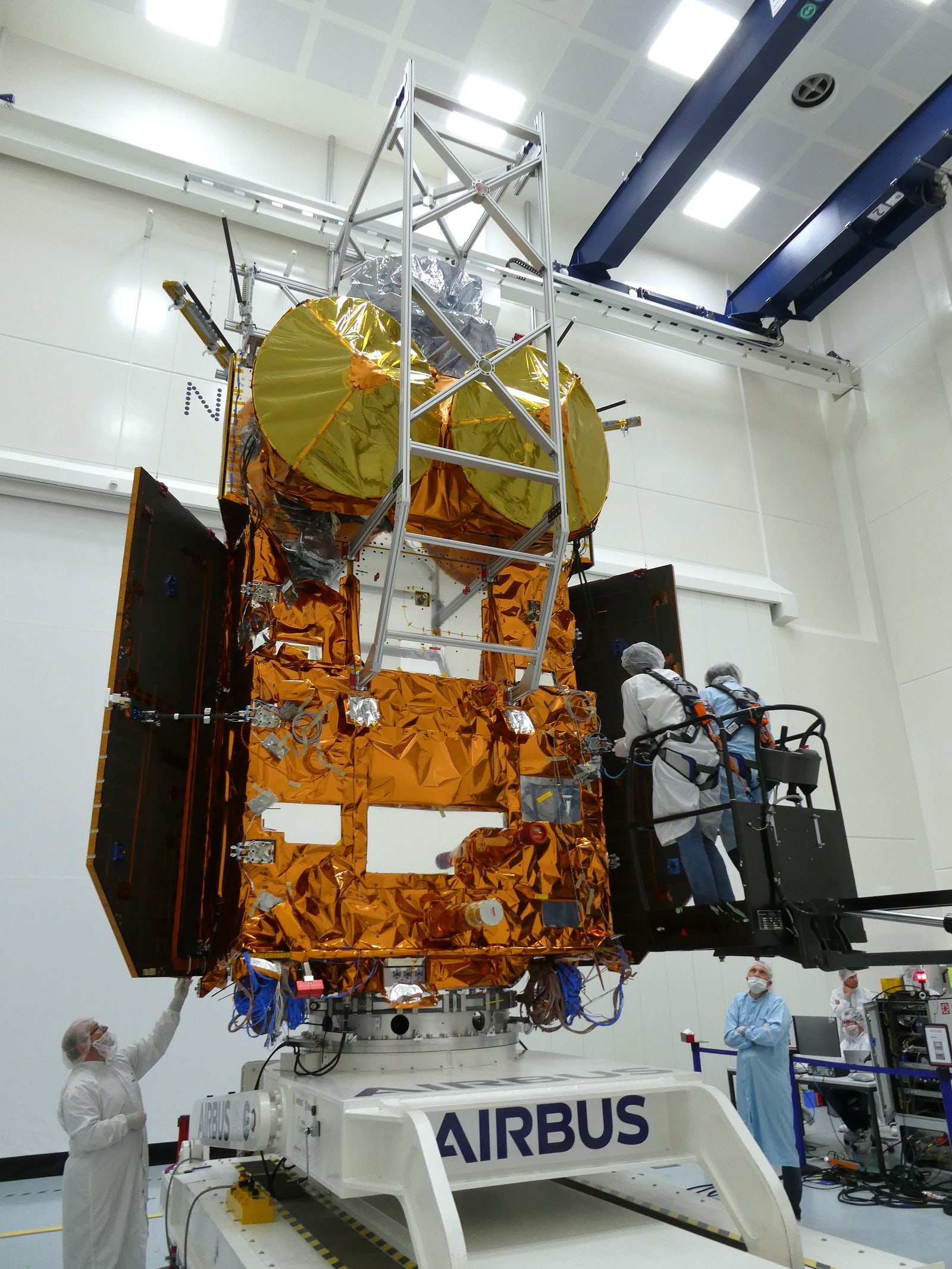
What has been checked
Three dated milestones establish the sequence:
| Milestone | Published evidence | Status |
|---|---|---|
| Solar arrays delivered | SpaceTech's August 21 announcement says it supplied the arrays to Airbus.[3] | Supplier-reported delivery. |
| Satellite assembled | ESA dates completion to September.[1] | Assembly milestone. |
| Deployment and separation checks | ESA's October 26 account reports successful tests involving the solar wings and launch adapter.[1] | Ground tests; qualification continues. |
The arrays supply electricity for the instruments, onboard systems and communications. Their manufacturer, SpaceTech, describes delivery as a step in integration.[3] ESA's subsequent deployment test checked the interaction of mechanisms and software sequences; the adapter work, conducted with launch provider Avio, checked fit and release.[1] These are distinct problems: supplying power after arrival and separating successfully from the rocket that carries the spacecraft there.
Next comes a move to ESA's Netherlands establishment, where the satellite is expected to spend most of 2027 undergoing environmental tests.[1] ESA's description of its ESTEC Test Centre explains the purpose of that work: shaker tables reproduce launch vibration, acoustic facilities reproduce launch noise, and vacuum chambers expose hardware to space-like temperatures and pressure.[6] A mechanism that opens successfully in a cleanroom has cleared one hurdle. The wider campaign asks whether the assembled spacecraft can survive the journey and function in its operating environment.
Why the snow measurement matters
CRISTAL's IRIS radar instrument will operate at two frequencies, Ku and Ka. The Centre for Polar Observation and Modelling explains that using both is intended to support simultaneous estimates of snow depth and sea-ice thickness, alongside measurements of ice-sheet elevation.[4]
Snow complicates the calculation because a radar echo's interaction with the snow layer affects the inferred height of the ice surface. The mission's peer-reviewed scientific rationale identifies snow as a major source of uncertainty in sea-ice thickness estimates. Two frequencies offer additional information about that layer, although snow and ice densities still require estimates from other means.[5] Better instrumentation therefore improves the evidence available for the calculation; interpreting it remains a scientific task.
That work has been developing alongside the hardware. In June 2025, CPOM reported progress on CLEV2ER, a project building prototype processing software for land ice and inland water, together with research into uncertainty and radar penetration.[4] For researchers preparing to use CRISTAL, software readiness belongs on the same watchlist as spacecraft readiness.
The next checkpoints
The following are conditional interpretations, not project forecasts:
- Base case: the environmental campaign proceeds, with successful results supporting the present launch target.
- Upside: test results and progress on scientific processing give prospective users firmer grounds for planning data use.
- Downside: a test anomaly requires repair or repeat testing, or the launch target changes; either would invalidate an assumption of uninterrupted progress.
For mission followers, the immediate task is to retain the October announcement as a dated baseline. Over the next week, watch for a transfer or test-campaign update. Over the next month, researchers can review preparation of the processing methods relevant to their work. Those are monitoring horizons, not announced deadlines.
- Record assembly, environmental qualification and launch as separate milestones.
- Replace the current schedule if ESA publishes a revised target.
- Require published validation evidence before treating anticipated measurement improvements as demonstrated performance.
Sources
- European Space Agency, “Ice mission CRISTAL opens its wings” (October 26, 2026) — assembly, deployment checks and current schedule.
- European Space Agency, “Testing CRISTAL's solar panel deployment” (October 26, 2026) — photograph and Airbus credit.
- SpaceTech, “SpaceTech Solar Arrays for ESA's CRISTAL Mission” (August 21, 2026) — supplier account of delivery and power-system purpose.
- Centre for Polar Observation and Modelling, “CRISTAL, CLEV2ER and Kuka – the next generation of satellite sensing technology” (June 24, 2025) — instrument and processing research; historical schedule superseded by source 1.
- Michael Kern and colleagues, “The Copernicus Polar Ice and Snow Topography Altimeter (CRISTAL) high-priority candidate mission,” The Cryosphere 14 (2020), 2235–2251 — sections 4.1–4.2 on snow and thickness uncertainty.
- European Space Agency, “About ESTEC Test Centre” — general environmental-testing facilities and purpose.