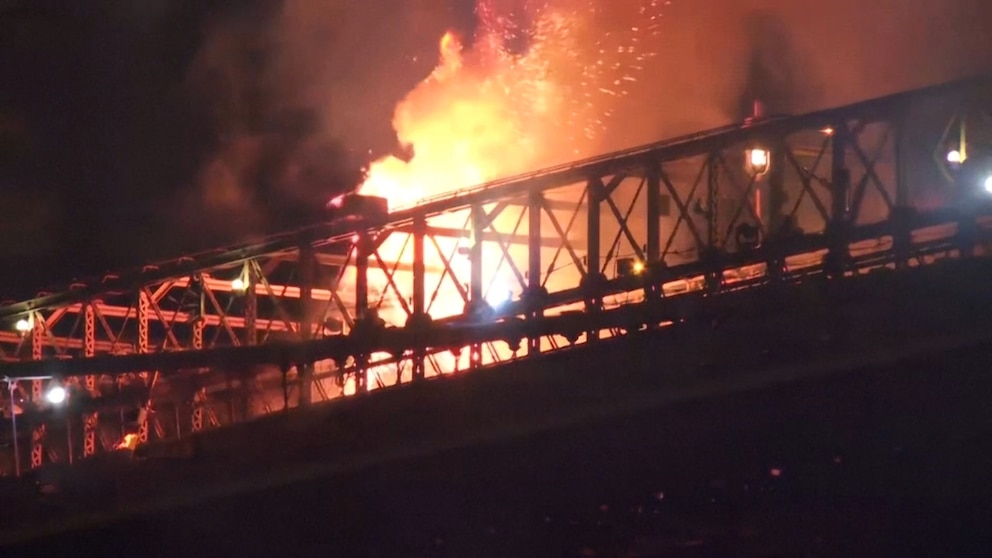
As of 2026-07-05 10:33 UTC, the most important fact about the Brooklyn Bridge fire is not the flame in the photograph. It is the distance between the flame and the crowd. A fire broke out during New York City's July Fourth fireworks show, produced visible smoke, and was extinguished by firefighters; no injuries were reported.[1][2] The bridge had already been closed to vehicles, pedestrians, and bicycles for the event, while official viewing areas and park closures pushed spectators into controlled zones away from the pyrotechnic corridor.[3][4][5]
That makes this a contained incident with an unsettled cause line, not a proven structural emergency. AP reported that two fire engines were used and that firefighters were seen dousing flames shortly before 10 p.m.; WABC reported the fire broke out after 9:30 p.m. on the Manhattan-bound side and was likely caused by the display.[1][2] The useful public-safety lesson is narrower: major urban fireworks are engineered around the assumption that things can go wrong, so closure perimeters, entry screening, and crowd placement are not ceremonial friction. They are the safety system.
Image context: the cover image is a real AP photograph from video of the fire during the July 4, 2026 celebration. It is used because the article is about visible fire risk and crowd separation at the actual event. It is not a diagram, chart, or generated image.[1]
Fact File
| Timestamp / source | Key signal | Confidence note |
|---|---|---|
| AP report, July 4-5 | A fire broke out on the Brooklyn Bridge during the July Fourth fireworks show; no injuries were reported; two fire engines were used; firefighters doused flames shortly before 10 p.m.[1] | High for observed incident and no-injury report as of publication; later inspection findings could add detail. |
| WABC local report, July 5 | The fire broke out after 9:30 p.m. on the Manhattan-bound side and was likely caused by the display.[2] | Useful local timing and preliminary cause language; "likely" should stay provisional unless officials publish a final cause. |
| NYC street-closure notice | The Brooklyn Bridge was scheduled to close at 8 a.m. on July 4 for vehicles, pedestrians, and bicycles and not reopen until July 5.[3] | High for official event operations; actual reopening can vary with incident response and inspection. |
| Brooklyn Bridge Park event page | The fireworks launched from the Brooklyn Bridge and East River barges; the park was closed all day until ticketed entry at 4 p.m.; screening and prohibited-item rules applied.[4] | High for official public-facing crowd-management plan. |
| NYC Mayor's Office, June 26 | The city announced 100,000 free tickets for prime viewing areas at Brooklyn Bridge Park and the Seaport, with additional non-ticketed viewing along the FDR Drive.[5] | High for planned access model; final crowd behavior depends on weather, transit, and enforcement. |
Decision Impact
Next 24 hours: the bridge story should be read through response and inspection, not through viral video alone. If officials continue to report no injuries and no structural compromise, the incident remains a contained fire within a planned exclusion zone. If DOT, FDNY, or NYPD later report structural damage, delayed reopening, or a broader pyrotechnic malfunction, the risk frame changes.[1][2][3]
Next 7 days: event planners will care less about whether a flame was photogenic and more about whether the perimeter worked. The bridge closure, Brooklyn Bridge Park ticketing, Seaport access, FDR viewing, ferry suspension, screening rules, and prohibited-item list together show a system designed to keep spectators out of the hazard lane before anything catches fire.[3][4][5]
Next 30 days: the question becomes whether bridge-launched fireworks return unchanged. The strongest argument for keeping them is that the public was already kept away and the fire was extinguished without reported injuries. The strongest argument for revision is that a visible fire on a 19th-century bridge creates enough public confidence risk to require new limits, more suppression staging, different launch hardware, or a tighter inspection protocol before the next major show.[1][2][4]
Scenarios
Base case: officials treat the fire as an expected class of event risk that was contained by closure distance and response staffing. The bridge reopens after checks, and the lesson is operational: keep spectators away, keep fire crews staged, and do not relax closure rules just because the event is familiar.[1][3][4]
Upside case: the incident becomes a useful public example of why access control matters. Visitors who complained about closed paths, ticketing, ferry shutdowns, or screenings can see the reason in one frame: the unsafe area was on the bridge, while the public was outside it.[3][4][5]
Downside case: later findings show the fire involved more than rubbish or a temporary launch platform, or that inspection found heat damage requiring repair. That would turn the story from "crowd buffer worked" into "bridge use for pyrotechnics needs redesign."[1][2]
Action Checklist
- For readers: separate spectacle from confirmed harm. Fire and smoke were visible, but the current reported injury count is zero.[1][2]
- For city agencies: publish a short after-action note that separates ignition cause, response time, bridge condition, reopening decision, and any required vendor changes.
- For event operators: keep closure maps and prohibited-item rules easy to find before the event, because those rules are most persuasive after people can see what they prevented.[3][4]
- For editors: avoid saying the bridge "caught fire" in a way that implies confirmed structural damage unless an official inspection supports that stronger claim.
- Invalidation condition: this brief's read fails if an official inspection identifies major bridge damage, if injuries are later reported, or if investigators determine the fire came from a non-event source unrelated to the fireworks setup.
The practical takeaway is that the safety plan should be judged by the gap it created. The fire was real, visible, and alarming. But the bridge closure and viewing-zone discipline meant the public was not standing under the problem when it happened. In a city-scale fireworks show, that is not an incidental detail. It is the point of the plan.[1][3][4][5]
Sources
- Associated Press, "Fire breaks out on Brooklyn Bridge during New York's fireworks show" (July 4-5, 2026) - incident report, no-injury statement, fire-engine response, bridge closure note, and source page for the AP image used in this article.
- WABC / ABC7NY Eyewitness News, "Fire breaks out on Brooklyn Bridge amid Macy's fireworks display" (July 5, 2026) - local timing, location, likely display-related cause, and no-injury note.
- New York City, "4th of July Fireworks Street Closures" PDF (July 4, 2026) - official bridge, street, sidewalk, and traffic restrictions for the event.
- Brooklyn Bridge Park, "Macy's 4th of July Fireworks" - official park access, closure, screening, ferry, launch-site, and prohibited-item information.
- New York City Mayor's Office, "Mayor Mamdani Announces 100,000 Free Tickets to Watch Macy's Fourth of July Fireworks Along Brooklyn and Manhattan Waterfront" (June 26, 2026) - public access plan and official viewing-area context.