As of 2026-07-04 21:33 UTC, the United States is marking 250 years since the Declaration of Independence under three pressures at once: heat that has altered outdoor events, a harbor spectacle that requires security-zone discipline, and a political climate in which celebration and doubt are sharing the same stage.[1][2][5]
The visible birthday is large: fireworks, parades, naturalization ceremonies, World Cup crowds, Coney Island hot dogs, tall ships moving past the Statue of Liberty, and military aircraft over New York Harbor.[1][4] The operational story is narrower and more useful. A national commemoration that was meant to feel expansive is being measured by shade, medical capacity, crowd control, maritime standoff distances, and whether civic symbolism can hold together under polarized interpretation.[1][2][3][5]
The uncertainty boundary is also clear. Weather alerts and Coast Guard rules are high-confidence official information. Crowd mood, political meaning, and claims about national unity are softer signals. Treat images of full waterfronts or empty sidewalks as weather-conditioned snapshots, not as a final referendum on the country.
Fact Line
| Timestamp / source | What changed | Confidence note |
|---|---|---|
| AP, July 4 | The 250th anniversary opened with nationwide celebrations, triple-digit heat in parts of the East, a canceled main Independence Day parade in Washington, tall ships in New York, World Cup-linked festivities in Philadelphia and Houston, and naturalization ceremonies at Mount Vernon.[1] | High for observed events; lower for any broad claim about national mood from individual scenes. |
| NWS/WPC, issued 1959Z July 4 | The Weather Prediction Center said dangerous heat would persist across much of the eastern U.S. through the holiday weekend, with highs broadly in the mid-90s to around 105 F and peak heat indices of 100-115 F.[2] | High for official forecast framing; local conditions can change quickly with storms and frontal timing. |
| Coast Guard final rule, May 18 | The Federal Register rule for Sail 4th 250 and International Naval Review 250 put temporary local regulations, security zones, suspended anchorage changes, spectator areas, and paddlecraft-only areas in effect for the July 1-9 window.[3] | High for regulatory and operational guidance. |
| Sail4th 250 organizers | Organizers described the New York Harbor program as an international maritime spectacle built around tall ships, naval vessels, aerial events, and public viewing through the July 3-9 period.[4] | High for event-scope planning; final on-water participation depends on weather, security, and vessel readiness. |
| AP polling context | AP reported that about 4 in 10 U.S. adults felt proud about the 250th anniversary and about 3 in 10 felt excited, while many also felt indifferent or conflicted.[5] | Useful for mood context, but polling cannot predict turnout or event behavior in a heat wave. |
The Day Became An Operations Test
The first constraint is the weather. AP reported that Washington's main Independence Day parade was canceled while a smaller Capitol Hill parade went ahead in the shade, and that celebrations along the East Coast had to adjust as temperatures approached or passed triple digits.[1] The WPC forecast makes the risk more than anecdotal: heat indices in the 100-115 F range turn long outdoor waits into public-health events, especially for children, older adults, workers, and visitors standing near pavement, security gates, and transit choke points.[2]
That changes how to read attendance. A thinner-than-expected parade route may show heat avoidance rather than apathy. A waterfront crowd that looks strong may indicate successful shade, water, transit, and medical planning as much as patriotic intensity. The same logic applies to Philadelphia's World Cup overlap and Houston's stadium celebration, where the patriotic moment is moving through sports infrastructure that already has gate control, seating, concessions, and emergency protocols.[1]
The second constraint is New York Harbor. This is the most photogenic part of the anniversary, but it is not just a picture. The Coast Guard's final rule puts the scale into operational terms: temporary special local regulations, security zones, suspended anchorage changes, spectator areas, paddlecraft-only areas, and access conditioned by capacity, safety, vessel type, and size.[3] That is the real shape of Sail 250. The harbor has to function as a ceremonial stage, a security perimeter, a transportation system, and a crowded recreational waterway at the same time.
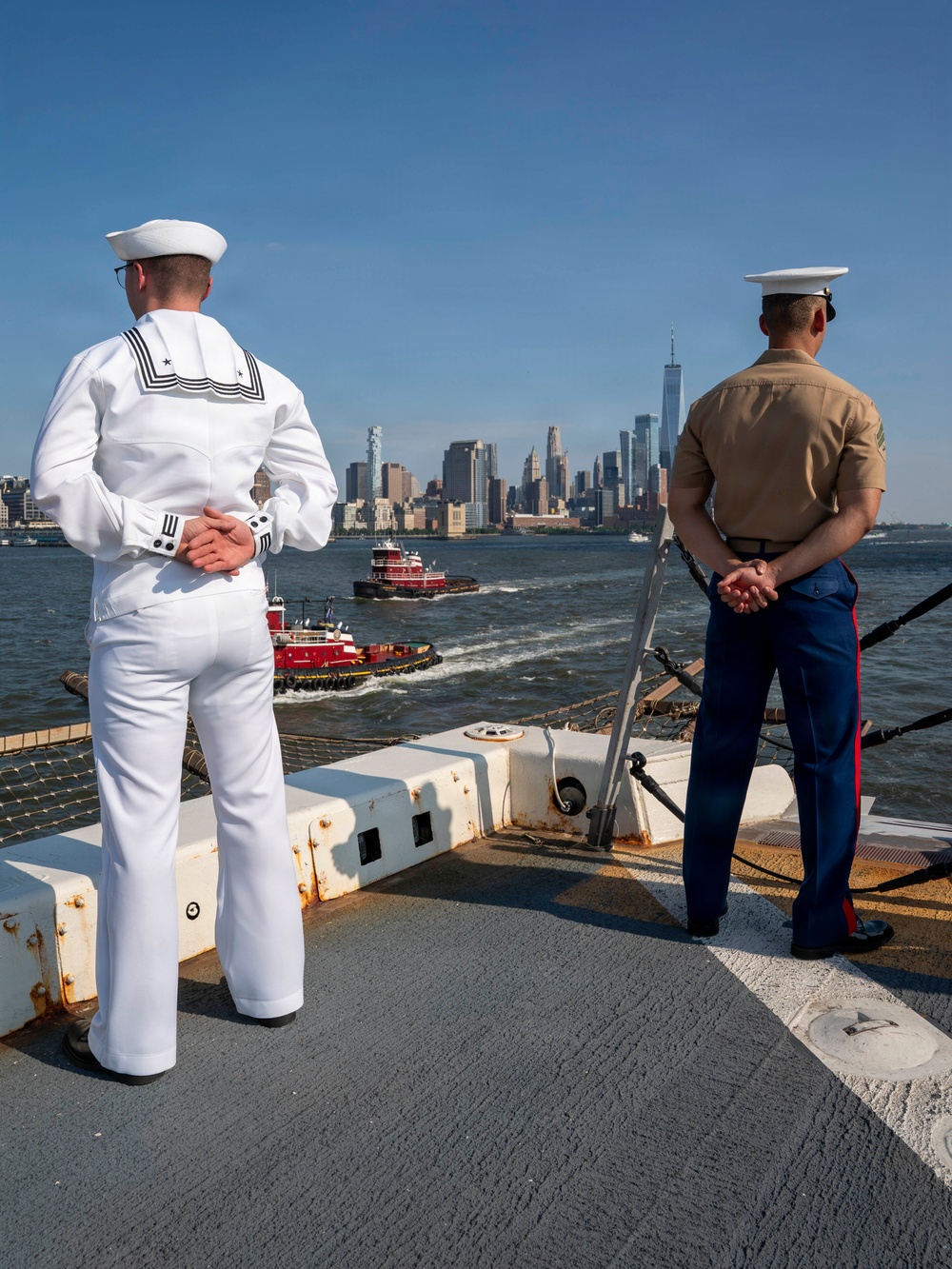
Sail4th 250 organizers explain why the harbor has become the center of gravity. Their New York program runs through the July 3-9 period and ties the Parade of Sail, International Naval Review 250, aerial events, visiting ships, and public viewing into one compressed calendar.[4] The image of USS Arlington entering the harbor on June 30 is useful because it shows the event before the fireworks: uniformed personnel, deck discipline, tug traffic, Manhattan in the distance, and the physical waterway that has to absorb the spectacle.[6]
The Political Meaning Is Not Settled
The 250th was always going to invite argument. AP's national report describes celebrations unfolding against an election-year backdrop of deep division around race, class, immigration, political expression, and the country's own founding ideals.[1] Its polling coverage gives that mood a numeric floor: pride and excitement are real, but so are indifference, disappointment, and conflict over what the anniversary should mean.[5]
That makes the day politically sensitive without making every event partisan. A naturalization ceremony at Mount Vernon, a family waiting for fireworks, a fan dressed as a Founder outside a World Cup match, and a military flyover over the Hudson are not the same kind of civic act.[1] They belong to different publics. The anniversary works only if it has room for all of them without pretending the conflict has vanished.
The main mistake is to confuse spectacle with consensus. Fireworks can draw a crowd without settling the argument over history. A presidential speech can dominate the news cycle without owning the meaning of the holiday. A harbor review can project national strength while the Coast Guard guidance quietly reminds everyone that order depends on specific rules, spacing, and compliance.[3][4]
Decision Impact
Next 24 hours: event operators should treat heat and severe-weather updates as first-order programming decisions, not background conditions. The practical measure of success is not only whether fireworks launch, but whether emergency medical calls, transit crowding, harbor violations, and storm interruptions stay within manageable bounds.[1][2][3]
Next 7 days: New York's continuing July 3-8 harbor program is the measurable file. If public viewing, vessel tours, security zones, and aerial programming continue without major maritime incidents, the city and federal agencies can claim the country's most visible semiquincentennial event worked as logistics, not just pageantry.[3][4]
Next 30 days: the political afterlife will matter. Campaigns, civic groups, museums, veterans organizations, immigrant-rights groups, and local officials will all point to different pictures from the weekend. The strongest reading will separate operational facts from symbolic claims: what was canceled, what stayed safe, who showed up, who stayed away because of heat, and which images became durable political shorthand.[1][5]
Scenarios
Base case: the weekend is remembered as a strained but functioning commemoration. Heat forces adjustments, New York Harbor remains controlled, and the national story stays mixed: pride, spectacle, discomfort, and political argument all visible at once.[1][2][3][5]
Upside case: the operational story improves the symbolic one. Heat plans hold, maritime rules are followed, and the most durable images are civic rather than partisan: new citizens, tall ships, families under fireworks, and local celebrations that feel larger than Washington.[1][3][4]
Downside case: the weather or security story overtakes the anniversary. A serious heat-casualty cluster, severe storm disruption, harbor-zone breach, or major political confrontation would shift the frame from national birthday to public-safety failure.[2][3]
Action Checklist
- For attendees: check local heat and thunderstorm warnings before leaving, build in shade and water stops, and treat long security lines as part of the exposure time.[2]
- For boaters in New York Harbor: follow the Coast Guard's temporary rules, local notices, and spectator-area limits; smaller vessels should seriously consider shore viewing when crowding or weather increases risk.[3]
- For editors and analysts: do not overread a single crowd image. Pair it with heat index, transit status, event cancellations, and official safety restrictions.[1][2][3]
- For civic groups: preserve the distinction between commemoration and consensus. The anniversary can be widely observed and still politically contested.[5]
- Invalidation condition: this report's base read fails if a major medical, maritime, weather, or security incident becomes the dominant national memory of the weekend.[2][3]
The cleanest read is that America 250 is not behaving like one unified national birthday party. It is a live stress test of public celebration under heat, harbor density, security management, and democratic disagreement. The fact that the day contains all of those at once is not a side note. It is the story.[1][2][3][5]
Sources
- Steven Sloan, Associated Press, "Fireworks, heat, hot dogs and politics: America celebrates its 250th birthday" (July 4, 2026) - national celebration, heat disruptions, New York harbor procession, Coney Island contest, naturalization scenes, and polarization frame.
- NOAA/NWS Weather Prediction Center, "Short Range Forecast Discussion" issued 1959Z July 4, 2026 - heat indices, thunderstorm risk, and weekend weather boundary.
- Federal Register, U.S. Coast Guard, "Special Local Regulation, Temporary Anchorage Ground Suspension, and Security Zones: Sail 4th 250, International Naval Review 250; Port of New York and New Jersey" (May 18, 2026) - July 1-9 rules, security zones, spectator areas, paddlecraft-only areas, and anchorage changes.
- Sail4th 250, "With 50 Days to Go, New York Harbor Gets Ready for an Historic Maritime Spectacle for the Nation's 250th" - event scope, Parade of Sail, International Naval Review 250, vessel participation, and public viewing context.
- Associated Press, "How US adults feel about America 250, according to new polls" (June 2026) - public mood and AP-NORC/Gallup polling context.
- DVIDS, U.S. Navy photo by Mass Communication Specialist 3rd Class Greggory Fisher, "USS Arlington (LPD 24) Enters The New York Harbor [Image 7 of 7]" (photo taken June 30, 2026) - source page for the article photograph.