As of 2026-07-05 16:35 UTC, the immediate news is not that the Lincoln Memorial Reflecting Pool is still politically messy. It is that Interior Secretary Doug Burgum says the Trump administration will not reopen the repair work to new bidders and will keep using the same company as the pool is at least partly drained again.[1]
That choice raises the standard of proof. If officials are going to explain the latest repair cycle as vandalism plus touch-up work rather than a failed procurement and execution process, the public now needs evidence, scope, cost, and schedule in the same file. The story has moved beyond whether the blue surface looked good in photographs.
The strongest boundary is uncertainty. AP reports that Burgum said vandals caused the damage and that President Trump has described cuts totaling hundreds of feet; AP also reports that Burgum did not answer directly when asked whether photographic evidence exists.[1] Treat vandalism as an official claim under legal and factual development, not as a settled explanation for every visible problem.
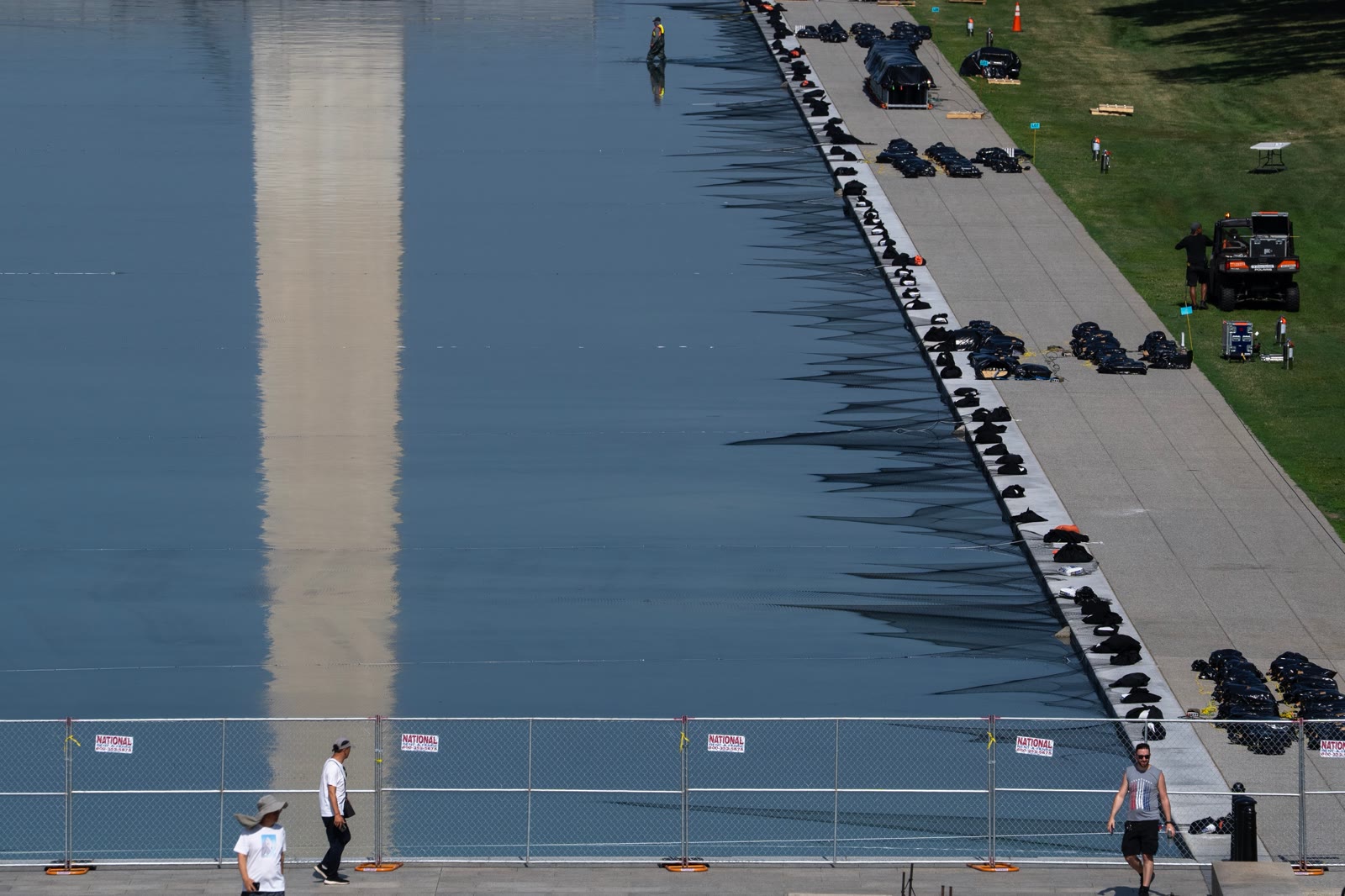
Image context: the cover image is real photojournalism of the Reflecting Pool site just before the July Fourth anniversary events. It is used because the article is about public closure, repair governance, and work around the actual pool, not an abstract federal-spending concept.[1]
Fact Line
| Timestamp / source | Key signal | Confidence note |
|---|---|---|
| AP, July 5 | Burgum said the administration will not seek new bids, will use the same company, and expects at least partial draining in the coming week to finish repairs.[1] | High for the statement and current administration position; lower for the ultimate cause of damage until evidence and court records are clearer. |
| AP, July 5 | Federal prosecutors have charged former Olympian David Hearn with property destruction; Hearn's lawyers deny wrongdoing and call the case politically motivated.[1] | High that the legal conflict exists; culpability is unresolved and belongs to the court process. |
| NPS record, updated May 19 | The Park Service authorized temporary closures beginning April 10 for cleaning, joint repair, and installation of lining material, with an initial window running to June 10 unless extended.[4] | High for official closure rationale; it does not resolve whether later problems came from workmanship, algae, vandalism, or some mix. |
| ABC News, May 12 | ABC reported that contract records showed costs nearing $15 million, with resurfacing and filtration contracts awarded without competitive bidding under an urgency rationale tied to the 250th anniversary.[2] | High for reported contract-record summary; exact obligations can change with modifications and later repair orders. |
| ABC/AP, June 24 | Congressional Democrats demanded investigations into what AP called a problem-plagued $16 million rehabilitation project and noted that no evidence had then been released to substantiate vandalism claims.[3] | High for the oversight dispute and lack-of-public-evidence status then; later indictments add legal process but do not answer all technical questions. |
| House Oversight Democrats, June 24 | A letter to Atlantic Industrial Coatings requested documents on vetting, contracting, qualifications, cost estimates, repairs, and the firm's prior work, while alleging the contract was noncompetitive and worth more than $14 million.[6] | Useful as an oversight demand and allegation record; it is not neutral engineering proof. |
What Changed
The July 5 decision compresses several disputes into one accountability test. A project can survive an embarrassing bloom, a peeled surface, or a vandalism case if officials can show a clean chain: what was specified, who was hired, what failed, who damaged what, what repairs are required, what they cost, and why the same contractor remains the best option.[1][2][3][6]
Right now, those files are not equally public. The government has visible outcomes: closures, fencing, algae reporting, repair claims, and legal accusations.[1][3][4] It also has procurement questions: why the work skipped ordinary competition, how urgency was defined, how costs moved, and whether contractor selection matched the technical problem.[2][6] The analysis should not collapse those into one verdict. A vandalism case, even if proved, would not automatically explain prior algae and coating issues. A troubled procurement, even if proved, would not automatically disprove separate vandalism.
That distinction matters because the Reflecting Pool is not a minor decorative basin. The National Park Service describes it as one of Washington's most recognizable and filmed sites and a key feature of the Lincoln Memorial landscape.[5] Its public value is symbolic, but its operating problem is mundane: water, lining, joints, filtration, heat, algae, surface durability, and visitor control have to work together. When a civic symbol is treated like a deadline-driven venue improvement, technical claims need to be unusually plain.
The administration's own closure record made the work sound limited and protective: clean the pool, repair joints, and install lining material, with closures described as limited in scope and time.[4] That frame is harder to sustain when the pool becomes the subject of repeated draining, congressional letters, no-bid questions, criminal allegations, and a decision to keep the same contractor without testing the market again.[1][2][3][6]
Decision Impact
Next 24 hours: the most important document is not a speech clip. It is a repair scope. If the pool is partly drained this week, officials should specify what is being repaired: liner cuts, peeled coating, joint failure, algae treatment, fireworks-related safety cleanup, or some combination.[1][4]
Next 7 days: the administration's no-rebid position creates a performance clock. Keeping the same contractor is defensible only if the repair is narrow, fast, documented, and clearly distinct from earlier execution problems. If the work expands, the no-bid rationale becomes harder to separate from a sunk-cost choice.[1][2][6]
Next 30 days: oversight will move from outrage to records. The durable questions are procurement and proof: contract modifications, invoices, incident reports, photographs or video of alleged damage, treatment logs, coating specifications, and any independent inspection of what actually failed.[3][6]
Scenarios
Base case: officials release enough evidence to show a limited vandalism repair layered on top of an otherwise serviceable project. The same contractor completes the work, the pool reopens, and the controversy becomes a procurement-and-communications fight rather than an infrastructure failure.[1][2][6]
Upside case: the draining creates a clean public record. Photos, repair logs, and contract documents separate intentional damage from workmanship, algae, and ordinary maintenance. That would not erase the no-bid dispute, but it would make the operational problem legible.[1][3][4][6]
Downside case: the repair scope keeps expanding, evidence remains selective, and the pool needs more work after the same contractor is retained. In that scenario, the vandalism narrative starts to look less like an explanation and more like a shield against procurement scrutiny.[1][2][3][6]
Action Checklist
- For federal officials: publish a short repair memo with cause categories, photographs, contractor responsibility, expected cost, and reopening criteria.
- For congressional overseers: ask for the contract file, not only the headline amount: solicitation rationale, selection notes, modifications, inspection records, and payment milestones.[2][6]
- For reporters: separate legal accusations against named defendants from engineering explanations for algae, coating, and liner performance.[1][3]
- For readers: treat "vandalism" and "failed repair" as hypotheses that can both be partly true until records show otherwise.
- Invalidation condition: this analysis fails if officials produce comprehensive evidence proving that nearly all post-reopening problems came from discrete vandalism after a technically sound project, or if court filings show the repair story is materially different from current public reporting.[1][3]
The useful question is no longer whether the Reflecting Pool should be blue. It is whether a high-visibility national site can be repaired under deadline pressure while still giving taxpayers a visible evidence chain. If the answer is yes, the records should be easy to release. If the answer is no, keeping the same contractor without a new competition turns a cosmetic controversy into a governance story.[1][2][4][6]
Sources
- Steve Peoples, Associated Press, "Trump's administration won't seek new bids to repair the Lincoln Memorial Reflecting Pool" (July 5, 2026) - current no-rebid decision, Burgum statements, vandalism claim, Hearn case, and source page for the AP photograph used in this article.
- Katherine Faulders and Peter Charalambous, ABC News, "Cost of Lincoln Memorial reflecting pool repairs nearing $15M" (May 12, 2026) - contract-record reporting, urgency rationale, no-competition note, and cost escalation context.
- Matthew Daly, Associated Press via ABC News, "Lawmakers demand answers as turmoil over Reflecting Pool repair continues" (June 24, 2026) - congressional investigation demands, reported project problems, no-evidence boundary at that point, and contract amounts.
- U.S. National Park Service, "Reflecting Pool Renovations ROD" (last updated May 19, 2026) - official closure scope, repair purpose, lining work, and temporary-closure rationale.
- U.S. National Park Service, "Lincoln Memorial Reflecting Pool" - official place page describing the pool's landscape role and public significance.
- House Committee on Oversight and Government Reform Democrats, letter from Rep. Robert Garcia to Atlantic Industrial Coatings LLC (June 24, 2026) - document requests and allegations about noncompetitive contracting, cost, vetting, and repair performance.