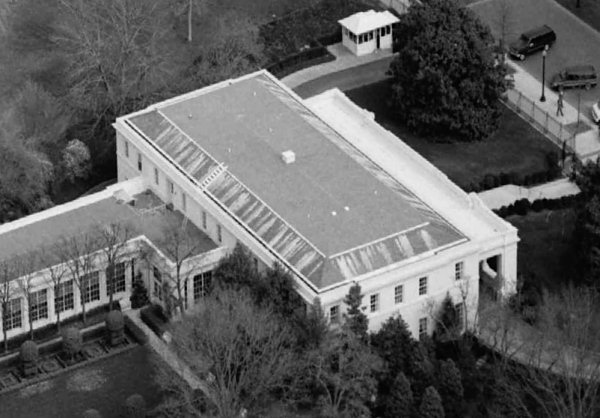
As of 2026-04-20 07:32 UTC, the White House ballroom case has moved from a construction-stop story into a compressed appellate test. The U.S. Court of Appeals for the D.C. Circuit has administratively stayed Judge Richard Leon's April 16 injunction, which means construction can continue for now, but the panel also said the stay is not a ruling on the merits and set an expedited argument for June 5, 2026.[1][2] That distinction is the whole story: work may move at the site, while the legal question has become faster and sharper rather than settled.
The case matters because two clocks now run at once. One is physical: the East Wing was demolished in October 2025, below-grade security work is already part of the record, and the administration says the project addresses event capacity and White House security.[1][3][5] The other is legal: the National Trust for Historic Preservation says the project moved ahead without the approvals and congressional authorization required for a transformation of the White House complex, while the administration argues that the president has authority to proceed and that security work cannot be neatly separated from the ballroom buildout.[3][4][7]
Fast facts
- Current procedural posture: the D.C. Circuit's April 17 order temporarily stayed the April 16 injunction and folded the stay dispute into the merits appeal.[2]
- Next hard date: appellants' opening brief and joint appendix are due May 8, the National Trust's brief is due May 27, the reply is due June 1, and oral argument is scheduled for June 5.[2]
- What the lower court tried to stop: Judge Leon's April 16 amended order blocked above-ground ballroom construction while preserving space for below-ground national-security and safety work.[4]
- What regulators already approved: the National Capital Planning Commission voted April 2 to approve preliminary and final site and building plans for the East Wing Modernization Project.[5][6]
- What remains uncertain: the administrative stay lets construction proceed temporarily, but it does not answer whether the project rests on sufficient statutory authority, whether preservation plaintiffs can keep the case alive, or how much of the build is truly security-dependent.[2][3][4]
The stay changed tempo, not the merits
The April 17 D.C. Circuit order is deliberately narrow. It says the district court's April 16 injunction is administratively stayed so the appellate court has time to consider the emergency stay request; it also warns that the stay should not be read as a merits ruling.[2] In practical terms, the administration has breathing room at the construction site. In legal terms, the court has simply prevented the injunction from taking immediate effect while it accelerates the full appeal.
That is why the June 5 date matters more than the weekend headline. AP framed the immediate effect correctly: a federal appeals court allowed construction to continue for now after Leon continued to block above-ground work the day before.[1] But the order's internal calendar is the signal. The D.C. Circuit did not slow the case down into ordinary litigation time. It compressed briefing into May and put the core dispute before the same panel in early June.[2]
The useful reading is procedural, not symbolic. The administration won time. The preservation plaintiffs kept a live merits track. Contractors may move while lawyers brief, but the court has not yet blessed the theory that private funding, presidential residence authority, or security upgrades are enough to carry the whole above-ground ballroom project.[2][3][4]
The hard split is security versus ballroom authority
The lower-court orders and the appellate record keep circling the same practical boundary: what work is needed to secure the White House now that the site has been opened, and what work is the discretionary ballroom itself. The D.C. Circuit's earlier April 15 remand order described the administration's own representations that below-grade work would not lock in the size or design of the above-grade ballroom, while also noting the government's later argument that national-security upgrades were linked to the broader project.[3]
Judge Leon's April 16 amended order tried to draw that line from the district court's side. It did not stop below-ground construction of national-security facilities, work needed for presidential security, or work necessary to protect the White House and the construction site. It did keep the injunction aimed at above-ground visible ballroom construction, the part the court treated as the source of the National Trust's claimed irreparable harm.[4]
That division is now the hinge of the appeal. If the administration persuades the panel that ballroom progress is inseparable from near-term safety, the stay logic becomes stronger. If the National Trust persuades the panel that security work can continue without locking in the ballroom, the lower court's narrower pause becomes easier to defend. My inference from the orders is that the case is no longer just about whether construction should stop; it is about who gets to define the project unit.
NCPC approval helps the project, but it does not erase the lawsuit
The administration also has an approval milestone in hand. NCPC's project page says the commission voted on April 2 to approve preliminary and final site and building plans for the East Wing Modernization Project, described as a permanent, secure event space within White House grounds to increase capacity for official state functions.[5] The commission action also notes that the U.S. Commission of Fine Arts had approved the concept and final plans at its February 19 meeting.[6]
Those approvals are material because they answer part of the process critique: the project did eventually receive a formal planning vote. But timing is why the litigation survives as more than a paperwork argument. The National Trust's complaint targeted the sequence in which demolition and construction preparation advanced before the full review track had run, and the D.C. Circuit's earlier order recited the fact pattern that the East Wing was demolished within days of the president's October 20, 2025 post that ground had been broken.[3][7]
So the question for June is not simply whether any agency has approved anything. It is whether later approval cures or narrows an earlier authority problem, whether the presidency's control over the Executive Residence reaches a privately funded 90,000-square-foot ballroom replacement, and whether Congress has a role that cannot be bypassed by treating the project as residence improvement plus security work.[3][5][6][7]
Who should care over the next 24 hours, 7 days, and 45 days
In the next 24 hours, the immediate audience is operational: White House construction managers, the National Park Service, security officials, and preservation lawyers. The administrative stay removes the most urgent stop-work pressure, but it also creates a documentation burden. Every step taken during the stay can become evidence in the June argument over whether the project was separable, security-driven, or pushed forward to create new facts on the ground.[2][3][4]
Over the next 7 days, the key audience broadens to congressional oversight staff, historic-preservation groups, and federal planners. If Congress wants to intervene politically or legally, the appellate calendar leaves little slack. The May 8 opening brief deadline means the administration's best statutory and security arguments will soon be locked into a public appellate frame.[2]
By June 5, the issue becomes constitutional and institutional. A ruling for the administration could make it easier for presidents to treat major White House residence changes as executive-controlled improvements, especially when private funding and security claims are involved. A ruling for the National Trust could force a sharper distinction between emergency security work and public, visible, historically consequential additions to federal property.[2][3][7]
Scenarios to watch
The base case is a tailored appellate ruling that keeps some work moving while forcing a clearer boundary between security necessities and above-ground ballroom construction. The trigger would be a panel decision that accepts the administration's near-term safety concerns but refuses to decide the broader statutory authority question without limits.[2][3][4]
The administration upside is a stay or merits ruling broad enough to let the project continue largely uninterrupted. The trigger would be the panel accepting Judge Rao's dissent-style view from the earlier appellate order: that standing is weak, the president has sufficient statutory room to make White House improvements, and security injury outweighs aesthetic or preservation harm.[3]
The National Trust upside is a restored or modified injunction that lets protective security work continue while stopping above-ground ballroom progress until Congress or a clearer legal authorization appears. The trigger would be a panel finding that later NCPC approval does not solve the demolition-and-authority sequence, and that visible construction creates harm that cannot be repaired after the building rises.[3][4][5][7]
The invalidation condition for this analysis is simple: if the parties settle, Congress expressly authorizes the project, or the appellate panel issues a merits ruling before June 5, the watchlist changes. Until then, the stay should be treated as a temporary permission slip, not as a final legal green light.[2]
Sources
- Associated Press, "Construction on Trump's White House ballroom can continue for now, US appeals court says" (April 18, 2026).
- U.S. Court of Appeals for the D.C. Circuit, administrative stay order in National Trust for Historic Preservation in the United States v. National Park Service, No. 26-5123 (filed April 17, 2026).
- U.S. Court of Appeals for the D.C. Circuit, remand order and Judge Rao dissent in related appeal No. 26-5101 (April 2026).
- U.S. District Court for the District of Columbia, Judge Richard J. Leon amended order, Document 72 in National Trust for Historic Preservation in the United States v. National Park Service (April 16, 2026), via Justia PDF.
- National Capital Planning Commission, "Project Information: 8733 East Wing Modernization Project" (April 2, 2026 action record).
- National Capital Planning Commission, "East Wing Modernization Project Commission Action" (April 2026 PDF).
- National Trust for Historic Preservation in the United States, amended complaint in National Trust for Historic Preservation in the United States v. National Park Service (December 29, 2025 PDF).
- Wikimedia Commons, "White House East Wing from SE in 1992.jpg," HABS photograph by Jack Boucher, National Park Service.