As of 2026-04-19 16:04 UTC, President Donald Trump's April 18 order on psychedelic treatments has opened a real federal acceleration file. It tells FDA, DEA, HHS, VA, and the attorney general to move faster on certain psychedelic-drug pathways, with ibogaine pushed to the front of the story in administration messaging and press coverage.[1][2][3] What it has not done is legalize ibogaine, deschedule psychedelics across the board, or create instant broad access for every patient with depression, PTSD, or another serious mental-health condition.[1][4][6][8]
The narrower reading matters because every major tool in the order is conditional. Breakthrough Therapy designation still applies to drugs aimed at a serious condition where preliminary clinical evidence suggests substantial improvement over available therapy.[5] Right to Try remains narrower than the headline language around "serious mental illness": FDA says eligible patients must have a life-threatening disease or condition, must have exhausted approved options, and must be unable to join a relevant clinical trial.[4] My inference from those source documents is that Saturday's order is best read as a federal speed-up directive for a small set of candidate products, not as a general psychedelic-access decree.[1][4][5]
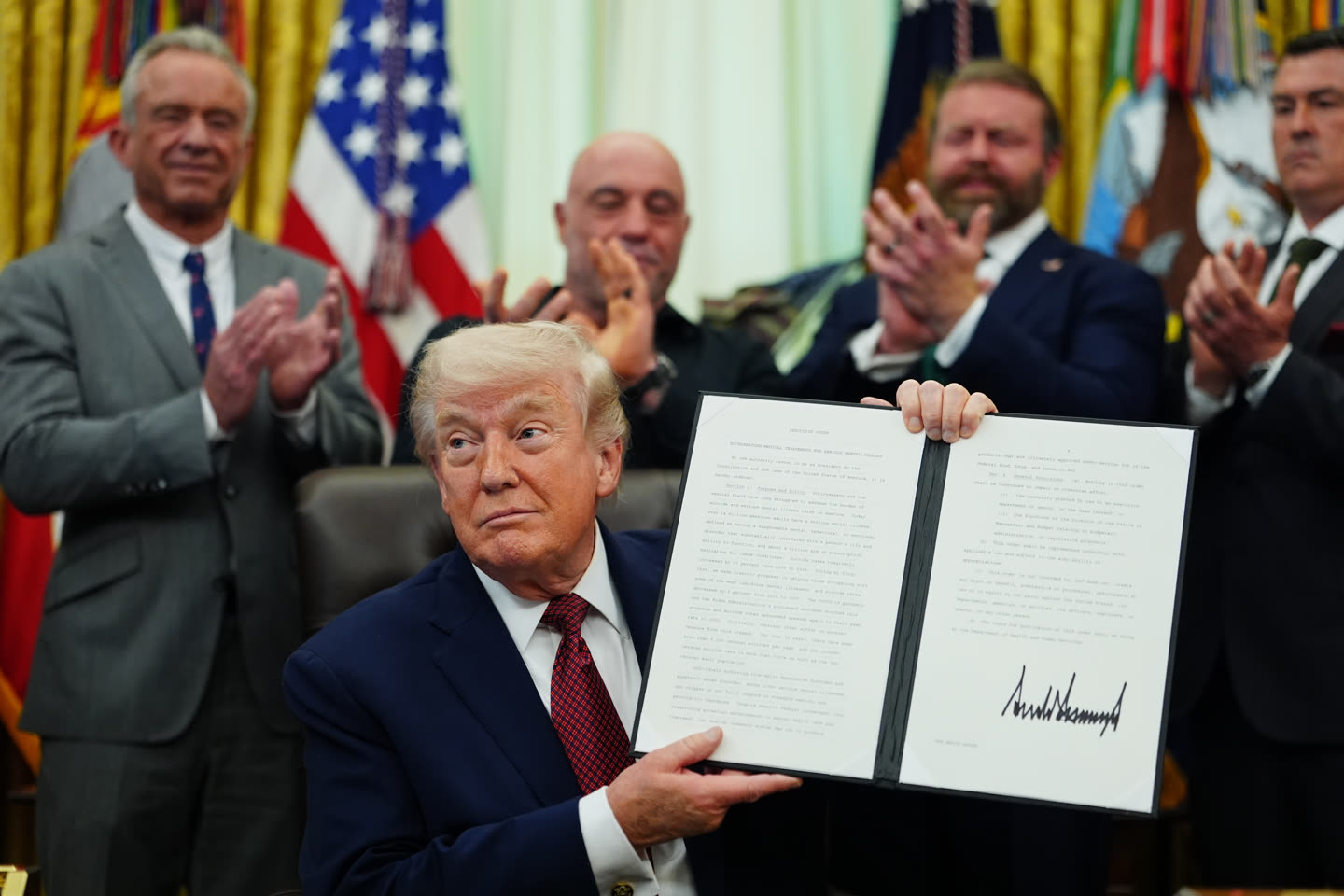
Image context: the header photo shows Trump holding the signed executive order in the Oval Office on April 18, 2026. It fits this article because the live development is institutional and procedural: the White House has told agencies to accelerate review, coordination, and scheduling work, but the actual market-access gates still sit inside FDA evidence review, sponsor decisions, and DEA scheduling law.[3]
Fast facts
- Signed on April 18: the White House order says the administration's policy is to accelerate research models and appropriate approvals for psychedelic drugs aimed at serious mental illness.[1]
- Immediate agency asks: FDA is told to use National Priority Vouchers for appropriate psychedelic drugs with Breakthrough Therapy designation, while FDA and DEA are told to establish a Right to Try access pathway that includes necessary Schedule I handling authorizations.[1][2]
- Money and data: HHS is ordered to direct at least $50 million from existing funds through ARPA-H to support state collaboration, and HHS, FDA, and VA are told to work on trial participation, data sharing, and real-world evidence generation.[1]
- Scheduling is still separate: the attorney general is told to review products containing Schedule I substances after successful Phase 3 trials so rescheduling, if appropriate, can move quickly for specific products that are ultimately approved.[1][8]
- Why ibogaine keeps appearing: AP says the drug has gained support from combat veterans and conservative lawmakers even as serious safety concerns remain part of the file.[3]
What changed on April 18
The order changed the tempo of federal handling more than the legal baseline. On paper, the White House created four acceleration lanes at once: faster FDA prioritization for certain breakthrough-designated psychedelic drugs; a coordinated FDA/DEA Right to Try path; ARPA-H-backed federal-state collaboration; and product-specific rescheduling work tied to Phase 3 completion and ultimate FDA approval.[1][2]
That is a material shift because it pulls several agencies into one chain. The order also tells HHS, FDA, and VA to sign data-sharing memoranda where appropriate so that relevant clinical-study data from across the executive branch can move toward FDA review more quickly.[1] If that coordination actually happens, the practical effect could be less about one headline-grabbing Oval Office moment and more about whether evidence packages, trial recruitment, and review sequencing stop moving as separate bureaucratic tracks.
Why this is not blanket legalization
The strongest overstatement to avoid is the idea that the order has somehow taken psychedelics, or ibogaine specifically, out of Schedule I by fiat. DEA's own scheduling page says Schedule I substances are defined as having no currently accepted medical use and a high potential for abuse.[6] Its Controlled Substances Act explainer also says proceedings to add, delete, or change a schedule move through a formal mechanism that can be initiated by DEA, HHS, or petition, and that the analysis must consider scientific evidence, abuse patterns, and public-health risk.[8]
The White House order tracks that structure rather than wiping it away. It speaks about review of products containing a Schedule I substance after successful Phase 3 trials, and then only so rescheduling may proceed quickly if appropriate for specific products that are ultimately approved under the Food, Drug, and Cosmetic Act.[1][8] That is a targeted lane, not a broad descheduling order.
There is another limiting clause that matters. The order says it must be implemented consistent with applicable law and available appropriations, and it explicitly says it does not create an enforceable right or benefit for private parties.[1] So the correct reporting frame is pressure on agencies, not on-demand patient access on day one.
Why the Right to Try lane is narrower than the headline
The order's most politically striking line is the instruction to FDA and DEA to create a pathway for eligible patients to access investigational psychedelic drugs under the Right to Try Act, including ibogaine compounds.[1][2] But FDA's own page describes Right to Try in tighter terms than many headline summaries do. An eligible patient must have a life-threatening disease or condition, must have exhausted approved options, must be unable to participate in a clinical trial, and still depends on a sponsor willing to provide the investigational drug.[4]
That means the statute is not a general shortcut for anyone who wants psychedelic treatment. FDA also notes that the agency does not review or approve individual Right to Try requests; its role is limited, and sponsors are not obligated to supply a drug.[4] My inference from the order and FDA's patient guidance together is that any practical access lane emerging from this directive will likely be selective, sponsor-dependent, and narrower than the phrase "serious mental illness" suggests in ordinary political speech.[1][4]
Why ibogaine moved to the front of the policy file
Ibogaine is in this order because the political and research conversation around it has already moved. AP's April 18 report says the drug has recently been embraced by combat veterans and conservative lawmakers, even while serious safety risks remain part of the story.[3] Stanford Medicine's 2024 report helps explain why veteran advocates keep pressing the issue: researchers described an open-label study of 30 special-operations veterans treated in Mexico with ibogaine plus magnesium, and wrote that symptoms and functioning improved in that cohort through the study endpoint one month later.[7]
That evidence is interesting, but it does not collapse the distance to approval. Stanford's own write-up says the treatment in that study occurred under medical monitoring in Mexico, used magnesium to help prevent heart complications that have been associated with ibogaine, and still called for further study.[7] In other words, ibogaine has moved into the federal conversation because there is visible demand, a veteran constituency, and suggestive early evidence. It still has to cross the same approval-and-safety boundary that the order is trying to accelerate rather than erase.[3][7][8]
What to watch next
Three practical questions matter more than the symbolism of the signing.
First, watch whether FDA actually operationalizes the promised priority lane in a way sponsors can use, and how narrowly it interprets the "appropriate" products language around Breakthrough Therapy designation.[1][5]
Second, watch whether FDA and DEA publish a usable Right to Try process for Schedule I investigational drugs, because that is where the administration's broad rhetoric meets the narrower statute FDA already describes.[1][4]
Third, watch for the first product-specific rescheduling file that reaches the Phase 3 and approval gates. Until that happens, the administration has changed expectations and agency posture more than it has changed the legal availability of any one psychedelic medicine.[1][6][8]
The useful bottom line is procedural. The April 18 order is a real federal acceleration move. It is also still a gated one. The agencies now have a mandate to move faster on a small set of psychedelic-drug pathways, but the decisive hurdles remain clinical evidence, sponsor participation, FDA approval, and product-by-product scheduling review.[1][4][5][6][8]
Sources
- The White House, "Accelerating Medical Treatments for Serious Mental Illness" (Executive Order, April 18, 2026).
- The White House, "Fact Sheet: President Donald J. Trump is Accelerating Medical Treatments for Serious Mental Illness" (April 18, 2026).
- Associated Press, "Trump signs order to speed review of psychedelics, including the controversial drug ibogaine" (April 18, 2026).
- FDA, "Right to Try" (patient guidance page).
- FDA, "Breakthrough Therapy" (patient guidance page).
- Drug Enforcement Administration, "Drug Scheduling."
- Stanford Report, "Drug safely treats post-traumatic stress disorder in vets" (May 1, 2024).
- Drug Enforcement Administration, "The Controlled Substances Act."