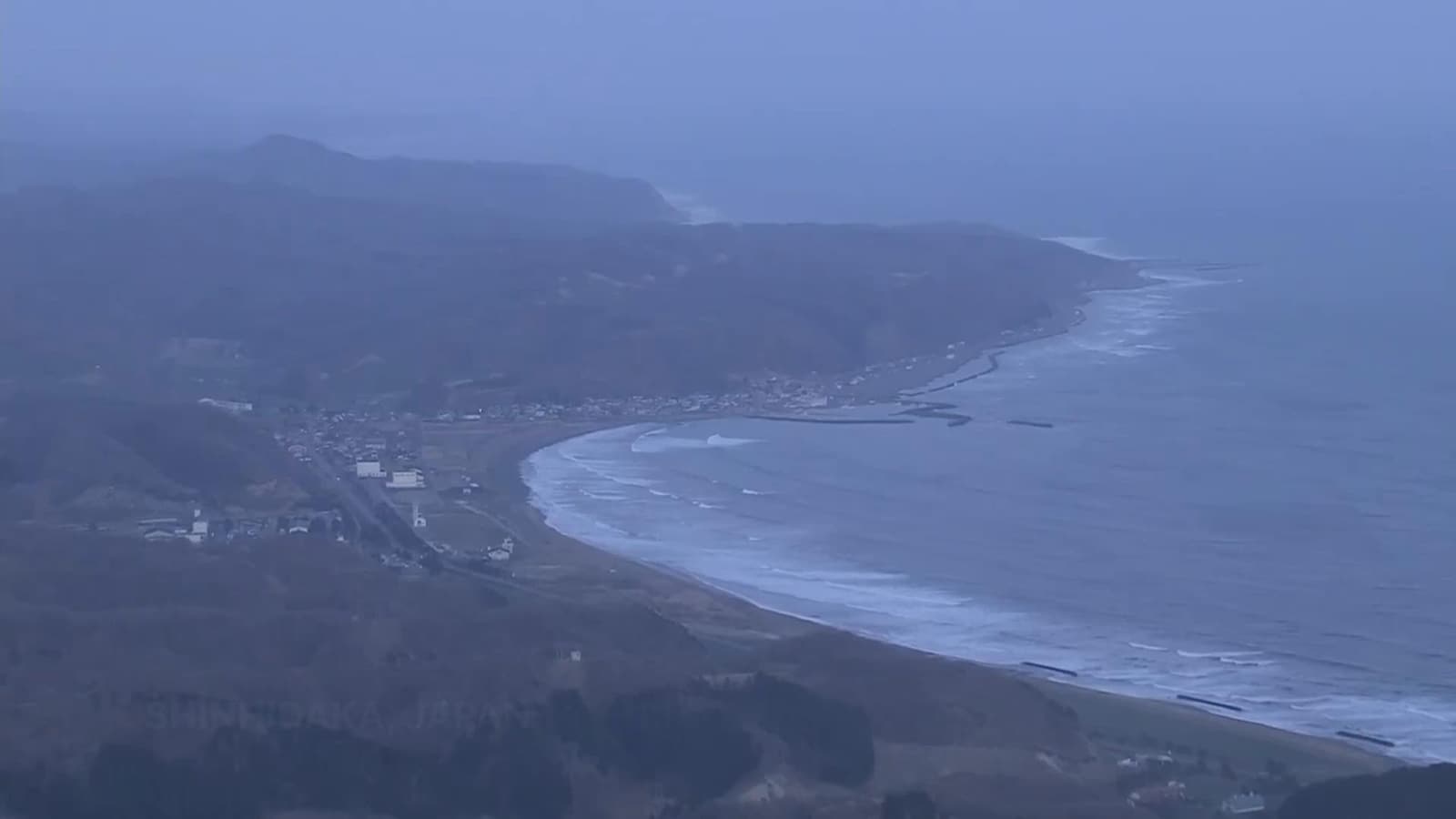
As of 2026-04-20 12:02 UTC, Japan's northern Pacific coast was dealing with two linked but different warnings. The first was immediate: a magnitude-7.5 offshore earthquake near Sanriku triggered tsunami warnings and evacuations after waves were detected at Iwate ports.[1][3][4] The second was probabilistic: the Cabinet Office and Japan Meteorological Agency later issued an advisory saying the quake had slightly increased the chance of a larger follow-on event along the northern coast.[1][4]
The distinction matters. A tsunami warning asks people in exposed places to move now. A megaquake advisory, as reported by AP from the Cabinet Office and JMA, is not a prediction; it asks households and local operators to tighten readiness while daily life continues.[1] The useful reading of Monday's event is therefore neither "the worst happened" nor "nothing happened." It is that Japan's warning system converted uncertain seismic risk into a series of practical decisions: higher ground, port movement, train stops, infrastructure checks, and a one-week aftershock watch.[1][4][6]
Fast facts
| Item | What is known | Confidence note |
|---|---|---|
| Main shock | JMA reported a preliminary magnitude 7.5 earthquake off Sanriku at about 4:53 p.m. JST / 07:53 UTC, at roughly 10 km depth.[1][3] | High for timing and broad location; preliminary magnitude and depth can be revised. |
| USGS location | USGS placed the epicenter about 62 miles east-northeast of Miyako on the Sanriku coast.[2][4] | High for the U.S. event record; local Japanese products may use different magnitude scales. |
| Tsunami observations | AP reported about 80 cm at Kuji port and 40 cm at another Iwate port within one hour.[1] | High for reported observations; later tide-gauge updates may refine the record. |
| Warning zone | Reports described tsunami warnings for Iwate, Aomori, and parts of Hokkaido, with warnings for waves up to 3 meters.[3][4][5] | High for initial warnings; warning status can change quickly. |
| Advisory | AP reported a 1% chance of a megaquake along the northern coast in the next week or so, with officials stressing that this was not a prediction.[1] | Medium-high for official framing as reported; advisory language is inherently probabilistic. |
| Impact | AP said no major injuries or damage had been reported at the time of its update; Weather.com reported no abnormalities at regional nuclear facilities.[1][4] | Provisional; damage assessment often lags after coastal evacuations and transport disruption. |
Why this was not just a tsunami headline
The earthquake happened in a region where the memory of 2011 gives every offshore shock a larger civic meaning. Al Jazeera noted that northeastern Japan's 2011 magnitude-9 earthquake and tsunami killed about 18,500 people and triggered the Fukushima nuclear disaster.[3] That history does not make every Sanriku quake a repeat, but it explains why evacuation messaging is direct and why ports, rail operators, schools, and nuclear regulators become part of the same news cycle.
The tsunami side was concrete. AP reported observed waves before the hour was out, and broadcasters showed people moving to higher ground.[1] SCMP reported boats leaving northeastern ports while low-lying areas were urged to evacuate, and described local congestion around designated evacuation areas in Hokkaido.[5] Those details are operationally important: a warning is only as good as the movement it produces. Monday's early account suggests the warning message did move people, vehicles, and vessels, even before damage totals were clear.
The advisory side is more easily misunderstood. The later megaquake advisory was not an order to evacuate the entire northern coast for a week. It was a preparedness prompt. AP reported that officials placed the near-term probability at 1%, told residents the advisory was not a prediction, and recommended emergency food and grab bags while people continued daily life.[1] That is a narrow, disciplined message: the probability is low in ordinary language but elevated enough, given the size of the potential event, to justify extra readiness.
JMA's public earthquake-and-tsunami materials explain why the system has to separate actions by hazard type. Tsunami warnings and advisories are designed to push immediate coastal behavior after a triggering quake, while earthquake information and follow-up communications keep updating as observations improve.[6] Monday's sequence fits that structure: first move away from the coast and rivers, then watch aftershocks and readiness guidance as agencies refine the seismic picture.[1][6]
Who should care in the next 24 hours
For residents in the warned prefectures, the immediate priority is location discipline. The JMA message quoted by Al Jazeera was blunt: leave coastal and riverside areas for high ground or an evacuation building, and do not leave safe ground until the warning is lifted.[3] That instruction matters even when observed waves look modest, because tsunami waves can arrive in trains, local harbors can amplify water movement, and rivers can carry the hazard inland.[6]
For local governments, the next job is friction removal. SCMP's account of traffic around evacuation sites shows a familiar problem: the warning can be correct and still produce crowding at known safe points.[5] Municipal officials need to redirect cars, open alternate sites, keep shelters supplied, and communicate warning changes without creating a false all-clear. The strongest local performance is not only issuing the alert; it is keeping movement orderly after the first surge of compliance.
For transport and port operators, the event is a live drill under real stakes. Weather.com reported a 5.6 aftershock less than an hour after the main quake and social-media reports of train disruption, while The National and SCMP described suspended rail service and vessels leaving port.[4][5] The practical question is when to stop, when to inspect, and when to restart. Restarting too early creates exposure; waiting too long turns a contained hazard into wider economic and social disruption.
For nuclear-site monitors, the key fact is negative but still important. Weather.com reported that Japan's Nuclear Regulation Authority said regional nuclear power plants and related facilities were intact and that no abnormalities had been detected.[4] That does not end the monitoring obligation. It tells readers what the first-pass inspection found and why the Fukushima memory did not automatically translate into a new nuclear emergency.
The next seven days are about uncertainty management
After a large offshore earthquake, uncertainty has a rhythm. The first hours are about evacuation and situational awareness. The first day is about damage assessment, transport checks, port conditions, and utility reports. The next week is about aftershocks and the possibility, however small, that the main shock was not the largest event in the sequence.[1][4]
That is the logic behind the advisory. AP reported that officials cautioned people about possible aftershocks for about a week, and Weather.com reported the later advisory for a slightly increased chance of a larger quake in the same broad northern coastal region.[1][4] The advisory is useful only if it changes small behaviors without freezing normal life: charge devices, confirm evacuation routes, keep fuel and medication buffers, move valuables off low floors in coastal zones, and avoid unnecessary shoreline visits while official warnings remain active.
The public-communication risk cuts two ways. If officials overstate certainty, people hear a prediction and either panic or later dismiss the system when no larger quake follows. If officials understate the risk, residents treat the advisory as bureaucratic noise. Monday's better frame is conditional preparedness: the odds are low, the consequence could be high, and the cost of basic readiness is limited.
Scenarios to watch
The base case is a managed de-escalation: tsunami warnings and advisories step down as observations confirm that the largest waves have passed, damage remains limited, transport gradually restarts after inspection, and the one-week advisory period becomes a readiness exercise rather than a second disaster.[1][4]
The upside case is institutional proof. Evacuation compliance remains high, traffic management improves around crowded safe points, port and rail restarts happen without major secondary incidents, and the advisory teaches households the difference between immediate evacuation orders and low-probability preparedness prompts.[5][6]
The downside case is a damaging aftershock or larger follow-on event during the advisory window. The triggers would be renewed coastal warnings, additional significant aftershocks, confirmed infrastructure damage, or a change in nuclear-site or port status. If that happens, the story stops being a warning-system explainer and becomes an emergency-response story.[1][4]
The invalidation condition for this piece is specific: if Japanese authorities revise the event size, withdraw or materially change the advisory, report major damage, or identify abnormal conditions at critical infrastructure, the assessment should be updated from the official record rather than carried forward from early reports.
Action checklist
- Coastal households: stay off beaches, river mouths, and harbor edges until local warnings are lifted; keep a grab bag, medication, phone power, and a family contact plan ready for the advisory window.[1][3][6]
- Travelers in Tohoku or Hokkaido: check local rail, airport, ferry, and hotel instructions before moving; do not use shoreline sightseeing as a way to "check" the tsunami.[4][5]
- Local officials: keep evacuation-site routing flexible, publish clear all-clear criteria, and separate tsunami-warning language from megaquake-advisory language so residents know which action is required now.[1][5][6]
- Editors and readers: do not flatten the advisory into a prediction. The reported 1% probability is the reason for preparedness, not a forecast that a larger quake will happen.[1]
Sources
- Mari Yamaguchi, Associated Press, "Japan issues an advisory for northern coastal areas for a slightly increased risk of a mega-quake" (April 20, 2026).
- U.S. Geological Survey, "M 7.4 - near the east coast of Honshu, Japan" event page, event ID us6000sri7 (April 20, 2026).
- Al Jazeera, "Magnitude 7.5 earthquake strikes northern Japan; tsunami warning issued" (April 20, 2026).
- Renee Straker, The Weather Channel, "Powerful Earthquake Strikes Off Japan's Coast, Evacuations Ordered As Tsunami Warning Issued" (April 20, 2026).
- South China Morning Post, "Tsunami warning issued in Japan after magnitude-7.5 quake hits northeast" (April 20, 2026).
- Japan Meteorological Agency, "Earthquake & Tsunami Warnings/Information in Japan" public brochure.