As of 2026-06-02 19:03 UTC, NASA's newest Artemis preparation story is not a rocket, a crew assignment, or a lunar lander render. It is an airplane contract. NASA said on June 1, 2026 that it selected Denmar Technical Services of Nevada to modify and support a Boeing 737-700 that will fly lunar-gravity parabolas for suit and crew-system testing.[1]
That sounds small next to the scale of Artemis, but the useful reading is the opposite. A lunar spacesuit is not only clothing. It is a pressure vessel, mobility system, life-support interface, tool platform, field-science constraint, and emergency-management problem. NASA can test parts of that problem underwater, in offload rigs, in labs, and in field sites. A modified aircraft adds a missing middle layer: short, repeatable slices of lunar gravity before the hardware has to work on the Moon.
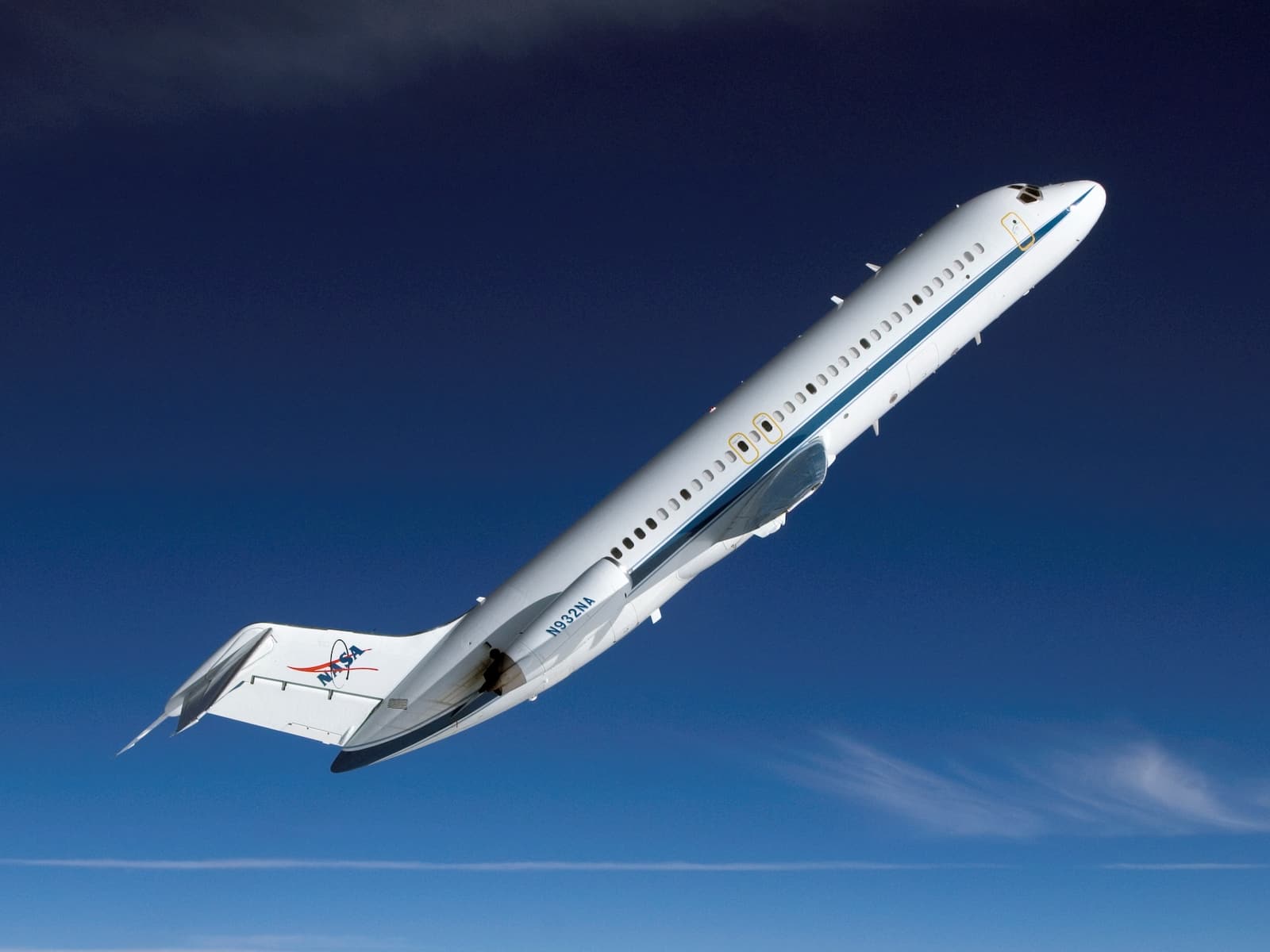
Image context: the cover is a real NASA archival photograph of a C-9 reduced-gravity aircraft, not a diagram or generated visual.[7] It is relevant because the article is about the flight regime, not the specific tail number. NASA's new award concerns a future 737-700 testbed for lunar-gravity parabolic flight.[1]
Facts on the File
| Item | What is known | Confidence note |
|---|---|---|
| Immediate trigger | NASA announced the Denmar Technical Services award on June 1, 2026.[1] | High; direct NASA release. |
| Contract shape | The contract has a maximum potential value of $8.4 million and runs through Feb. 1, 2027.[1] | High for award terms; actual task execution can still change. |
| Aircraft plan | Denmar will modify a Boeing 737-700 for lunar-gravity parabolic flights; NASA Armstrong will own the aircraft after modification and oversee operations out of NASA Johnson.[1] | High for stated plan; the release does not yet provide a first-flight date. |
| Test purpose | NASA says the aircraft will validate astronaut lunar suits and associated crew systems for Artemis mission objectives.[1] | High for intent; test outcomes remain unknown. |
| Flight mechanics | NASA describes parabolic flights as short periods of weightlessness or partial gravity, with the reduced-gravity portion of each parabola lasting about 20 seconds and typical missions flying 15 to 30 parabolas.[2] | High for NASA's current parabolic-flight overview. |
| Program pressure | NASA's inspector general reported in April that next-generation suit demonstrations are behind the original schedule, with Axiom planning demonstration readiness in late 2027.[6] | High for oversight finding; schedule risk is still conditional. |
What Changed
The practical change is that NASA is trying to turn lunar-gravity testing into an owned, repeatable aircraft capability rather than relying only on borrowed analogs. The agency already uses a portfolio of training environments. A June 2 NASA profile of Artemis EVA training lead Scott Wray describes the Neutral Buoyancy Laboratory, the Active Response Gravity Offload System, virtual reality, lighting labs, field geology sites, and suit simulators as part of lunar EVA preparation.[3] Those environments are useful because each isolates a different failure mode.
The 737 testbed is valuable because it isolates a different one: how crew and hardware behave when the body is actually in partial free fall, not merely supported or resisted by another system. NASA's parabolic-flight overview says pilots can adjust the maneuver to create partial gravity, including lunar gravity, for brief intervals.[2] Twenty seconds is not a moonwalk. It is enough time to test a reach, a stumble recovery, a tool handoff, a body posture, a restraint, a crew procedure, or a suit-system interaction under a gravity level that normal rooms cannot create.
That distinction matters because lunar work is not weightlessness. On the International Space Station, astronauts translate mostly with their hands and body restraint systems. On the Moon, Artemis crews are supposed to stand, walk, bend, collect samples, manage tools, descend and ascend vehicle interfaces, and work in low-angle South Pole lighting.[3][5] The physics are awkward: there is gravity, but only about one-sixth of Earth's; there is traction, but in dust; there is mass, but less weight; there is motion, but with a suit that changes how the body bends.
Why the Airplane Matters for Suits
NASA's February update on the Artemis III lunar spacesuit, the Axiom Extravehicular Mobility Unit, or AxEMU, said the suit had passed a contractor-led technical review and was already being tested by NASA astronauts and suit engineers in underwater surface-operation simulations.[4] The same update emphasized flexibility, mobility, bending to collect geology samples, life support, protection, and specialized tools.[4] Those are exactly the features that become more meaningful when tested in more than one analog.
Underwater testing is strong for training timelines, procedures, visibility, communication discipline, and long-duration practice. Offload rigs are strong for repeated mobility tests and instrumented measurements. Field sites are strong for geology and traverse judgment. Parabolic flights are weak on duration, but strong on the pure gravity problem. If a crew member cannot start, stop, kneel, recover, or manipulate a tool cleanly in a short lunar-gravity interval, the test reveals something that a longer but less physically exact analog might hide.
The current award is also a schedule signal. NASA's Office of Inspector General warned in April that next-generation spacesuit services remain one of the harder Artemis dependencies. The OIG said NASA awarded xEVAS contracts to Axiom Space and Collins Aerospace in 2022, that those contracts are worth up to $3.1 billion, and that NASA is now reliant on Axiom after Collins' work was descoped.[6] It also said the original goals for lunar and microgravity suit demonstrations were overly optimistic and that Axiom was planning demonstration readiness in late 2027.[6]
That does not mean the 737 contract solves the suit schedule. It means NASA is adding a test lane in the same risk neighborhood. If the aircraft becomes available on a useful cadence, teams can compress learning cycles around suited mobility and crew-system interactions. If it arrives late, underperforms, or proves too limited for meaningful suited work, then it becomes another support activity rather than a risk reducer.
The Decision Impact
Next 24 hours: the news does not change Artemis flight dates by itself. The live question is documentation: whether NASA releases more detail on the modification plan, aircraft configuration, first test objectives, and how the 737 testbed will fit with existing Johnson and Armstrong workflows.[1][3]
Next 7 days: watch for procurement and program signals rather than spectacle. The important details are not whether the aircraft gets a nickname. They are whether NASA identifies which suit tasks, crew-system checks, and Artemis mission phases will use lunar-gravity parabolas first.[1][4][5]
Next 30 days: the stronger signal would be integration with the spacesuit schedule. If NASA links the new aircraft to AxEMU test milestones, geology-tool trials, lander-interface rehearsals, or crew procedure validation, the 737 becomes part of a serious Artemis risk-control stack.[4][6]
Scenarios
Base case: NASA gets a modest but useful testbed. The modified 737 supplies short lunar-gravity runs that complement underwater, offload, and field training. It does not replace those environments, but it catches enough mobility and procedure issues to justify the contract.
Upside case: the aircraft becomes a fast feedback machine. Suit engineers, EVA trainers, and crew-system teams use repeated parabolas to tune hardware and procedures before higher-cost integrated tests. That would make the $8.4 million ceiling look small compared with the cost of discovering suit-interface problems later.[1]
Downside case: the aircraft is late, too constrained, or poorly matched to the most important suited tasks. Twenty-second gravity windows can expose specific problems, but they cannot simulate a long moonwalk. If NASA treats the airplane as proof rather than as one analog among several, it could overread the results.[2][3]
What to Watch
The falsifier is clear: if NASA cannot connect the 737 to named Artemis suit and crew-system test objectives by late 2026 or early 2027, the contract is less a mission-readiness tool than a generic research-aircraft upgrade. The stronger outcome is a visible chain from aircraft modification to suited parabolic tests, from those tests to procedure changes, and from those changes to Artemis III surface-readiness reviews.
For now, the contract is best read as a small operational hedge. Artemis III asks astronauts to work near the lunar South Pole, use advanced spacesuits, handle geology tasks, and operate in conditions unlike Apollo's equatorial landing sites.[5] A lunar-gravity aircraft cannot make that easy. It can make part of the problem visible while there is still time to change the hardware, training, or procedure.
Sources
- NASA, "NASA Awards Modification Contract for Reduced Gravity Test Aircraft" (June 1, 2026).
- NASA, "Parabolic Flight" mission overview (reduced-gravity mechanics and typical flight profile).
- NASA Johnson Space Center, "Spacewalking With Scott Wray, Artemis EVA Training Lead" (June 2, 2026).
- NASA, "NASA Moon Mission Spacesuit Nears Milestone" (Feb. 12, 2026).
- NASA, "Artemis III: NASA's First Human Mission to Lunar South Pole" (mission overview).
- NASA Office of Inspector General, "Spacesuit Development Delays Could Impact Artemis Timeline and ISS Operations" (Apr. 20, 2026).
- Wikimedia Commons, "File: NASA 932 during parabolic flight (JSC2006-E-02418).jpg" (NASA archival photograph; source for article image).