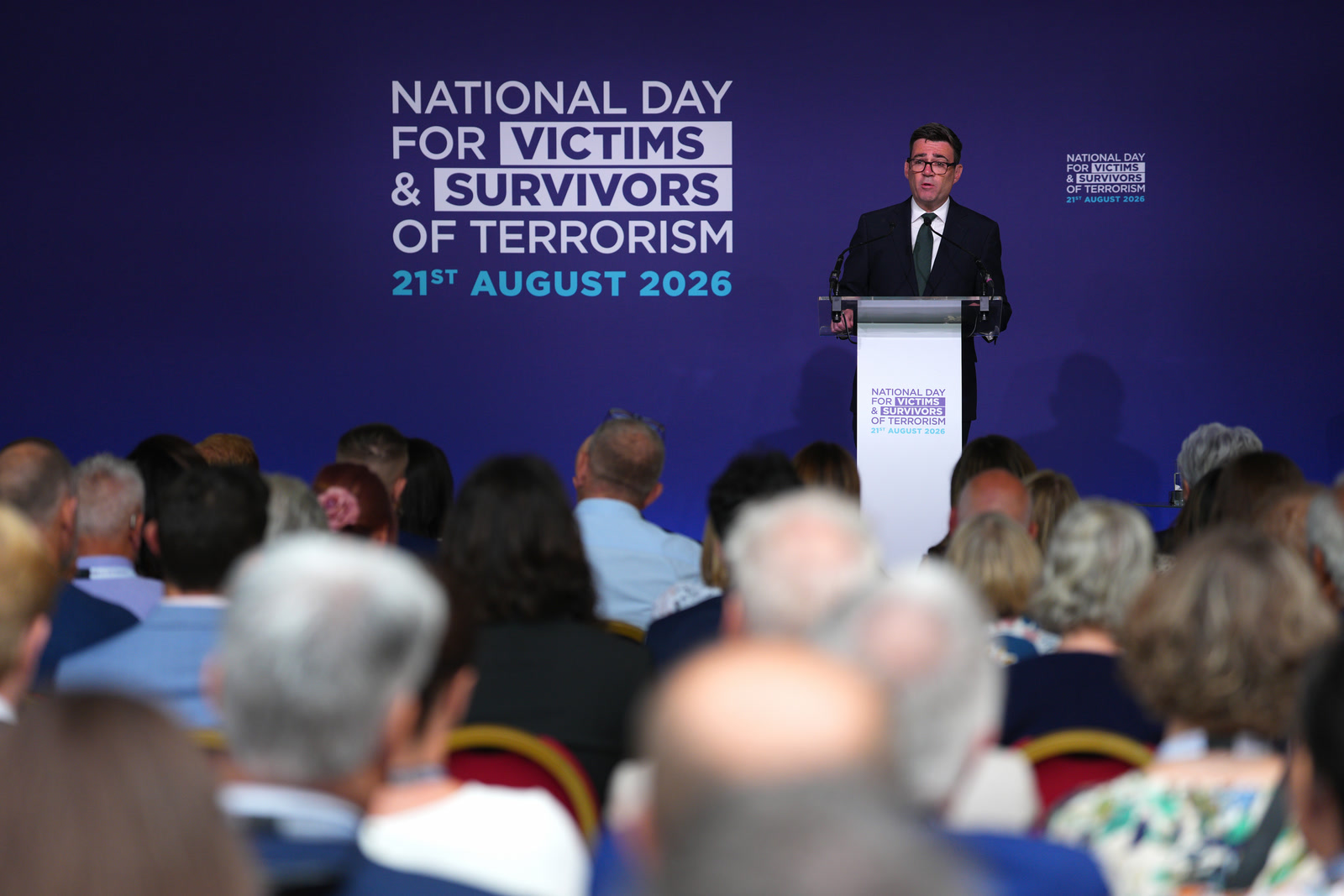
As of 2026-08-22 00:34 UTC, Britain has completed its first National Day for Victims and Survivors of Terrorism. At the central London event on Friday, Prime Minister Andy Burnham promised consultation on a permanent national memorial and said the government would examine reform of the Criminal Injuries Compensation Authority, or CICA, and access to legal help. Victims Minister Alex Davies-Jones was named to lead the CICA and legal-assistance work.[1]
That is more than ceremonial language. It joins three pieces that did not exist together a year ago: an annual date, a national support hub and a new public commitment to revisit compensation. But it also creates a clean accountability question. By the second national day, will survivors be able to see what changed during the other 364 days?
The answer cannot be inferred from the dignity of a service or the size of an audience. Recognition, care and compensation are different functions. Each needs a different measure, and the government has so far published more about the form of remembrance than about the outcomes that will connect one anniversary to the next.
Recognition was never an empty demand
The day should not be dismissed as symbolism designed in Whitehall. Survivors campaigned for it, and the Home Office consultation found substantial support for both remembrance and practical help. Among respondents, 86% wanted the day to remember and recognise those affected; 70% wanted it to encourage people to seek support; and 66% wanted it to educate the public about survivors' experiences. Three-quarters supported an annual gathering.[3]
Those results matter because they reject a false choice between a ceremony and a service. The stated design was meant to make the ceremony a route into support. Home Office guidance says the day should amplify survivors' stories, build public understanding and encourage affected people to use specialist help.[2]
The consultation also records the limits. Only 53% judged a national day more beneficial than other forms of recognition, while 14% judged it less beneficial; some respondents explicitly preferred practical initiatives. One in ten raised concern about negative consequences, including renewed trauma, safety and political misuse.[3] This was not a referendum on whether remembrance is good. It was a warning that remembrance has to remain voluntary, survivor-shaped and connected to something available after the flags and lecterns are put away.
That makes Friday's memorial promise important but incomplete. A permanent place can acknowledge lives that public memory has treated unevenly. Yet a site, design and opening date are outputs. The harder evidence will be who sets the brief, how disagreement among survivors is recorded, whether people affected overseas are represented, and whether the project consumes attention that was promised to service reform. Consultation is the beginning of that record, not proof of its result.
The support hub gives the promise a front door
The strongest year-round infrastructure is the Support Hub for victims and survivors of terrorism, launched on 1 June. It is delivered by Victim Support with Peace Collective and the National Psychology Service hosted by West London NHS Trust. Its helpline is open around the clock, and a person can refer themselves or someone else. The government says each person receives a dedicated caseworker and a needs assessment that travels with them, reducing the need to repeat their experience to every new professional.[4]
That design responds directly to a recurring failure: fragmented help that makes traumatised people become their own case coordinators. It also draws a useful boundary. The hub can provide emotional, practical and psychological support and help people navigate compensation; it does not itself decide a CICA award.[4][9]
The distinction matters for evaluation. A rise in calls after the national day might show awareness, unmet need, or both. Raw volume alone would say little. A meaningful first-year account would report, in privacy-protecting aggregate form, how quickly referrals reach a caseworker, how many handoffs are completed, how often people have to retell their story, whether support continues beyond an initial contact, and whether access varies by attack, geography or type of harm.
At this cutoff, the public pages describing the national day and hub explain what people can seek and how the service is organised. They do not publish that outcome set.[2][4] That is an uncertainty, not evidence that the hub is failing. It is also the most repairable gap: define the measures now, before the first anniversary becomes the baseline by accident.
Compensation is the harder institutional test
Burnham's commitment to look at CICA reform and legal assistance lands in a system already under pressure. CICA's July annual report says it received more than 47,000 new claims across its schemes in 2025–26, more than 10% above the previous year. Just over six in ten applicants received a first decision within 12 months, below the target of seven in ten. The authority reported more than 1,000 emails a day, more than 600 complaints a month, and over £180 million paid in compensation.[5]
Those figures cover the authority as a whole; they are not a performance series for terrorism cases. That is precisely the analytical problem. A promise aimed at terrorism survivors cannot be judged only through an all-claim average, especially when complex physical and psychological injuries, bereavement, overseas attacks and multiple systems can make those cases unusually demanding.
The survivor evidence is older and narrower, but too severe to ignore. A 2023 Survivors Against Terror report, based on a Kantar-administered online survey of 132 people affected by 11 attacks, found that 68% of respondents considered the CICA process unfair and unreasonable. Only 7% felt the authority had been sympathetic to their needs, while 72% said it had not.[6] This was an advocacy survey of respondents, not a probability sample of every terrorism survivor, so its percentages should not be projected onto the entire population. They still document a concentrated service failure among people who used or encountered the system.
The operational boundary was visible in a June 2025 meeting between the Victims' Commissioner and CICA. Minutes say CICA had a dedicated team for victims of terror but could not allocate a named caseworker to every applicant, except that a bereaved victim would receive one. The authority was reviewing communications, letter templates, online guidance and timeline updates.[7] The new support hub's dedicated caseworker may make the journey less isolating, but a navigator outside CICA is not the same as continuity inside the body making the decision.
This is why “review CICA” needs to become a published scope. There are at least three separate questions: whether the statutory scheme and tariffs fit terrorism-related harm; whether applicants receive timely, trauma-informed and continuous handling; and whether legal help is available when evidence or an appeal becomes complex. Changing a letter template would not answer the first question. Announcing a broad legal-support intention would not answer who qualifies, at what stage, or with what funding.
A memorial should mark progress, not substitute for it
Survivors Against Terror's memorialisation research helps explain why the permanent-memorial pledge resonated. In its survey of 101 British people affected by terrorism, 97.1% supported a national day and 78% supported a permanent physical or living memorial.[8] The sample was recruited for an advocacy project and is not a national public-opinion poll. Its value is different: it shows that many directly affected people see public memory as part of the state's obligation, not as a distraction from recovery.
The risk is sequencing. A memorial is visible, bounded and eventually complete. Trauma care, case coordination and compensation are dispersed, private and never opened with a ribbon. Government therefore needs to resist treating the most photographable promise as the finish line.
What changes over 24 hours, seven days and 30 days
In the next 24 hours, coverage should keep three verbs separate. The national day was held; a memorial consultation was promised; CICA reform and legal assistance will be examined.[1] Reporting the latter two as completed policies would erase the very delivery test the event created.
In the next seven days, Davies-Jones's appointment supplies a political lead for the CICA and legal-assistance work.[1] The useful next signal would be departmental remit and scope for each strand: who leads the memorial process, how survivors enter both processes, and whether there is a publication date for terms of reference. No such document was linked from the official national-day or support-hub pages at this cutoff.[2][4] Silence for a week would not disprove the commitments, but it would leave them as speech rather than an implementation record.
In the next 30 days, the test moves from announcement to baseline. A hub outcome framework, a terrorism-specific CICA service baseline, or a defined route to legal help would make later progress measurable. A memorial design exercise without any of those service records would show that commemoration is advancing faster than care and compensation; it would not, by itself, show that either service has deteriorated.
Three paths to the second national day
Base path — consultation advances, services remain only partly measurable. The hub continues operating, the government opens memorial and CICA discussions, and public reporting remains largely authority-wide. The trigger is a published consultation or review scope without a linked set of hub outcomes or terrorism-specific compensation measures.
Upside path — remembrance becomes an accountability cycle. Survivor representatives help define the memorial and annual event while the Home Office and Ministry of Justice publish service baselines, reform responsibilities, funding and milestones. The trigger is not another pledge; it is a dated record that lets the public compare referral continuity, claim handling and legal access before August 2027.
Downside path — the visible project outruns the difficult systems. A site, symbol or design competition moves forward while CICA reform stays undefined, legal assistance has no eligibility or funding model, and the hub publishes no outcome framework. The trigger is material progress on the memorial alongside continued absence of those service records.
These are conditional paths, not probability forecasts. The government could also publish parts of more than one path at the same time.
By 21 August 2027, a credible public account should be able to answer four questions:
- Did people referred through the national day reach sustained, appropriate support, and where did handoffs fail?
- What exactly entered the CICA reform and legal-assistance review, who represented survivors, and which changes have a timetable?
- How many terrorism-related claims moved through CICA, how long did key stages take, and how did applicants rate communication and continuity?
- How were differing survivor views incorporated into the memorial and the next commemoration, including concerns about trauma, safety and politicisation?
None of those answers requires publishing private case histories. They require clear definitions, aggregated outcomes, survivor governance and an honest account of what remains unresolved.
Friday established that victims and survivors belong in the national calendar. That achievement should be protected. Its durability, however, will be decided outside the ceremony: in the call that reaches a person rather than a maze, the claim that moves without repeated re-traumatisation, the legal help that exists before an appeal deadline, and the consultation whose difficult views remain visible after a design is chosen.
A calendar can create an anniversary. Only delivery can create continuity.
Action and invalidation check
- Government: publish departmental remits, terms of reference and dates for the memorial, CICA and legal-assistance work; add privacy-protecting hub outcomes and a terrorism-claim baseline before the next annual event.
- Reporters and watchdogs: distinguish a service offered from an outcome achieved, and a review announced from a rule, budget or process changed.
- Reviewers: revise this analysis if official documents show that the missing outcome framework, terrorism-specific CICA baseline or fully scoped reform programme already existed by the cutoff.
- Invalidate the central measurement-gap finding if the Home Office or Ministry of Justice publishes all three: auditable hub outcomes, terror-claim performance data, and funded milestones for compensation and legal-support reform. If Friday's commitments are narrowed or withdrawn instead, replace the delivery test with an account of that reversal.
Sources
- PA Media, “Burnham pledges to consult on national memorial for terrorism survivors” (21 August 2026) — report from the inaugural event, policy commitments and source page for the Carl Court photograph.
- UK Home Office, “Find out about the National Day for Victims and Survivors of Terrorism” (14 August 2026) — official purpose, annual date and participation guidance.
- UK Home Office, “National day for victims and survivors of terrorism: government response” (24 November 2025) — consultation results, design choices, practical-support priorities and recorded concerns.
- UK Home Office, “Support Hub for victims and survivors of terrorism” (updated 1 June 2026) — providers, round-the-clock access, referral process, dedicated caseworker and needs assessment.
- Criminal Injuries Compensation Authority, Annual Report and Accounts 2025 to 2026 (14 July 2026) — authority-wide claim volumes, decision timeliness, contacts, complaints and compensation payments.
- Survivors Against Terror, Broken: Survivors' Experiences of the UK's Compensation Scheme (2023) — methodology, respondent profile and reported experiences with CICA.
- Victims' Commissioner for England and Wales, “Meeting with the Victims' Commissioner and CICA” (12 June 2025) — named-caseworker boundary and CICA communication-review work.
- Survivors Against Terror, Memorialisation of the Victims of Terrorism (2025) — survivor survey on a national day and permanent memorial, plus comparative context.
- UK Home Office and Criminal Injuries Compensation Authority, “Compensation and benefits for victims of terrorist attacks” (updated 29 July 2026) — CICA's decision role and the Support Hub's claim-navigation role.