As of 2026-07-12 04:40 UTC, the tenth anniversary of the South China Sea arbitral award is no longer just a ceremony about a 2016 judgment. Fourteen governments have issued a joint statement calling the award final and legally binding between China and the Philippines, while Beijing has answered that the award has "absolutely no relevance" to the ASEAN-China Code of Conduct now under negotiation.[1][2]
That clash identifies the next consequential question. ASEAN says it will endeavour to conclude an effective, substantive code consistent with international law, particularly the UN Convention on the Law of the Sea, within 2026.[3] The award already supplies a detailed UNCLOS baseline for the maritime entitlements and conduct it decided. The test is whether the new political rulebook carries that baseline into day-to-day restraint—or creates a softer zone of ambiguity around it.
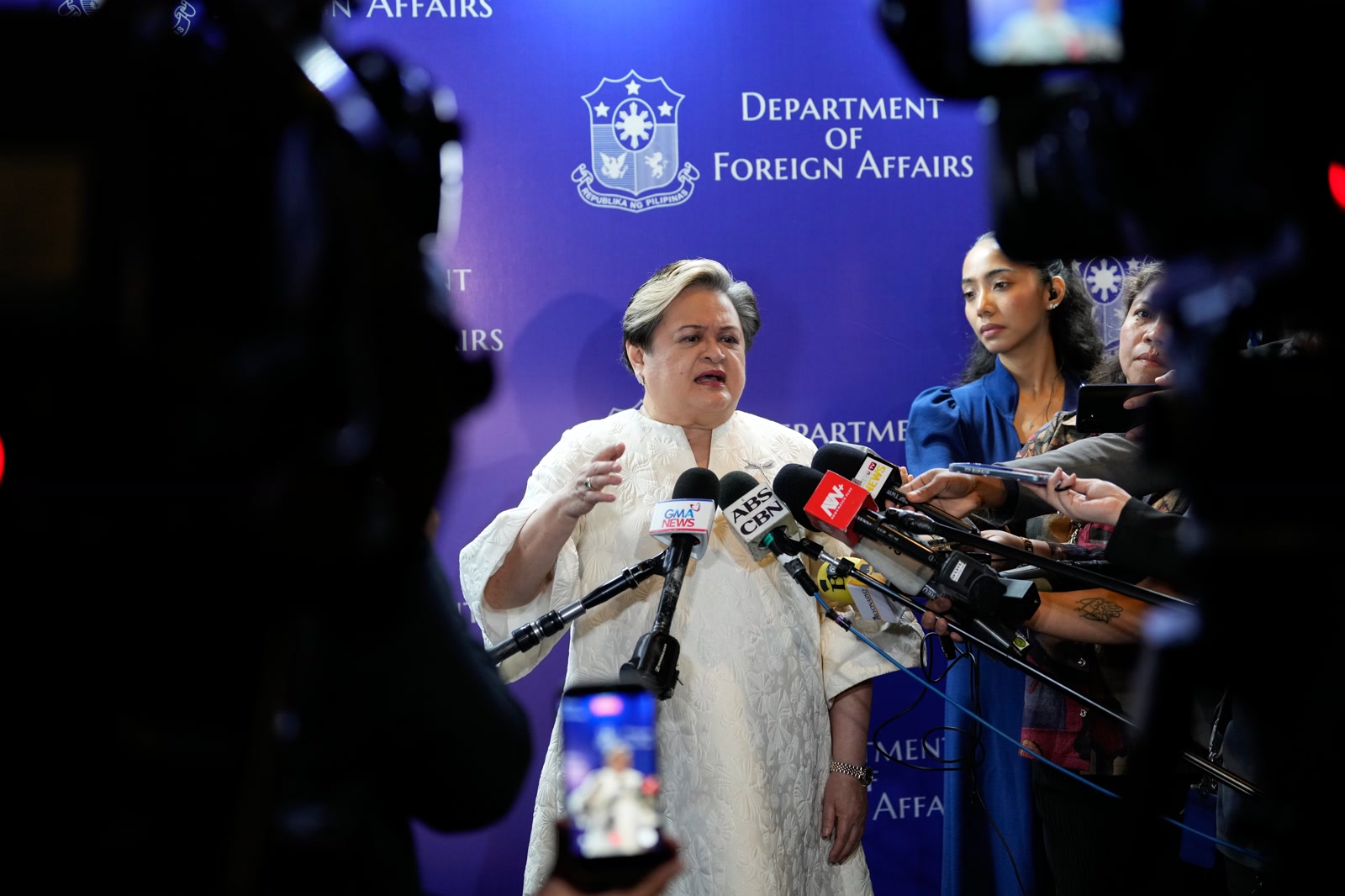
Image context: the cover is an AP photograph of Philippine Foreign Secretary Maria Theresa Lazaro taking questions at the Manila anniversary conference on July 10. It is documentary evidence of the event discussed here, not a map, diagram, generated scene, or symbolic news graphic.[5]
Fact Line
| Timestamp / source | Key signal | Confidence note |
|---|---|---|
| July 12, joint statement | Australia, Canada, Estonia, Germany, Italy, Japan, Latvia, Lithuania, New Zealand, the Philippines, Romania, Slovenia, the United Kingdom, and the United States reaffirmed the award as final and binding between China and the Philippines on the matters decided.[1] | High for the signatories' position. The statement is diplomatic support, not an enforcement mechanism. |
| July 10, Chinese Foreign Ministry | Beijing repeated that it does not accept or recognize the award and said it must not be used to obstruct Code of Conduct negotiations.[2] | High for China's stated position. It does not resolve the legal disagreement. |
| January 29, ASEAN chair's statement | ASEAN ministers said they would endeavour to finish an effective and substantive code, consistent with UNCLOS, within 2026.[3] | High for the collective aspiration. "Endeavour" is not a guaranteed deadline, and the negotiating text is not public. |
| July 12, 2016, arbitral tribunal | The Annex VII tribunal issued a unanimous award that is final and binding under UNCLOS; it did not decide sovereignty over land territory or delimit a maritime boundary.[4] | High for the award's scope. Calling it a ruling on ownership of every disputed feature would overstate it. |
| July 10, Manila conference | Lazaro described the award as a legal guide amid coercion; AP reported that China still rejects it and continues to defend expansive claims in the sea.[5] | High for the public positions. Operational compliance remains contested. |
What The Award Did—and Did Not Do
Precision matters because both supporters and opponents often enlarge the award into something easier to praise or dismiss. The case was heard by an arbitral tribunal constituted under Annex VII of UNCLOS; the Permanent Court of Arbitration served as registry. The tribunal addressed historic rights, the maritime zones particular features could generate, and the lawfulness of specified Chinese conduct.[4]
It found that UNCLOS left no legal basis for Chinese historic-rights claims to resources beyond the maritime entitlements allowed by the convention. It also made findings about the status of features and about conduct affecting Philippine rights and the marine environment.[4] Those conclusions narrowed the range of claims that can be defended as lawful under UNCLOS.
But the tribunal expressly said it was not deciding which state owns land territory, and it did not draw a maritime boundary.[4] The award therefore cannot settle every sovereignty dispute in the South China Sea. Its force is narrower and more useful: it sets legal boundaries for specified maritime claims and behavior between the parties even though it has no police force of its own.
That distinction explains the decade since. China has retained the material capacity to reject the award in practice, but rejection has not erased the legal reference point. The ISEAS-Yusof Ishak Institute analysis argues that the award's effect lies in changing the language of legitimacy: it gives governments a baseline against which to judge claims and conduct even when immediate compliance is absent.[6] Law has constrained the argument more successfully than it has constrained every vessel.
Why The Code Is Now The Real Test
The code and the award do different jobs. The award decided legal questions submitted by the Philippines under UNCLOS. A Code of Conduct would be a negotiated political and operational framework among China and ASEAN states for managing future behavior. One cannot simply substitute for the other.
The danger is in the seam between them. A code can reduce risk by specifying restraint, communications, incident procedures, and accountability. It can also become a lowest-common-denominator document whose reassuring language leaves the hardest questions untouched. Beijing's July 10 statement makes the seam explicit: China supports accelerating the code but rejects any connection between that process and the award.[2] Manila's position is the reverse: Foreign Secretary Lazaro said the Philippines would use the award as the basis for pursuing completion of the code.[7]
ASEAN's January language helps, but it does not finish the work. It calls for a code "in accordance with international law, particularly" UNCLOS and links negotiations to reducing accidents, misunderstandings, and miscalculation.[3] That is a meaningful standard. Yet without a published draft, readers cannot know whether the operative clauses match that publicly stated standard.
Five questions would reveal the difference:
- Legal fit: Does the code say plainly that it conforms to UNCLOS and does not prejudice existing rights, entitlements, or binding decisions between parties?
- Geographic scope: Does it identify where its rules apply clearly enough to prevent every incident from reopening the scope debate?
- Actors covered: Do its restraint rules reach coast guards and state-supported maritime militia as well as navies? The anniversary statement names all three.[1] The operational reason for testing that breadth is that coercion can occur below the threshold of conventional military conflict.
- Incident machinery: Are there usable hotlines, reporting timelines, evidence-preservation rules, and investigation procedures after collisions, water-cannon use, obstruction, or dangerous maneuvering?
- Compliance: Is the code legally binding, and does it provide verification or dispute-resolution steps when accounts diverge?
A text that fails those tests may still be politically marketable. It would not reliably change conditions at sea.
The Coalition Signal Has A Boundary
The new joint statement is broader than a bilateral anniversary note. Its 14 signatories span North America, Europe, the Pacific, Japan, and the Philippines, and it directly opposes harassment by coast guard, military, and maritime militia forces.[1] That breadth raises the diplomatic cost of treating the award as forgotten.
It also has a visible limit: the published list contains only one ASEAN member, the Philippines.[1] That observation should not be misread. Absence from this particular statement does not prove that another ASEAN state rejects the award or favors China's claims. It does show why Manila's 2026 chairship is difficult. The Philippines must defend a national legal baseline while building the consensus needed for an ASEAN-China agreement.
Decision Impact
Next 24 hours: governments and newsrooms should separate three propositions that are often blurred: the award is binding between China and the Philippines on the issues decided; China rejects it; and a future code remains untested because its text is not public.[1][2][4] Reporting all three is more accurate than declaring either that the award solved the sea or that noncompliance made it meaningless.
Next 7 days: watch whether additional governments endorse the anniversary statement, whether ASEAN members describe the award or only UNCLOS, and whether Beijing or Manila adds detail about the code's legal relationship to existing obligations. Signatory counts matter less than the wording governments are prepared to carry into negotiations.
Next 30 days: the Philippines, as ASEAN chair, should push the process toward verifiable design rather than another deadline slogan. Even if negotiators cannot publish the draft, they can disclose whether the five issues above—legal fit, scope, covered actors, incident machinery, and compliance—are settled, open, or excluded. That would let the public distinguish progress on text from progress on ceremony.
Scenario Map
Base case: negotiations continue through 2026, with public statements emphasizing UNCLOS but the hardest clauses remaining confidential or unresolved. The 2026 target slips or produces a framework with useful confidence-building measures but weak compliance machinery. Trigger: officials keep reporting "progress" without disclosing scope, binding status, or incident procedures.[2][3]
Upside case: ASEAN and China agree on a code that explicitly conforms to UNCLOS, preserves existing legal positions, covers coast guards and other state-directed vessels, and includes timely incident reporting plus a credible review process. It would not settle sovereignty, but it could reduce the space in which coercive encounters are normalized. Trigger: negotiators publish or jointly describe operative clauses rather than only principles.
Downside case: urgency to claim a 2026 diplomatic win produces vague language that separates the code from the award, leaves geography contested, and depends entirely on voluntary restraint. Incidents then continue while every side cites the same code differently. Trigger: the final text avoids legal hierarchy, covered actors, and consequences for noncompliance.
Uncertainty boundary: the draft code is not public. This analysis evaluates the standards a credible agreement would need, not clauses that can presently be inspected. The 14-government statement is a political signal, not an enforcement coalition, and the absence of other ASEAN signatures cannot be treated as evidence of their legal positions.[1][3]
Action Checklist
- For ASEAN negotiators: publish a short implementation matrix showing which operational issues are agreed, disputed, or deferred, without exposing negotiating positions that must remain confidential.
- For maritime agencies: test hotlines, incident logging, evidence exchange, and search-and-rescue coordination before a code is signed; paper procedures are weakest when first used during a crisis.
- For diplomats: ask whether every reference to "international law" is tied specifically to UNCLOS and whether the text preserves existing rights and binding obligations.
- For analysts and editors: stop using "PCA ruling" as shorthand. Identify the Annex VII tribunal, the PCA's registry role, and the award's limits on sovereignty and boundary delimitation.[4]
- Invalidation condition: this analysis must be revised if ASEAN and China publish a draft or final text that clearly resolves legal fit, geographic scope, covered actors, incident procedures, and compliance. At that point, the task changes from testing ambiguity to auditing implementation.
Ten years after the tribunal spoke, the central divide is no longer hard to locate. Manila and its partners want the award to remain the legal floor. Beijing wants the code process kept separate from it. A successful code does not need to relitigate 2016, but it cannot create durable restraint by becoming less precise than the law it is supposed to operate beside.
Sources
- UK Foreign, Commonwealth & Development Office, "Joint statement on the tenth anniversary of the Philippines-China South China Sea Arbitral Tribunal Award" (July 12, 2026) - full statement and list of 14 participating governments.
- Embassy of the People's Republic of China in the United Kingdom, "MFA Spokesperson on the So-called 'South China Sea Arbitration Award'" (July 10, 2026) - China's current position on the award and Code of Conduct negotiations.
- ANTARA News, "ASEAN aims to complete South China Sea CoC by 2026" (January 30, 2026) - report quoting the ASEAN Foreign Ministers' Retreat statement on UNCLOS, risk reduction, and the stated endeavor to conclude a code within 2026.
- Permanent Court of Arbitration, "The South China Sea Arbitration: The Tribunal Renders Its Award" (July 12, 2016) - official press release on the Annex VII tribunal, scope limits, principal findings, and final-and-binding status.
- Jim Gomez, Associated Press, "Philippines marks 10th anniversary of arbitration ruling that rejected China's sea claims" (July 10, 2026) - independent event report, the Philippines' current framing, and source page for Aaron Favila's article photograph.
- Lowell Bautista and Aries A. Arugay, ISEAS-Yusof Ishak Institute, "The 2016 South China Sea Arbitration Award Did Not Fail" (May 28, 2026) - analysis of enforcement limits, normative effects, and the code's relationship to the award.
- Reuters via Devdiscourse, "Philippine minister says 2016 South China Sea arbitration ruling is a permanent anchor" (July 10, 2026) - Lazaro's statement that Manila will use the award as a basis for pursuing completion of the ASEAN-China code.