As of 2026-06-11 00:32 UTC, the news from Barcelona is not simply that another famous monument had a papal ceremony. Pope Leo XIV presided over a Mass at the Sagrada Familia on June 10, 2026, marking the centenary of Antoni Gaudi's death, and blessed the newly completed Tower of Jesus Christ, the basilica's central and tallest tower.[1] The useful analysis starts with the double meaning of that moment: the basilica has gained its strongest completion symbol, while Barcelona has inherited a sharper version of the pressure that made the building famous in the first place.
The official Sagrada Familia account says the tower stands 172.5 meters tall and makes the basilica the tallest church in the world. It also says more than 8,500 people took part in the celebration in person, split between 4,500 inside and 4,000 outside, with thousands more watching on city screens and the international broadcast.[1] Those numbers are not only event color. They show the basilica operating at three scales at once: parish church, national ceremony, and global media object.
That is why the headline should not be read as "Sagrada Familia finished." The tower blessing is a culmination, not a closure. Official materials still frame the tower as a decisive step toward fulfilling Gaudi's plans, and the history page says construction continues more than 140 years after the cornerstone was laid.[2][5] The change is that the building's unfinished status is no longer the same story it was last week. The central vertical claim is now visible, blessed, illuminated, and internationally packaged.
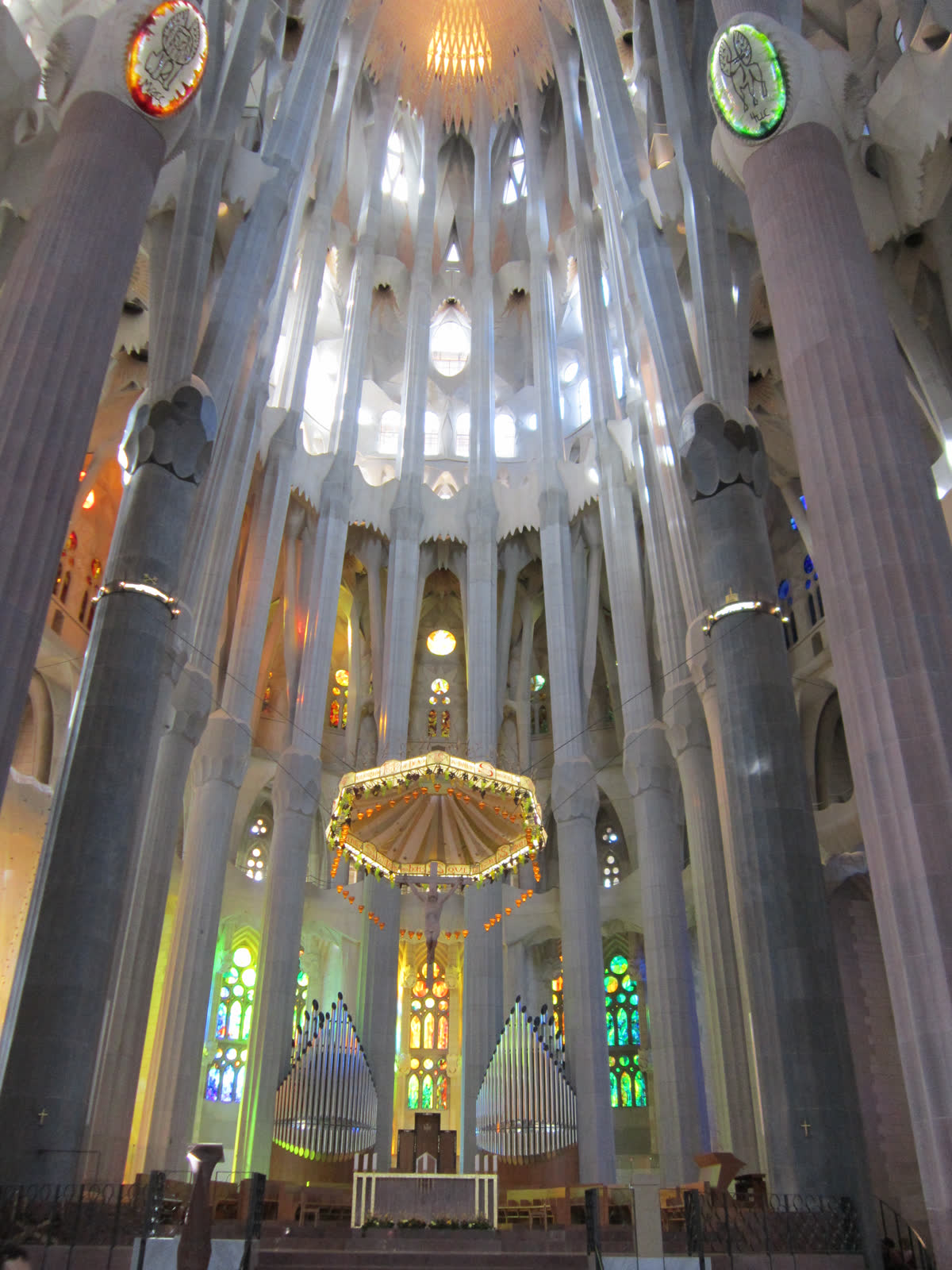
Fact File
| Item | What is known now | Confidence note |
|---|---|---|
| Event | Pope Leo XIV presided over the June 10 Mass for the centenary of Gaudi's death and blessed the Tower of Jesus Christ.[1] | High; official Sagrada Familia post-event account. |
| Tower | The Tower of Jesus Christ is listed at 172.5 meters and described by the basilica as its highest point and the element that makes it the tallest church in the world.[1] | High for official measurement and claim; independent ranking language can vary by definitions. |
| Attendance | The basilica says more than 8,500 attended in person, with thousands more watching on city screens and broadcast.[1] | High for organizer count; crowd estimates outside official zones may differ. |
| Cross | The tower is topped by a 17-meter tall, 13.5-meter wide four-armed cross clad in glass and white enamelled ceramic tiles.[1] | High; direct technical description from the basilica. |
| Event design | The separate event page describes the blessing and inauguration as following the solemn Mass and as a visual tribute over Barcelona.[2] | High; official event page. |
| City pressure | AP's pre-event reporting, carried by ABC News, says the basilica's fame has intensified overtourism concerns and that visits rose from about 3 million annually after the 2010 consecration to nearly 5 million in 2025, according to the construction project's CEO.[3] | Medium-high; credible wire reporting, but future tourism impact remains an inference. |
What Changed
The first change is symbolic. The central tower is the architectural element that lets the basilica read as a completed vertical idea rather than only a long-running work site. The Sagrada Familia's own event page calls the tower the tallest and most symbolic element of Gaudi's project and frames its inauguration as a decisive step toward fulfilling his plans.[2] That does not settle every construction question, but it gives the project a new public grammar: after June 10, visitors will not be looking only at cranes, facades, and projections. They will be looking for the tower the pope blessed.
The second change is ecclesial. Pope Benedict XVI consecrated the basilica for worship in 2010 and designated it a minor basilica; the official post says Leo XIV is the third pontiff to visit Sagrada Familia, after John Paul II and Benedict XVI.[1][5] Leo's visit therefore places the new tower inside a papal sequence rather than a tourism campaign alone. For Catholics, the central event is not height. It is a blessing, a Mass, a tomb visit, and a centenary tribute to an architect whose design was built as theology in stone.
The third change is urban. AP's pre-event reporting makes the tension explicit: the same artistic force that brings pilgrims and visitors also strains the surrounding neighborhood, where residents already associate the site with tour buses, souvenir commerce, and day-trip congestion.[3] Pope Leo's Mass gives the basilica a fresh global story just as Barcelona continues to manage the cost of being overvisited. The tower may deepen devotion and architectural interest, but it can also raise the volume on a local question: who gets to live around a world monument once the monument becomes even more successful?
Why This Is Not A Simple Completion Story
The word "completion" is doing too much work here. The official history says the cornerstone was laid in 1882, Gaudi took over in 1883, he worked exclusively on the temple from 1914 until his death in 1926, and construction continued through war damage, model reconstruction, twentieth-century management changes, and the modern tower campaign.[5] A tower can be complete while the project remains historically layered and administratively unfinished.
That distinction matters because it protects the story from becoming sentimental. The Sagrada Familia is not only a genius's dream finally delivered. It is also a financed, governed, engineered, ticketed, litigated, and visited urban institution. The official 2026 program describes the year as a city-wide commemoration and explicitly invites citizens into a tribute running from 2025 through Christmas 2026.[4] That language recognizes that the basilica's legitimacy is not maintained by stone alone. It has to be kept socially legible to the city that hosts it.
The strongest counterweight to celebration is the tourism load. AP's context is stark: Benedict's 2010 consecration helped lift visits from roughly 3 million a year to nearly 5 million in 2025, and the construction project's CEO predicted the new papal moment could similarly make the world discover the towers.[3] If that forecast is right, the tower blessing is a demand shock as much as a liturgical event.
Decision Impact
Next 24 hours: the immediate test is operational: crowd dispersal, transit pressure around the basilica, security wind-down, and how Spanish, Catalan, municipal, and church authorities describe the event after the first media cycle.[1][3]
Next 7 days: the useful signals will be booking demand, parish and pilgrimage messaging, neighborhood response, and whether local authorities frame the event as a religious commemoration, an architecture milestone, a tourism win, or a pressure point requiring management.[3][4]
Next 30 days: watch whether the tower blessing changes practical visitor behavior. If the newly illuminated cross and the "tallest church" claim become the dominant travel hook, Barcelona may see more tower-oriented demand even before later construction phases and civic disputes are resolved.[1][2][3]
Scenarios
Base case: the papal Mass becomes the defining image of Gaudi Year. The basilica absorbs a near-term wave of attention, but the effect is managed through normal ticketing, timed access, broadcast memory, and a wider 2026 cultural program rather than an uncontrolled rush.[1][4]
Upside case: the event helps Barcelona recast Sagrada Familia as a shared civic and spiritual site, not just a tourist machine. If the church's programming keeps local participation visible and if visitor flow is actively managed, the tower can become a calmer completion milestone rather than another reason to crowd the same streets.[3][4]
Downside case: the tower blessing becomes a pure demand amplifier. If marketing, pilgrimage, cruise traffic, and social-media attention all point at the new cross without better street management, resident frustration could grow around the very building the ceremony tried to present as a collective inheritance.[3]
Bottom Line
Pope Leo's Sagrada Familia Mass matters because it changed the status of the building's central tower in public memory. The basilica can now point to a blessed, lit, measurable culmination: 172.5 meters, a 17-meter cross, and a centenary ceremony around Gaudi's death.[1] But the event's durable meaning will be decided outside the photograph as much as inside it. If Barcelona can turn the new attention into worship, cultural programming, and managed visiting, the tower blessing will read as a rare alignment of architecture, faith, and civic patience. If not, it will become another proof that finishing a monument is easier than living with its success.[1][3][4]
Sources
- Sagrada Familia, "Pope Leo XIV presides over solemn mass commemorating hundredth anniversary of Antoni Gaudi's death and blesses tower of Jesus Christ" (June 10, 2026).
- Sagrada Familia, "Blessing and inauguration of the Tower of Jesus Christ" (event page, June 10, 2026).
- ABC News / Associated Press, "Pope Leo to hold evening Mass at the Sagrada Familia" (June 2026).
- Sagrada Familia, "Sagrada Familia 2026" official Gaudi Year programme page.
- Sagrada Familia, "History of the Temple" (official basilica history page).
- Wikimedia Commons, "File:Altar sagrada familia.jpg" (photograph of the Sagrada Familia altar, 2011).