As of 2026-04-17 02:03 UTC, the glamorous Artemis II story is already complete enough for a victory reel. Four astronauts launched on April 1, looped behind the Moon on April 6, set a new human-distance record at 252,756 miles from Earth, and splashed down off California on April 10 after a mission of about 10 days.[1][2][3] That public story is true. It is also no longer the most useful one.
The more important Artemis II headline now sits at the end of the mission rather than at the beginning. Orion has completed, with crew aboard, the exact return chain NASA most needed to watch after Artemis I: skip entry from lunar-return velocity, heat-shield performance through a two-phase atmospheric encounter, parachute deployment, and offshore recovery near San Diego.[1][2][5] If Artemis II matters operationally for Artemis III, it is because those systems have now been exercised in a real crewed mission rather than defended only through simulations, uncrewed data, and engineering rationale.[1][4]
That distinction matters because NASA's own heat-shield investigation in December 2024 did not describe a vague anomaly. It described a concrete mechanism. During Artemis I, gases generated inside Orion's Avcoat ablative material could not vent as expected during skip entry; pressure built up, cracking followed, and some charred material broke off across several locations.[4] NASA answered that problem with an extended investigation, 121 post-flight thermal tests, and an operational-change rationale that it said would keep Artemis II's crew safe while future heat shields move toward more uniform permeability.[4] The live question after splashdown, then, is no longer whether Orion could survive reentry on paper. It is how much real flight evidence Artemis II just added to that case.
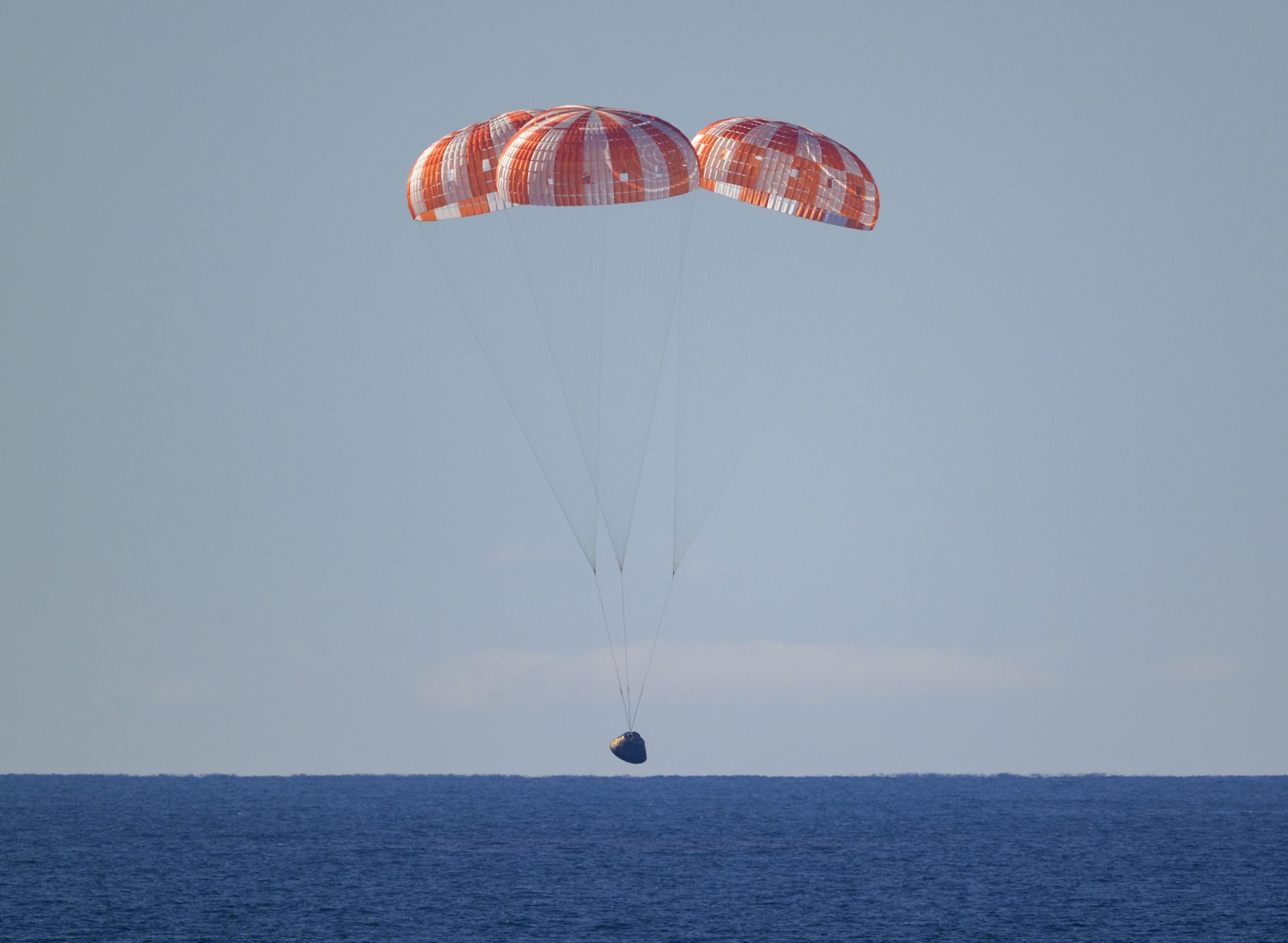
Image context: NASA's splashdown photo is a better lead image than a launch frame for this article because the event's current significance sits in controlled return, not departure. The mission's outward leg proved that the crew could get to lunar distance. The return leg is what speaks most directly to whether Orion is becoming an operationally credible crew vehicle for the next phase of Artemis.[7]
Why the real proof came at the end
NASA's own mission framing already points in this direction. The agency's April 10 release did celebrate the distance record and the symbolism of sending astronauts to the Moon for the first time in more than half a century, but it also said "focus now turns confidently toward assembling Artemis III."[1] That sentence is doing more work than the applause line around it. Artemis III does not need another reminder that lunar flyby pictures can move public attention. It needs a return system that behaves well enough to stop dominating risk discussions on the Orion side of the program.
Seen that way, splashdown is not just the coda to a successful mission. It is the first crewed check on whether NASA's post-Artemis-I understanding of the return environment was robust enough. The Artemis II crew did not merely come home; they came home through the exact profile NASA had spent the last year defending: a skip-entry architecture designed to stretch landing range, moderate crew loads, and guide Orion toward a recovery zone close enough to support faster retrieval.[4][5] That makes the last phase of Artemis II more decision-relevant than the far-side selfies.
Why the heat shield stayed at the center
The heat shield remained the core technical story for a reason. NASA's 2024 investigation found that the issue on Artemis I was not simple over-heating of the crew cabin. In fact, NASA said thermal performance exceeded expectations and that cabin temperatures would have remained safe had astronauts been aboard.[4] The problem sat in the material behavior of the heat shield itself. As Orion dipped into the atmosphere and then skipped back out, heating rates fell during the interval between the two entries, thermal energy accumulated inside Avcoat, and gases from ablation could not dissipate quickly enough in less-permeable sections.[4] That pressure buildup produced cracking and uneven char shedding.[4]
That background changes how Artemis II should be read. A successful crewed splashdown does not erase the old issue by public mood alone, and it does not instantly certify every future Orion heat shield. NASA has already said future shields for lunar-landing missions are being produced with more uniform and consistent permeability.[4] But Artemis II does provide something NASA lacked in 2024: crewed flight data collected after the agency had already isolated the failure mechanism and adjusted operations around it.[4] On April 16, the Associated Press reported that the astronauts singled out Orion's performance during reentry, especially the heat shield, in their first postflight news conference.[6] That is not proof by itself. It is, however, a useful signal that the most scrutinized part of the vehicle did not turn the mission's return phase into a visible instability story.
Why skip entry and recovery are one system
One reason the return matters so much is that Orion's reentry profile is not just a heat-shield problem. It is a combined guidance, loads, heating, parachute, and recovery problem. NASA's pre-Artemis explanation of skip entry makes clear why. Orion is designed to dip into the upper atmosphere, use lift to skip back out, then reenter for final descent under parachutes.[5] NASA said that approach can extend the vehicle's range to 5,524 miles beyond the point of entry, compared with about 1,725 miles for Apollo's direct-entry profile, and is intended to bring Orion down roughly 50 miles off the coast of San Diego.[5] The same architecture also splits the reentry burden into two lower-acceleration events of about four g's each and divides the heating over two encounters rather than one harsher plunge.[5]
Artemis II has now run that logic in crewed form. NASA's April 10 updates said Orion completed its final burn at 2:53 p.m. EDT, targeted splashdown for 8:07 p.m. EDT / 5:07 p.m. PDT, and was met by a combined NASA and U.S. military recovery team after landing in the Pacific.[1][2] That is why the right frame for the mission is not simply "humans went far." The more consequential fact is that Orion returned within the geometry and tempo its designers had been promising: lunar-return speed, controlled entry, parachutes, near-shore splashdown, and rapid crew recovery.[1][2][5]
What changes now
The prudent reading is not that Orion's return questions are finished forever. Postflight assessment still matters, and NASA will need to show that the flight data match the models closely enough to keep the Orion side of Artemis III from reopening as a major source of doubt.[1][4] But the burden has changed shape. Before Artemis II, NASA was asking observers to believe that it understood the Artemis I heat-shield behavior well enough to fly crew with operational changes. After Artemis II, the agency can point to a completed crewed mission that ran the same broad return concept all the way through Pacific recovery.[1][2][4]
That is why Orion's splashdown is the live file. The Moon loop gave Artemis II its historical meaning. The ride home gave it its engineering value.[1][3][4] If the ongoing postflight review supports what the mission looked like in public, then Artemis II will matter less as a nostalgia event than as the mission that made Orion's reentry case substantially harder to dismiss.[1][4][6]
Sources
- NASA, "NASA Welcomes Record-Setting Artemis II Moonfarers Back to Earth" (April 10, 2026).
- NASA, "Artemis II Flight Day 10: Crew Completes Final Burn Before Splashdown" (April 10, 2026).
- NASA, "Artemis II Flight Day 6: Lunar Flyby Updates" (April 6, 2026).
- NASA, "NASA Identifies Cause of Artemis I Orion Heat Shield Char Loss" (December 5, 2024).
- NASA, "Orion Spacecraft to Test New Entry Technique on Artemis I Mission" (April 8, 2021).
- Associated Press, "Artemis II astronauts praise their moonship's performance, especially the heat shield" (April 16, 2026).
- NASA, "Artemis II Splashes Down" (image article, April 11, 2026).