As of 2026-04-17 01:07 UTC, NASA's Northrop Grumman CRS-24 mission is best read as a station-throughput and hardware-refresh file, not as a launch-day highlight reel. The dramatic part already happened on April 11, when Cygnus XL lifted off from Cape Canaveral on a SpaceX Falcon 9 with more than 11,000 pounds of cargo for the International Space Station.[1][2] The more useful part of the story came after that: astronauts captured the spacecraft, installed it on the station's Unity module, and began unpacking hardware that immediately feeds research, maintenance, exercise capability, and daily life aboard the orbital laboratory.[4][5][6]
That distinction matters because cargo missions are easy to flatten into one visual event. The rocket climbs, the spacecraft separates, social feeds move on. NASA's own updates show that CRS-24 only becomes legible once the boring-sounding middle stage begins: berthing, unloading, activation, and integration into station workflows.[4][5][6] That is where the mission shifts from spectacle to operations.
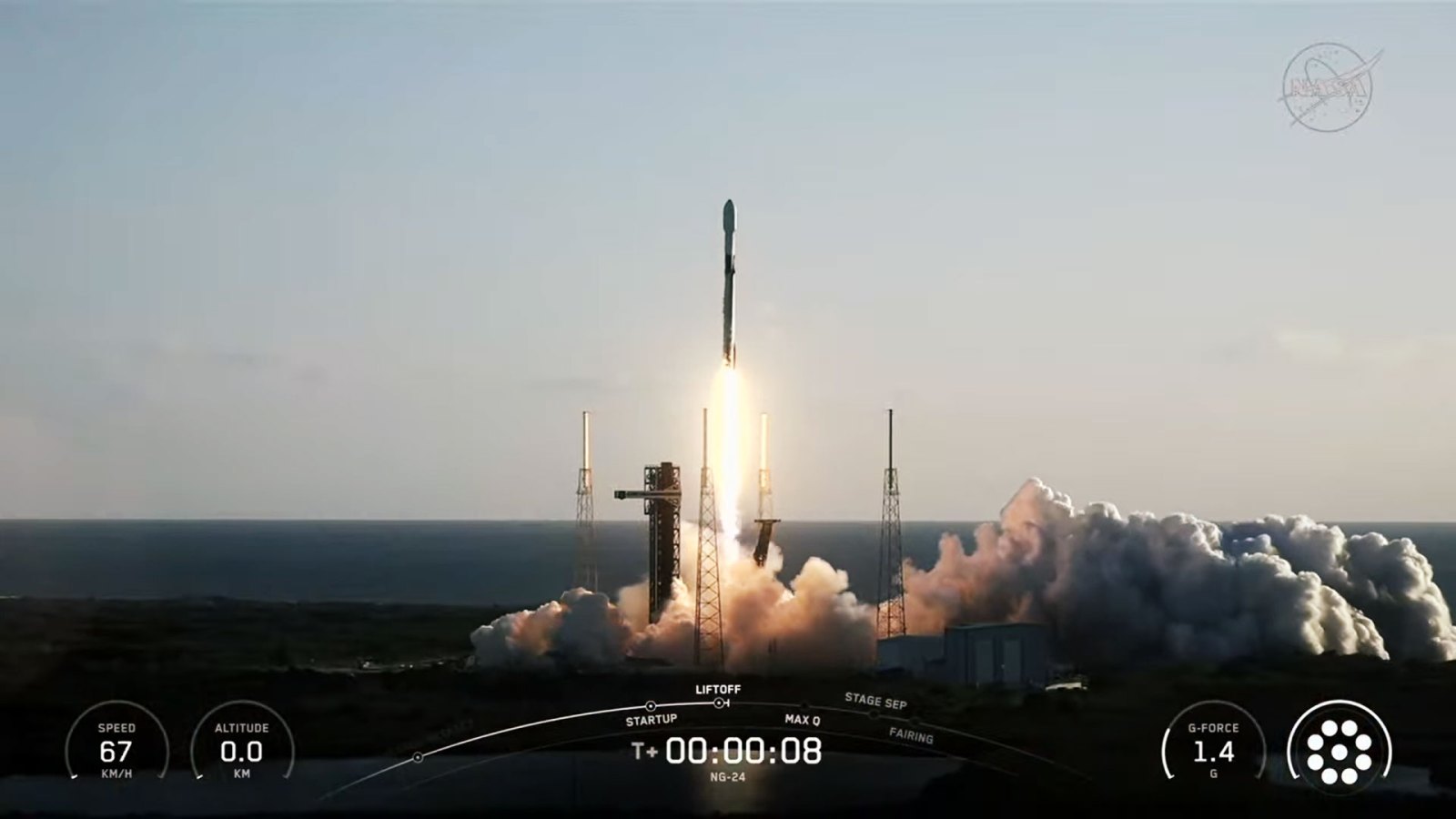
Image context: the cover image shows Cygnus XL leaving the ground on April 11. It fits this article because the launch is the visible opening of a longer logistics chain that now reaches into station maintenance, scientific throughput, and crew support.[1]
What changed after launch day
NASA's timeline is already clear. Cygnus XL launched at 7:41 a.m. EDT on April 11 from Space Launch Complex 40 at Cape Canaveral Space Force Station.[1][5] By April 13, station crew using the Canadarm2 robotic arm had captured the spacecraft and, later that day, NASA said it had been installed to the Unity module's Earth-facing port for cargo unloading.[4][5] By April 15, the crew was no longer waiting on arrival operations. NASA reported that new science experiments were getting underway and that newly delivered research hardware was already being configured inside the station's laboratories.[6]
That sequence is why CRS-24 should be treated as a throughput story. A cargo mission is not complete when the rocket clears the tower, and it is not even especially useful when the vehicle merely reaches orbit. Its value appears when station systems absorb what was delivered without bottlenecks: racks get loaded, replacement hardware gets swapped in, exercise gear gets installed, experiments move from manifest lines into running procedures, and the crew's workday changes because the cargo is now inside the station.[4][5][6]
The payload is a mix of science ambition and orbital housekeeping
NASA's mission overview makes the cargo mix unusually easy to parse. On the science side, Cygnus XL brought a new Cold Atom Lab module, which NASA says will expand quantum-science work tied to general relativity, planetary composition, and dark matter research.[2] It also carried the InSPA-StemCellEX-H2 investigation on blood stem cell production in microgravity, a radio-signal experiment aimed at better space-weather modeling, and the CBIOMES study of how spaceflight affects the relationship between organisms and their gut microbiome.[2]
If the mission only carried those investigations, the article could still be framed as a science brief. But NASA's own manifest argues for a broader read. CRS-24 also brought the European Enhanced Exploration Exercise Device, a new microgravity workout system developed with ESA; a Supplemental Heat Rejection Evaporative Cooler for thermal-control contingencies; a replacement Ocular Coherence Tomography unit for eye-health monitoring; hatch-seal covers, batteries, water tanks, gas tanks, and a spare water-dispenser unit for the Waste and Hygiene Compartment.[2] That is not one category of cargo. It is the full institutional bundle required to keep the ISS functioning as both laboratory and habitat.
This matters editorially because "science payload" can sound glamorous while "station hardware" sounds secondary. In practice, the second category is what keeps the first one alive. A quantum module or stem-cell experiment has more room to matter when the station's thermal margins, life-support routines, exercise systems, and replacement-device inventory are being maintained at the same time.[2][6]
The latest signal is activation, not arrival
The freshest NASA update in the source pack is operational rather than ceremonial. On April 15, NASA said the Expedition 74 crew had already moved into activation work: Chris Williams was unpacking and powering computer hardware that supports the new ESA exercise device; Williams and Jessica Meir were replacing components on that unit to prepare it for use; Jack Hathaway kicked off the Space Surface Spirulina experiment on protein production and carbon-dioxide processing; and Hathaway installed the new Cold Atom Lab hardware inside the station's Destiny laboratory module.[6]
That is the strongest clue about what CRS-24 means in real time. The mission has already crossed the threshold from "incoming shipment" to "working inventory." Readers do not need to wait for a distant paper or a glossy end-of-mission montage to see whether the cargo mattered. NASA is already describing crew hours being reassigned around the delivered equipment.[6]
It also clarifies why the Cygnus XL platform matters beyond this one flight. NASA's mission page calls CRS-24 an active mission and frames commercial resupply as part of the agency's longer partnership with private American companies serving the station.[3] The install update adds that this is the second flight of the larger, more cargo-capable version of Cygnus.[5] That combination suggests the live issue is not simply whether cargo got there. It is whether NASA's commercial logistics lane can keep moving increasingly varied payloads into a station that still depends on frequent, disciplined turnover of both experiments and infrastructure.[3][5]
What to watch next
The next few months should be read through three lenses. First, how much of the research manifest gets activated smoothly and quickly enough to use the current expedition window well.[2][6] Second, whether the hardware-refresh side of the cargo quietly lowers operational friction aboard the station, which is harder to headline but central to mission continuity.[2][6] Third, what Cygnus does on the back end: NASA says the vehicle is expected to remain at the ISS until October, then depart carrying station trash for destructive re-entry in Earth's atmosphere.[1][5]
That last point is worth keeping in view. CRS-24 is not only an inbound delivery. It is also part of the station's waste-management loop.[1][5] In other words, Cygnus is useful on the way up and on the way out. That is another reason the right frame is throughput rather than launch drama.
Bottom line
The cleanest way to read CRS-24 in mid-April is this: NASA has already moved past the photogenic phase. The mission now lives in berthing, activation, replacement hardware, and laboratory tempo.[4][5][6] The cargo list makes clear that the ISS still runs on an inseparable pair of needs: frontier research and ordinary upkeep.[2]
That is why Cygnus CRS-24 matters. It is carrying a quantum-science module, stem-cell work, and microbiome research, but it is also carrying exercise capacity, cooling resilience, eye-health instrumentation, tanks, covers, and sanitation support.[2] A station that cannot refresh itself cannot keep being a laboratory. CRS-24 is the latest proof that in low Earth orbit, logistics is part of the science story.[2][3][5][6]
Sources
- NASA, "NASA Science, Cargo Launch Aboard Northrop Grumman CRS-24" (April 11, 2026).
- NASA, "NASA's Northrop Grumman CRS-24 Mission Overview" (updated April 10, 2026).
- NASA, "NASA's Northrop Grumman CRS-24" mission page (active mission page, accessed April 17, 2026).
- NASA, "Cygnus XL Cargo Craft Approaching Station for Robotic Capture" (April 13, 2026).
- NASA, "Canadarm2 Installs Cygnus XL Cargo Craft to Unity Module" (April 13, 2026).
- NASA, "Crew Begins New Space Research and Installs New Science Gear" (April 15, 2026).