As of 2026-06-12 20:31 UTC, NATO's burden-sharing argument has moved from percentages to platforms. AP reported on June 12 that NATO's top military officer is weighing alternative European defense plans after the United States said it would cut the number of aircraft and warships available in a security crisis.[1] Defense News, carrying Reuters reporting on a New York Times account, put sharper numbers on the shift: fewer F-16 and F-15E fighters, fewer maritime reconnaissance aircraft, no previously assigned aerial refueling tankers, and possible movement of a missile-launching submarine and aircraft carrier away from the European plan.[2]
The key point is not that Article 5 has vanished or that Russia is about to attack NATO tomorrow. AP reported that Gen. Alex Grynkewich, NATO's Supreme Allied Commander Europe, said current intelligence and Russian troop movements do not suggest Moscow is seeking conflict with NATO now.[1] The point is narrower and more operational: if Washington holds back scarce air and naval assets for other theaters, Europe and Canada must close specific capability gaps before a crisis, not after one begins.
Fact File
| Point | What is verified | Confidence note |
|---|---|---|
| Current trigger | AP says NATO is weighing options as the U.S. reduces aircraft and warships available for Europe if a crisis occurs.[1] | High for AP's reporting; the precise classified force-plan details remain undisclosed. |
| Reported reductions | Reuters/Defense News says the plan cuts F-16 and F-15E fighters from about 150 to 100, maritime reconnaissance aircraft from 26 to 15, and removes all eight previously available aerial refueling tankers.[2] | Medium-high; sourced to senior European officials and a New York Times report, not a full Pentagon public table. |
| Strategic rationale | U.S. reporting frames the shift as part of planning for conflict elsewhere, especially the Indo-Pacific.[1][3] | Medium-high; consistent across defense reporting, but final allocations may still change. |
| NATO spending baseline | NATO says allies committed in 2025 to invest 5% of GDP annually by 2035, including 3.5% for core defense and up to 1.5% for related security and resilience.[5] | High; official NATO policy page. |
| Capability focus | NATO's 2025 capability targets include air and missile defense, long-range weapons, logistics, and large land maneuver formations.[4] | High; official NATO deterrence-and-defense page. |
| Threat window | AP says European governments and intelligence services have warned Russia could be able to attack elsewhere in Europe within three to five years, especially if it wins in Ukraine.[1] | Medium; warning horizon is an intelligence judgment, not a prediction. |
What Changed
Europe has already accepted the headline spending argument. NATO says all allies met or exceeded the pre-summit 2% defense-spending target in 2025, and that European allies plus Canada increased defense spending by 20% from 2024 to 2025, reaching more than $574 billion in adjusted 2021 dollars.[5] That is politically important. It is not the same thing as having enough tankers, reconnaissance aircraft, long-range fires, air defenses, ammunition stocks, trained crews, ports, rail routes, depots, and command systems ready when a contingency starts.
That is why the reported U.S. cut matters. Fighters can be counted, but modern air power depends on the chain around them. Removing tanker availability, if the Reuters/Defense News numbers hold, is not a footnote. Tankers extend patrol time, support reinforcement, and allow aircraft to operate from safer or more flexible bases. Maritime reconnaissance aircraft are similarly unglamorous until a navy needs to track submarines, protect sea lanes, or watch approaches to the North Atlantic, Baltic, Mediterranean, or Norwegian Sea.[2]
NATO has known this problem was coming. Its public deterrence page says the alliance moved from the old NATO Response Force to the NATO Force Model and Allied Reaction Force, aiming for a larger pool of combat-capable forces tied to regional expertise and geographic proximity.[4] The same page says the newer capability targets include air and missile defense, long-range weapons, logistics, and large land maneuver formations.[4] In plain English: the alliance is trying to turn national force promises into forces that can actually arrive, fight, and stay supplied.
The U.S. shift makes that conversion less optional. NATO Deputy Secretary General Radmila Shekerinska told the NATO Parliamentary Assembly on June 1 that America expects allies to carry greater responsibility for Europe's conventional defense while still being backed by U.S. power.[6] She also emphasized air defenses, jets, missiles, interceptors, counter-drone systems, drone technologies, and faster production at scale.[6] Those lines now read less like summit rhetoric and more like a task list.
Why The Gap Is Hard To Close
The obvious answer is "spend more," but that answer is incomplete. Buying new fighter aircraft, frigates, missile batteries, or tankers takes years. Training crews and maintainers takes years. Reopening industrial capacity takes contracts, skilled labor, components, explosives, propulsion systems, testing ranges, and political patience. A defense budget can rise in a single fiscal year; a credible reinforcement architecture cannot.
The more useful question is which gaps are most time-sensitive. Air defense and counter-drone systems can protect bases, ports, depots, and cities. Long-range fires can complicate an aggressor's planning. Drones and loitering munitions can be bought and adapted faster than many crewed platforms. But tankers, maritime patrol aircraft, submarines, carrier aviation, heavy airlift, and integrated command-and-control are not quick substitutes. If the United States reduces those enablers, Europe cannot fill every hole with cheap mass.
The political risk is that NATO members treat the new 5% commitment as proof of readiness before the money becomes deployable force.[5] Spending targets can mobilize parliaments and budgets, but they can also create false comfort. The force-planning question is sharper: by the Ankara summit and the next defense-planning cycle, can allies show which U.S. capabilities are being replaced, which are still assumed, and which operational plans are being rewritten around scarcity?
There is also a signaling problem. If Washington is reallocating scarce assets toward the Indo-Pacific, that does not automatically mean the U.S. is abandoning Europe. It can mean the U.S. wants Europe to cover more conventional defense so American power can remain available as strategic backstop and global reserve. But ambiguity is costly. Allies need enough public clarity to fund the right programs and enough private clarity to write realistic plans.
Decision Impact
Next 24 hours: the story is still partly reported through unnamed officials and press accounts. Watch whether the Pentagon, U.S. European Command, or NATO confirms the categories of cuts in public, even if they avoid classified plan details.[1][2]
Next 7 days: watch whether European governments respond with platform-specific commitments rather than general spending language. Useful signals would include tanker pooling, maritime patrol aircraft cooperation, integrated air-defense procurement, munitions contracts, or logistics corridors tied to NATO plans.[4][5][6]
Next 30 days: the Ankara summit agenda becomes the forcing function. If leaders restate the 5% by 2035 promise without naming near-term enabler gaps, the alliance will have a financing story but not yet a readiness story.[5][6]
Scenarios
Base case: the U.S. reduces some Europe-earmarked air and naval assets while keeping nuclear, space, intelligence, and high-end support available. European allies accelerate procurement but need several years to close the hardest enabler gaps.[1][2][5]
Upside case: the reported cuts force a more honest NATO plan. Allies stop measuring progress mainly through GDP shares and publish or privately lock in capability packages around air defense, tankers, maritime surveillance, long-range fires, ammunition, logistics, and command systems.[4][6]
Downside case: the cuts arrive faster than European replacement capacity. In that branch, NATO's public deterrence language remains firm, but commanders have to plan around thinner air cover, weaker surveillance, and fewer reinforcement options in the early days of a crisis.[1][2]
The falsifier is concrete: if NATO and national governments can identify funded, scheduled replacements for the U.S. air and sea enablers now being reduced, then this is a difficult rebalancing. If they cannot, the alliance has a capability gap dressed up as burden sharing.
Sources
- Lorne Cook, Associated Press, "NATO explores new defense plans as US cuts forces in Europe" (June 12, 2026).
- Reuters via Defense News, "US plans major cut to jets, warships for NATO operations in Europe, NYT reports" (June 12, 2026).
- Chris Gordon, Air & Space Forces Magazine, "US Reduces Forces Committed to NATO in a Crisis" (June 3, 2026).
- NATO, "Deterrence and defence" (topic page, capability targets and NATO Force Model context).
- NATO, "Defence expenditures and NATO's 5% commitment" (topic page, 2025 spending and 2035 commitment).
- NATO, "Keynote address by NATO Deputy Secretary General Radmila Shekerinska to the NATO Parliamentary Assembly Spring Session" (June 1, 2026).
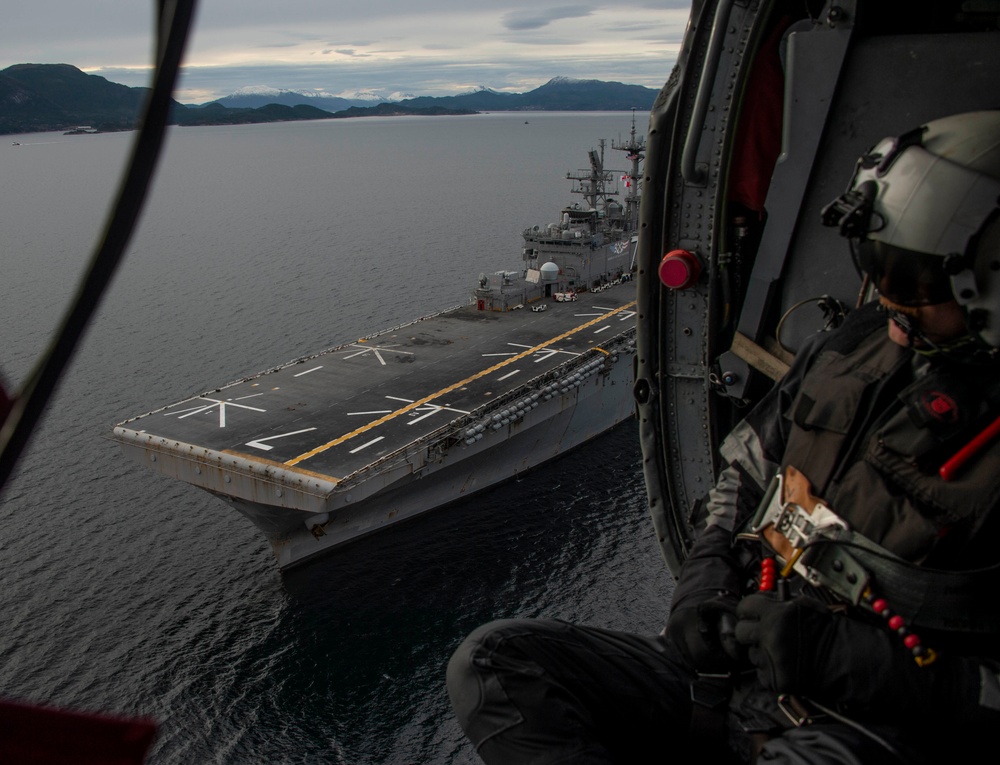
- DVIDS, "181031-N-ZK016-0021" (U.S. Navy photograph of USS Iwo Jima during Trident Juncture 2018, photographed October 31, 2018).