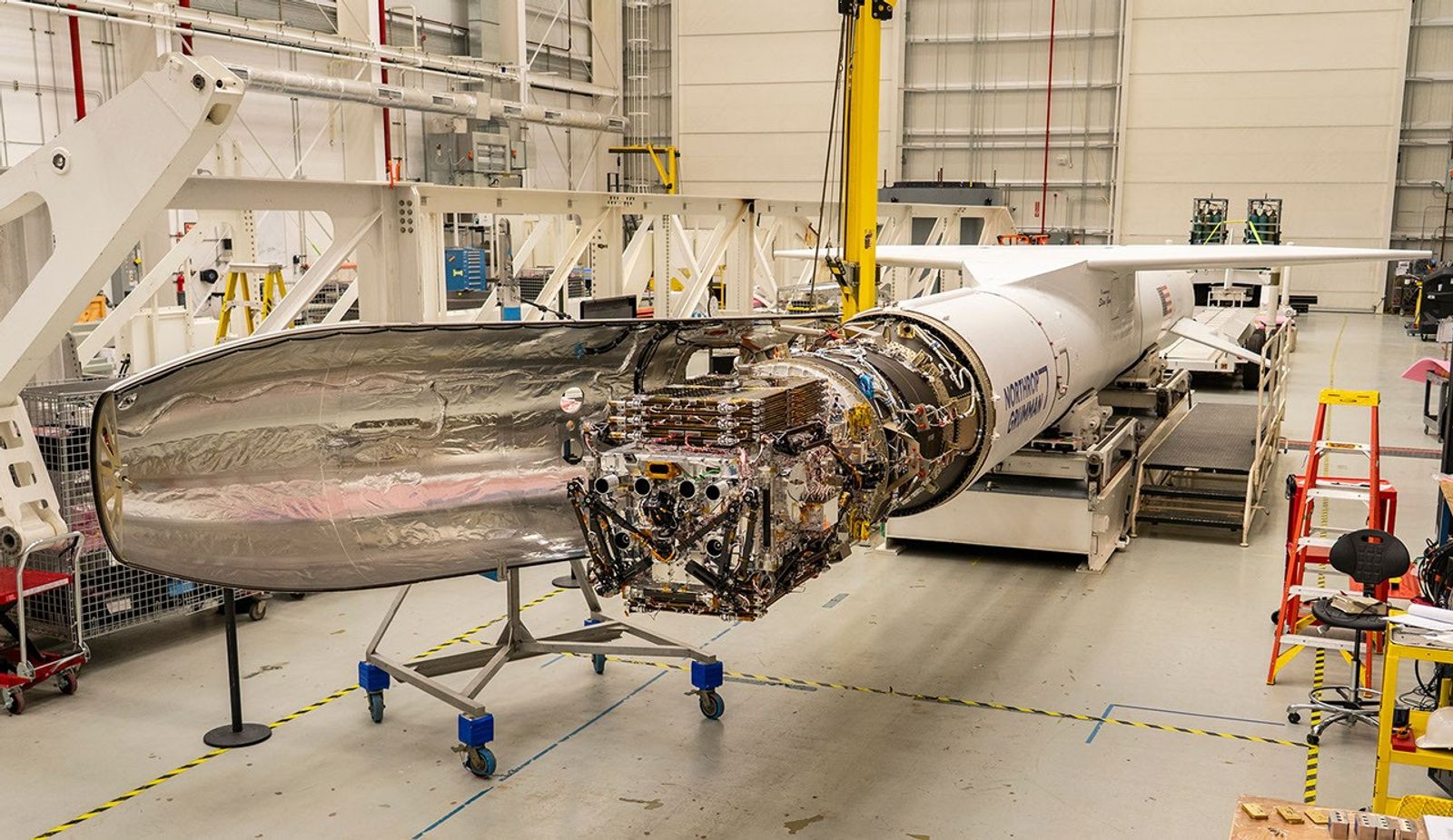
As of 2026-06-13 04:04 UTC, NASA's Swift rescue is no longer just a clever servicing idea. The operational clock has started. NASA says it will hold a June 17 media teleconference to preview Katalyst Space's LINK mission, which is targeted to launch later in June on a Northrop Grumman Pegasus XL from Kwajalein Atoll in the Marshall Islands.[1]
The immediate news is hardware status. LINK arrived at NASA Wallops on June 5, engineers completed installation into Pegasus XL on June 9, and the next major ground step is attaching Pegasus XL to Northrop Grumman's Stargazer L-1011 carrier aircraft before the system moves toward the South Pacific launch site.[3][4]
The bigger issue is whether NASA can convert a threatened science observatory into a live test of rapid, robotic satellite servicing. Swift is still scientifically useful, but its low Earth orbit has been decaying faster after recent solar activity increased atmospheric drag. Because Swift lacks propulsion for orbit maintenance, NASA is trying to keep it high enough for LINK to rendezvous, capture it, and raise its altitude rather than letting it re-enter.[1][2]
Fact File
| Item | What is verified | Confidence note |
|---|---|---|
| Current event | NASA will preview the Katalyst mission on June 17, 2026, with launch targeted later in June. | High: direct NASA media advisory.[1] |
| Hardware status | LINK was installed into a Pegasus XL rocket on June 9 after arriving at Wallops on June 5. | High: NASA Swift blog updates from Wallops.[3][4] |
| Launch architecture | Pegasus XL will be carried by Stargazer and launched from above Kwajalein Atoll. | High: direct NASA description; exact launch day remains pending.[1][3][4] |
| Mission goal | LINK will attempt to rendezvous with Swift, capture it, and boost it to a higher altitude over several months. | High for plan, uncertain for outcome because the servicing attempt has not yet flown.[1][2] |
| Altitude threshold | NASA says teams worked to keep Swift at least 185 miles, or 300 kilometers, above Earth, where the boost mission has the best chance of success. | High: NASA mission page; future altitude depends on space weather and operations.[2][6] |
| Cost and schedule | Katalyst describes the NASA award as a $30 million contract and a less-than-one-year rescue sprint from award to planned launch. | Medium-high: company statement, consistent with NASA's September 2025 contract framing.[1][7] |
What Changed
Swift has been in orbit since 2004, built to chase gamma-ray bursts and other fast-changing high-energy events. NASA describes it as a kind of astrophysics dispatcher: when something sudden appears in the sky, Swift can rapidly identify and observe it so other telescopes know where to follow up.[1][5]
That scientific role is why the reboost attempt is not just sentimental mission preservation. Replacing an observatory is slow and expensive; preserving one already in orbit can buy science time while also testing a servicing capability NASA wants for future spacecraft. The unusual part is that Swift was not designed with a docking port or refueling interface. LINK is attempting to service an unprepared, operational spacecraft, which is a harder proposition than docking with a cooperative target built for the job.[2][7]
The June integration milestone turns that argument from policy into execution. Until LINK is actually attached to Pegasus XL, the story can sound like a procurement case study. Once it is mounted to the rocket, the key constraints become launch access, orbit targeting, rendezvous timing, capture reliability, and Swift's continuing altitude margin.[3][4]
Decision Impact
Next 24 hours: the main thing to watch is not splashy countdown coverage. It is whether NASA, Katalyst, and Northrop Grumman provide a firmer launch window, Stargazer transfer plan, and constraints around the Pegasus flight from Kwajalein. The mission depends on reaching an orbit where LINK can get to Swift in time.[1][3]
Next 7 days: the June 17 call should clarify what NASA considers success. A clean launch alone is not enough. The mission has to navigate to Swift, conduct rendezvous and proximity operations, capture a spacecraft that was not built for capture, and raise it without damaging the observatory or ending science operations unnecessarily.[1][2]
Next 30 days: the high-value signal is whether LINK gets on orbit and begins the sequence NASA describes as a months-long attempt to lift Swift. That is where the story shifts from "can a private servicer launch?" to "can a rapid-response robotic mission safely intervene in the life of a government science asset?"[2][6][7]
Scenarios
Base case: LINK launches in June, reaches its planned orbit, and starts the approach campaign while Swift remains above the altitude margin NASA wants. In this branch, even a cautious, stepwise rendezvous would make the mission a serious demonstration of responsive servicing rather than a rescue stunt.[1][2]
Upside case: LINK captures Swift and raises the observatory enough to extend useful operations. That would give NASA two wins at once: more time for a working astrophysics mission and a proof point for servicing spacecraft that were not built to be serviced.[2][5][7]
Downside case: launch slips, Swift's altitude margin narrows faster than expected, or the rendezvous/capture sequence proves too risky. Space.com's pre-launch reporting emphasized that Swift's location forecast depends on changing space weather, current altitude, and spacecraft orientation; NASA teams are already using weekly predictions and attitude changes to reduce drag.[6]
The falsifier is simple: if LINK cannot safely reach, capture, and raise Swift before altitude or operational risk closes the window, then the mission remains a useful rapid-integration experiment but fails as a rescue.
Action Checklist
- Watch NASA's June 17 teleconference for a firm launch window, mission success criteria, and risk boundaries.[1]
- Separate launch success from servicing success. Pegasus delivery is only the first gate; rendezvous, capture, and orbit raise are the real test.[2][3]
- Track Swift's altitude and operational posture, because NASA's own materials frame the 300-kilometer threshold as important to mission odds.[2][6]
- Treat company claims about national-security and market implications as directional until the spacecraft demonstrates the core operation in orbit.[7]
- If the mission succeeds, watch whether NASA turns the result into a repeatable servicing pathway or treats it as a one-off emergency response.
The practical takeaway is narrow but important. Swift's rescue is now a launch-clock story because the hardware has reached the rocket. But the strategic story is larger: NASA is testing whether a useful spacecraft in decline can become the customer for a new servicing architecture before its orbit runs out.[1][2][3]
Sources
- NASA, "NASA to Preview Katalyst Mission to Boost Swift Spacecraft's Orbit" (June 11, 2026).
- NASA Science, "Swift Boost Mission" (mission page, updated June 8, 2026).
- NASA Science, "Rocket Integration Complete for Katalyst-NASA Swift Boost" (June 10, 2026).
- NASA Science, "Robotic Spacecraft for Swift Boost Mission Arrives at NASA Wallops" (June 5, 2026).
- NASA Science, "Swift" mission overview.
- Mike Wall, "NASA is hatching a 'fast-paced plan' to boost this space telescope. But first, they'll have to find it," Space.com (May 28, 2026).
- Katalyst Space, "A NASA Telescope is about to Fall out of the Sky - We're Planning a Rescue Mission to Save it" (company mission background).