As of 2026-05-21 04:03 UTC, NASA's newly scheduled May 26, 2026 Moon Base news conference is not important because the agency has found a new slogan for returning to the Moon. The slogan already exists. NASA says the Moon Base is a long-term lunar South Pole initiative meant to support sustained human presence and expanded scientific and commercial activity.[1] The useful question now is whether the agency can turn that phrase into an executable surface-infrastructure program.
The timing makes the briefing sharper. NASA's May 20 advisory says Administrator Jared Isaacman, acting exploration-systems chief Lori Glaze, and Moon Base program executive Carlos García-Galán will discuss program progress, new industry partners, and mission plans.[1] One week earlier, NASA described Artemis III as a 2027 Earth-orbit demonstration that will test Orion rendezvous and docking with commercial lander pathfinders from SpaceX and Blue Origin before a planned Artemis IV lunar landing.[2] In other words, the Moon Base briefing lands between ambition and proof: NASA is trying to explain a surface base while the immediate mission sequence is still being de-risked above Earth.
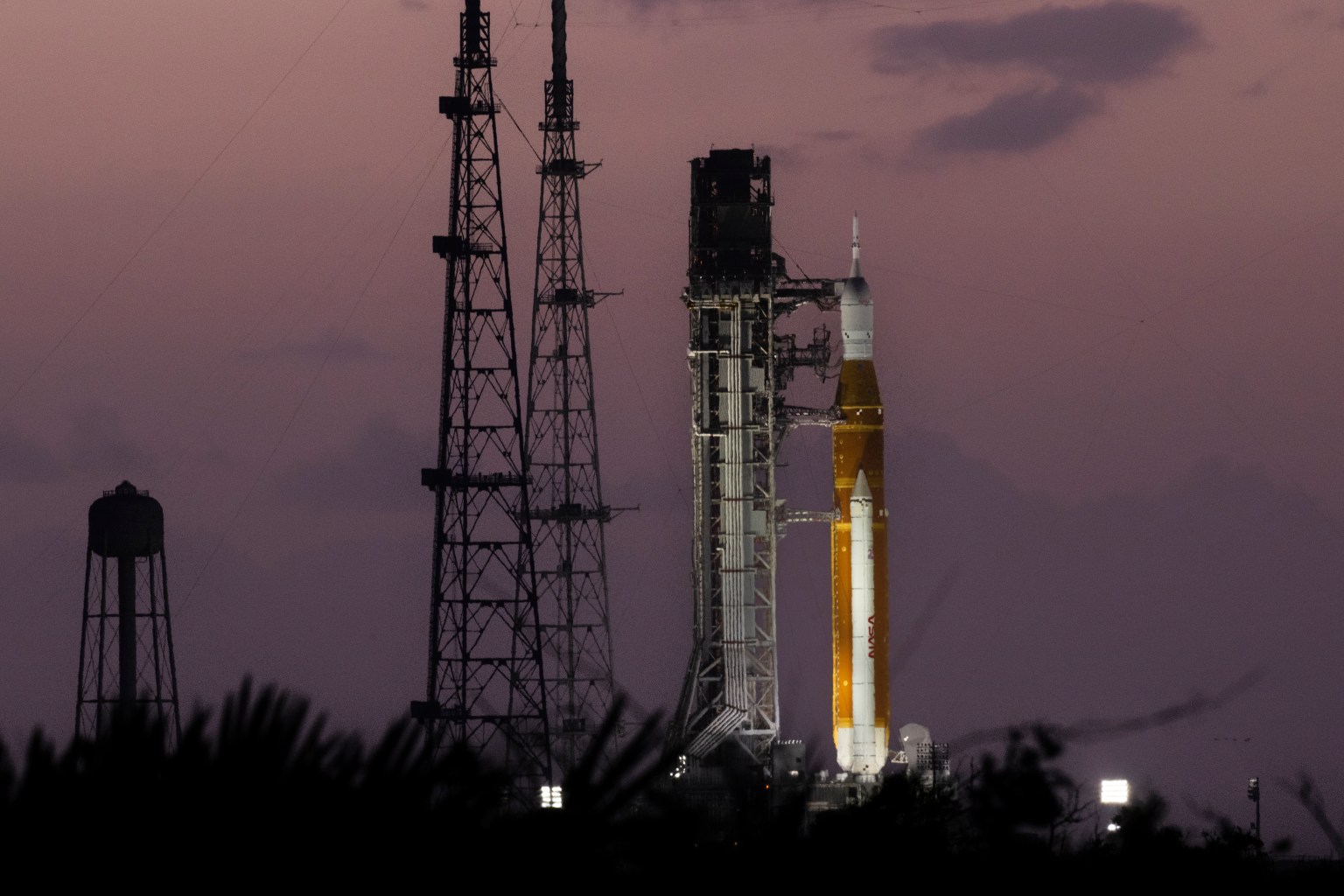
Image context: the cover uses NASA's photograph of Artemis II's SLS and Orion on Pad 39B at sunrise, taken March 30, 2026.[2] That is deliberately not the artist concept used in the advisory. The live issue is whether launch operations, lander tests, cargo delivery, and surface systems can accumulate into a repeatable Moon Base campaign.
Fact File
| Item | What is live now | Confidence note |
|---|---|---|
| Immediate event | NASA will hold a Moon Base strategy and missions briefing at 2 p.m. EDT on May 26, 2026.[1] | High; direct NASA media advisory. |
| Program claim | NASA describes Moon Base as a long-term lunar South Pole initiative for sustained human presence, science, and commercial activity.[1] | High for NASA's stated intent; not yet proof of delivery. |
| Near-term mission gate | Artemis III is now framed as a 2027 low-Earth-orbit demonstration of rendezvous and docking with commercial lander pathfinders.[2] | High; NASA updated the article May 15 and last updated the page May 19. |
| Landing sequence | NASA's Artemis overview says Artemis IV remains targeted for early 2028, with Artemis V expected by late 2028 and later surface missions roughly annual.[3] | Medium-high; public targets can move. |
| Technology demand signal | NASA's 2026 shortfall ranking puts extended-duration lunar operations first and surface mobility/logistics second among 32 shortfall categories.[4] | High for the ranking document; it is not a funded delivery schedule. |
| Scale of the base concept | NASA's Moon Base guide sketches three phases totaling 25, 27, and 29 launches and 21, 24, and 28 landings, with payload-to-surface mass rising from about 4,000 kg to 150,000 kg.[5] | Medium; it is an architecture guide, not a launch manifest. |
What Has to Be More Specific on May 26
The headline will probably be "Moon Base." The substance should be interfaces. NASA's own documents already reveal why. The Moon Base guide says early development depends on shared power, logistics, communications, and navigation rather than one self-contained habitat dropped onto the surface.[5] That is a different problem from a heroic landing. It is a utility problem: where power comes from, how assets talk to one another, how cargo is unloaded, how crews navigate terrain, how machinery survives darkness and dust, and how systems from many providers remain compatible.
This is where the May 20 technology-priorities release matters. NASA says the 2026 Civil Space Shortfall Ranking integrated 454 external responses and selected 40 focus areas for fiscal-year 2026 investment.[6] The lunar-relevant items are not abstract. They include landing at South Pole sites in varied lighting conditions, low-power thermal management for distributed surface assets, scalable surface-to-surface communications, high-performance computing in dusty and high-radiation environments, regolith manipulation for landing pads and berms, and modeling plume-surface interaction during landing.[4][6]
Those are not decorative details. They are the base. If a lander plume erodes a pad, if a rover cannot survive a cold stretch, if a power cable cannot be mated by a robot, if a surface asset cannot be located reliably, or if communications are brittle around ridges and craters, "sustained presence" remains a phrase attached to a few disconnected missions.
The Briefing Is Also a Partner Test
NASA says the May 26 event will highlight new industry partners.[1] That is the part to watch most closely, because the March Moon Base guide is explicit that the agency will not build the base alone. It points to commercial innovators and international partners as essential, and says Moon Base development should use shared systems and interoperability standards across government, industry, academia, and international contributors.[5]
The independent context is that this is also a program reset. CBS News reported in March that NASA described a roughly $20 billion seven-year plan near the lunar South Pole, including habitats, pressurized rovers, nuclear power systems, and a pivot away from the Gateway station in its existing form toward surface infrastructure.[7] NASA's own Moon Base guide similarly says the Power and Propulsion Element originally planned for Gateway would be repurposed for the SR-1 Freedom nuclear-electric propulsion demonstration.[5] The technical merits of that shift can be argued, but the management implication is simple: NASA has changed the center of gravity from lunar orbit to the lunar surface.
That makes partner specificity more important than partner enthusiasm. A useful briefing would name what industry is being asked to provide, what NASA will standardize, which interfaces are open, which services might be bought commercially, and how near-term missions will retire risk for later phases. A less useful briefing would add logos without clarifying obligations.
The 24-Hour, 7-Day, and 30-Day Impact
In the next 24 hours, nothing changes on the lunar surface. The practical impact is interpretive: NASA has put a date on a public accountability moment for the Moon Base plan.[1] Analysts should prepare questions about interfaces, schedules, procurement lanes, and which technology gaps have near-term owners.
Over the next 7 days, the critical update is whether NASA turns "new industry partners" into named commitments tied to power, communications, landing, logistics, mobility, habitats, or site preparation.[1][5][6] If the briefing only restates the lunar South Pole vision, the signal is weak. If it connects partner work to the 40 technology focus areas or the Moon Base functional gaps, the signal is stronger.[4][5][6]
Over the next 30 days, watch for documents after the briefing: requests for information, draft solicitations, acquisition notices, interface standards, lander-test objectives, or updates to the architecture library. A Moon Base is too complex to be validated by a podium event. It becomes real through boring artifacts: requirements, milestones, funded work packages, and test results.
Scenarios
Base case: NASA uses the May 26 briefing to narrow the surface-base story. The agency names partners, describes how Artemis III lander-pathfinder work feeds Artemis IV and V, and ties near-term investments to specific infrastructure gaps. The Moon Base remains ambitious, but observers get a clearer map of the first gates.
Upside case: the briefing produces a credible integrated sequence: commercial lander tests in orbit, CLPS and cargo demonstrations, shared communications and navigation services, power and thermal demonstrations, regolith/site-preparation experiments, and clear interface standards. In that case, "Moon Base" starts to look less like a replacement label for Gateway and more like a working architecture.
Downside case: the event leans on strategic language without delivery detail. If NASA cannot say which systems are being tested when, which partners own which functions, or how 2027 and 2028 missions reduce surface risk, then the Moon Base plan remains exposed to the same problem that has haunted lunar programs for decades: a persuasive destination without a disciplined operating chain.
What Would Falsify the Optimistic Read
The clearest falsifier is a gap between architecture language and procurement behavior. If, after the briefing, NASA does not produce concrete solicitations, partner scopes, interface standards, or milestone updates tied to power, logistics, communications, landing accuracy, and surface operations, then the May 26 event should be treated as messaging rather than execution.
The better read is conditional. NASA has a sharper Moon Base story than it did a year ago, and the technology-priority documents show that the agency understands many of the surface-system problems.[4][5][6] But understanding the problems is not the same as closing them. The May 26 briefing matters because it should reveal whether NASA is ready to move from naming the base to managing the infrastructure.
Sources
- NASA, "NASA to Provide Update on Moon Base Strategy, Missions" (May 20, 2026).
- NASA, "NASA Outlines Preliminary Artemis III Mission Plans" (May 13, 2026; updated May 15, 2026).
- NASA, "Moon to Mars | NASA's Artemis Program" (program overview; accessed May 21, 2026).
- NASA, FY26 Civil Space Shortfall Prioritization (May 2026 PDF).
- NASA, Moon Base User's Guide: Architecture Resources (April 2026 PDF).
- NASA, "NASA Releases Technology Priorities to Energize Space Industry" (May 20, 2026).
- William Harwood, "NASA unveils ambitious $20 billion plan to build moon base near lunar south pole," CBS News (March 24, 2026).