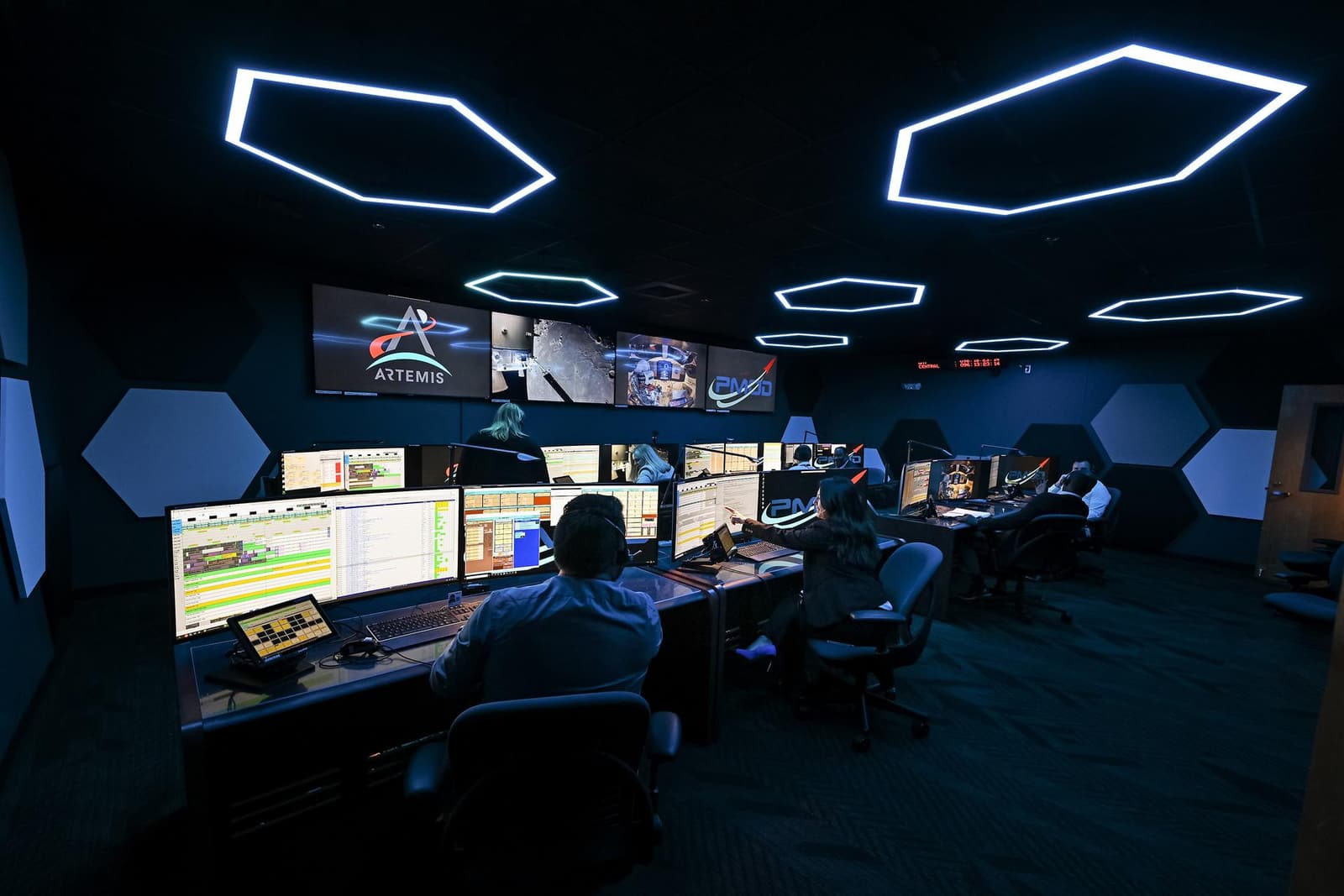
As of 2026-04-25 22:03 UTC, NASA Force should be read as a narrow staffing instrument, not as a full answer to NASA's workforce question. NASA and the Office of Personnel Management launched the new site on April 17, opened the first applications for aerospace engineers, and tied the initiative directly to mission-critical technical work supporting exploration, research, and advanced technology priorities.[1][2]
The operative detail is the appointment structure. NASA's own materials say the first opening is a two-year term position with the possibility of extension, and the NASA Force page points applicants into a broader OPM-run US Tech Force system rather than into a one-off permanent-civil-service pipeline.[1][3][4] That makes the current signal more specific than the name suggests. The government is trying to add targeted engineering capacity quickly, especially in areas it now says are central to lunar, Mars, software, and operations work.[3][5]
The broader context sharpens the point. NASA's March workforce fact sheet says the agency wants to rebuild core competencies, convert thousands of contractor positions to civil service, and create new pathways for experienced industry talent through term-based appointments.[5] At the same time, the White House's fiscal year 2027 budget asks Congress for $18.8 billion for NASA, describing that as a $5.6 billion reduction from the 2026 enacted level.[6] Put together, NASA Force looks less like a mass expansion than like a selective bridge: add scarce technical talent where the agency thinks schedule and mission risk are highest, then let the larger budget and appropriations fight determine how durable that staffing model can become.[1][3][5][6]
Fast facts
| Item | What is known | Confidence note |
|---|---|---|
| Launch date | NASA and OPM said the NASA Force website opened on April 17, 2026.[1][2] | High; both agencies published same-day announcements. |
| Program structure | OPM describes NASA Force as a dedicated track inside the broader US Tech Force initiative.[2][4] | High; explicit in OPM's release language. |
| First role | NASA said the first application is for aerospace engineer positions.[1] | High. |
| Appointment type | NASA said that first opening is a two-year term position with possible extensions.[1][3] | High; this is central to the staffing design. |
| Example work | NASA Force's public page lists projects including VIPER operations, deep-space logistics, Orion flight software, sample curation, ISRU plant development, AI/ML for air traffic control, and propulsion support across Commercial Crew, Launch Services, and Artemis.[3] | High for the kinds of work NASA is using to recruit applicants. |
| Workforce framing | NASA's March fact sheet says the agency is rebuilding core competencies, converting contractor positions to civil service, and using NASA Force to create pathways for experienced industry talent through term-based appointments.[5] | High; official program framing. |
| Budget backdrop | The President's FY2027 budget requests $18.8 billion for NASA, a $5.6 billion drop from the 2026 enacted level.[6] | High for the administration's request; Congress has not enacted FY2027 appropriations. |
What the site actually opens
The most useful way to read NASA Force is operationally. The new page is not a promise that NASA has reopened every hiring lane. It is a recruiting funnel for a defined kind of applicant: technically strong people, often early- to mid-career, who can be placed into high-impact work quickly enough to matter for live programs.[1][2][3]
NASA's examples are telling. This is not a page built around generic statements about public service. It points to lunar rover operations, deep-space logistics, Orion flight software, sample curation, in-situ resource utilization, AI/ML for air-traffic automation, and propulsion support across multiple flight programs.[3] That list reads like a map of where the agency wants additional technical depth: not everywhere at once, but at program bottlenecks where software, systems engineering, operations, and mission integration can still move schedules.
The two-year term structure is the other key fact. NASA Force offers a faster, narrower lane than a claim that the agency has fully rebuilt its long-term civil-service bench.[1][3] Term hiring can bring in specialized people faster, especially when the government wants industry experience on specific problems. It does not automatically solve the slower work of training, retention, promotion, and institutional continuity across an entire agency.
Why this looks like a bridge
The agency's own language makes the bridge logic hard to miss. NASA's March fact sheet pairs three ideas that belong together: rebuild internal core competencies, convert some contractor-heavy work back into civil service, and create a term-based path for experienced outside talent.[5] NASA Force is best understood as the third leg of that stool.
That matters because NASA is trying to do several things at once. After Artemis II, the agency is pushing a more aggressive Moon-to-Mars cadence, more embedded technical oversight across suppliers, and more in-house ability to challenge vendor assumptions.[5] Those ambitions reward deep technical staff who can step into program-level decision points. A term-based program is one way to plug gaps quickly while the agency works on slower structural changes.
The budget request introduces the obvious constraint. The administration is asking Congress for less total NASA money even while describing NASA Force as a pathway for elite engineers and technologists.[6] Those two signals are not impossible to reconcile, but they do imply prioritization. If the budget stays tight, NASA Force likely becomes a tool for concentrating talent in a smaller set of favored programs rather than a broad-based expansion across the agency.
The narrower inference from the official documents is therefore more useful than the marketing headline. NASA Force does not yet look like a promise that NASA will be hiring at scale everywhere. It looks like a mechanism for protecting or rebuilding a few mission-critical capability areas during a period when the agency wants more technical control and may have less fiscal room overall.[1][3][5][6]
What it can solve and what it cannot
NASA Force can solve one real problem: speed of access to scarce technical labor. If a program needs stronger flight-software engineering, propulsion expertise, deep-space logistics planning, or systems talent that can move between agency and industry contexts, a focused term-hiring path is easier to justify than a vague call for more applicants.[1][3]
It can also help align NASA with OPM's wider Tech Force apparatus. OPM has already framed Tech Force as a cross-government effort to embed elite technologists in agencies working on complex challenges, and NASA gets to use that administrative and recruiting machinery instead of standing up a completely separate pipeline from scratch.[2][4]
What it cannot do by itself is resolve the longer argument about NASA's permanent capacity. Term appointments are, by design, time-bounded.[1][3] They can strengthen live missions, but they do not by themselves prove that Congress will finance a larger long-term workforce, that the agency will retain people after the term ends, or that every major technical gap can be handled through selective outside recruitment.[5][6]
What to watch next
The first watch item is breadth. If NASA Force quickly expands beyond aerospace engineers into software, systems, AI/ML, operations, and science-infrastructure roles, then the initiative will look like a real staffing instrument rather than a single-launch announcement.[1][3]
The second is placement. NASA's public examples lean heavily toward Moon, Mars, software, and operations work.[3][5] If later openings cluster around those same areas, the agency will be confirming that NASA Force is aimed at a short list of strategic bottlenecks rather than at generalized headcount growth.
The third is appropriations. The White House has made its FY2027 request. Congress still has to decide what NASA actually gets.[6] If enacted funding diverges sharply from the request, the meaning of NASA Force changes with it. Under a tighter appropriation, the program becomes a triage tool. Under a stronger one, it could become part of a wider workforce rebuild.
The right conclusion is therefore modest and concrete. NASA Force is real, current, and more than branding. It opens a targeted path for technical hiring. But as of April 25, the official materials support a disciplined reading: this is a term-hiring bridge for mission-critical capability gaps, not a finished reset of NASA's workforce model.[1][3][5]
Sources
- NASA, "NASA, OPM Announce New NASA Force Website, Open Job Applications" (April 17, 2026).
- U.S. Office of Personnel Management, "OPM and NASA Launch NASA Force to Recruit Top Talent for America's Space Program" (April 17, 2026).
- NASA, "NASA Force" careers page (accessed April 25, 2026; project examples, application path, and term-hiring details).
- U.S. Office of Personnel Management, "OPM Launches US Tech Force to Implement President Trump's Vision for Technology Leadership" (April 2026).
- NASA, "FACT SHEET: NASA Unveils Transformative Initiatives to Achieve America's National Space Policy" (March 2026 workforce and implementation fact sheet).
- Executive Office of the President, Budget of the U.S. Government, Fiscal Year 2027 (April 2026), NASA budget request overview.