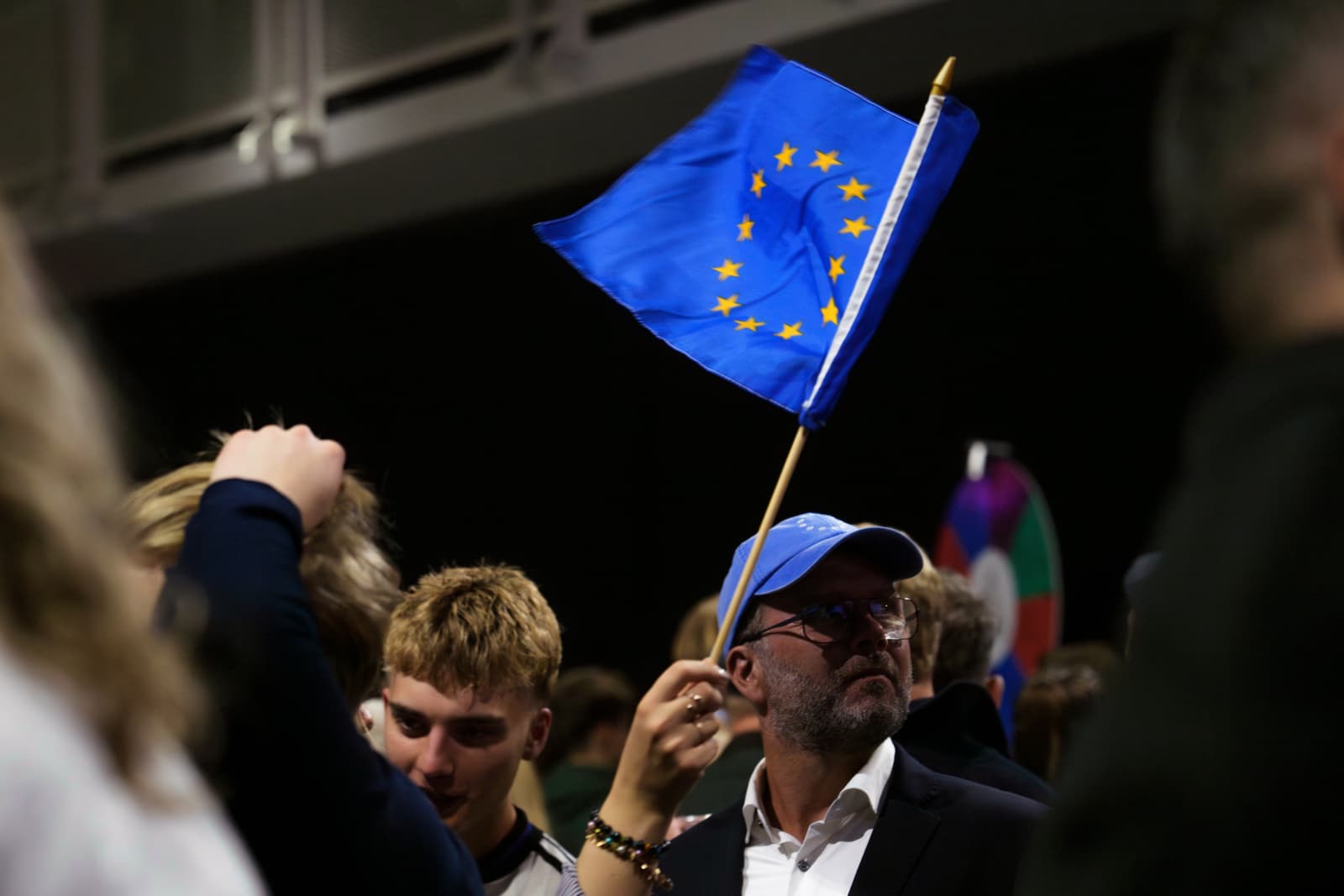
As of 2026-08-30 12:35 UTC, Iceland's No side had defeated the proposal to resume European Union accession talks by 52.8% to 47.2%, according to the completed national result reported by RÚV and the Associated Press. Reykjavík was the only part of the country where Yes won a majority.[1][2]
That is a clear political result, but its meaning is narrower than “Iceland rejected Europe.” The ballot asked whether to resume accession negotiations. It did not ask Icelanders to approve EU membership, leave the European single market or withdraw from passport-free travel.[3][4]
The immediate outcome is therefore a split decision: the current route toward membership stops, while the dense European framework Iceland already uses stays in place. Iceland remains outside the EU but inside the European Economic Area, the European Free Trade Association and the Schengen area.[5]
What is established at the cutoff
| Question | Verified position | Confidence and uncertainty boundary |
|---|---|---|
| What was the reported result? | No won 52.8% and Yes 47.2%; the two Reykjavík constituencies voted Yes while the four constituencies outside the capital voted No.[1][2] | High for the completed media count. The National Electoral Commission's formal publication remains the authoritative legal record if it differs. |
| What did the question decide? | Whether Iceland should resume accession negotiations with the EU.[3][4] | High. This was not a membership referendum. A successful negotiation would have required a second popular vote on the resulting agreement.[4] |
| Was the referendum legally binding? | The National Electoral Commission says the result is advisory under Article 123(3) of the Elections Act.[3] | High as a matter of legal form. “Advisory” does not make the result politically optional without cost; it means the vote itself does not amend Iceland's treaty status. |
| What is Iceland's position today? | It is an EEA EFTA state, participates in the single market and Schengen, and is not treated as an EU candidate country.[5] | High. None of those statuses was on the ballot. |
| How economically connected is the status quo? | The EU accounted for 53.6% of Iceland's goods trade in 2025, including 66.5% of exports and 45.1% of imports.[6] | High for the European Commission's 2025 trade series. Trade shares can move without any treaty change. |
What No actually stops
The government framed the referendum as the first decision in a two-vote sequence. A Yes would have authorized renewed negotiations; only after an agreement existed would Icelanders have voted on whether to join. No ended that sequence before bargaining restarted.[4]
That distinction matters because negotiations are not membership. They are the process through which the difficult terms become concrete: fisheries, agriculture, budget contributions, institutional representation, monetary questions and any transitional arrangements. Voting No means Iceland will not use a new accession negotiation to discover what Brussels would offer on those points—at least under the political mandate tested on August 29.
The result does not create a permanent constitutional ban on another attempt. The official election notice calls the vote advisory, and no source cited here establishes a ten-year or generational legal lockout.[3] A future government and parliament could revisit the question. Doing so soon, however, would require an explicit political decision to reopen a matter voters have just rejected. The safest formulation is therefore precise: the current accession route is closed, not that Iceland can never apply again.
There was substantial unfinished material to reopen. Iceland applied in July 2009, began negotiations in June 2010 and put them on hold in May 2013. By then, 27 negotiating chapters had been opened and 11 provisionally closed. In March 2015, the government asked that Iceland no longer be regarded as a candidate country.[5] The 2026 ballot was about reactivating that dormant direction, not starting Iceland's relationship with Europe from zero.
What will still be true on Monday
The EEA extends the EU single market's four freedoms—goods, services, people and capital—to Iceland, Norway and Liechtenstein. It also carries common rules in areas such as competition, state aid and public procurement. Iceland applies a significant body of EU law through that system and participates in EU agencies and programmes, though without an EU member state's vote in the Union's institutions.[5][6]
Schengen is separate again. Iceland remains one of the non-EU countries inside the passport-free area.[5] The referendum does not reinstate routine internal border checks, cancel existing mobility rights or alter a traveller's documents on August 31.
The boundaries also remain. The EEA is not a customs union, and the EU's common agriculture and fisheries policies are outside the EEA agreement.[6][7] Iceland continues to pursue trade agreements through EFTA and retains its existing national and treaty arrangements for the fisheries sector. No created no new fishing quota, customs declaration or product standard overnight.
The same restraint applies to money. The ballot contained no change to the króna, the Central Bank's policy rate or household mortgage contracts. Supporters could argue that membership and a later route toward the euro would improve stability; opponents could argue for monetary autonomy. The vote selected neither a new interest rate nor a new currency regime. It removed the accession negotiation that might eventually have put those choices into a membership package.[1][4]
The status quo is deep integration, not distance
No preserves a particular bargain. Iceland keeps broad access to the single market and passport-free movement while remaining outside the EU's voting institutions, customs union, common fisheries policy and economic and monetary union.[5][6][7] That combination is neither disguised membership nor a clean break.
Its economic weight is visible in the trade data. In 2025, two-thirds of Icelandic goods exports went to the EU, while slightly less than half of goods imports came from it.[6] Businesses will therefore keep following EEA-relevant European rules because market access depends on them, not because the referendum failed to matter.
The democratic tension also survives. Iceland can shape EEA legislation during preparatory work and through the EEA's joint institutions, but it does not appoint voting members to the EU Council or European Parliament. The No result protects room outside EU policies that the EEA excludes; it also leaves Iceland adapting many single-market rules that it did not vote on as a member state. Both halves belong in any honest description of the status quo.[5][6]
Nor can a 52.8% answer to one institutional question settle every argument attached to the campaign. AP reported debates about fisheries, prices, the króna, security and Iceland's room to act independently.[1] The result authorizes a No to talks. It does not prove that 52.8% of voters share one reason, hold the same view of NATO or favor withdrawal from the EEA. Geography shows where the result differed; it does not reveal a single motive for every ballot.
The next 24 hours, seven days and 30 days
In the next 24 hours, the useful update is formal confirmation: the National Electoral Commission's published result, the final valid-ballot totals and the government's exact statement on how it will implement an advisory No. Until that record appears, the 52.8–47.2 result should remain attached to RÚV and AP rather than presented as an independently audited total.[1][2][3]
Over the next seven days, watch the governing coalition and parliament, not customs desks or airport gates. The live question is whether ministers describe the file as closed for this term, set out a longer political pause or propose another form of consultation. Any coalition dispute would be political fallout; it would not itself remove Iceland from the EEA or Schengen.
Over the next 30 days, the test is whether the government turns No into a defined European policy rather than an empty absence. It can prioritize EEA incorporation, sectoral agreements, security cooperation and EFTA trade work without reopening accession. Businesses and households should expect existing law to continue unless an institution with authority over that law announces a specific change.
Three paths from the same result
These are conditional paths, not probability forecasts.
Base case — the EEA status quo continues. The government treats No as the end of the current accession initiative and conducts European policy through the EEA, EFTA, Schengen and bilateral cooperation. Trigger: an official government statement accepts the result without submitting a new accession motion.
Upside case — the boundary becomes clearer. Ministers use the result to publish a concrete non-membership agenda: which EEA files to accelerate, which excluded sectors need bilateral work and where Iceland wants deeper security or research cooperation. Trigger: a dated programme names specific agreements, decisions or negotiating forums rather than promising only “close relations.”
Downside case — a clear vote produces an unclear mandate fight. Coalition parties disagree over whether advisory means final, or political actors recast No as authority to weaken EEA or Schengen ties that were not on the ballot. Trigger: a confidence dispute, a fresh accession motion during the current term, or a formal proposal to reopen one of Iceland's existing European frameworks without a separate mandate.
Use the result without overreading it
- Newsrooms: write “rejected resuming EU accession talks,” not “voted to leave the EU” and not “rejected a membership treaty.” Iceland was not voting on either proposition.[3][4]
- Businesses: keep current EEA product, employment and services compliance in place. Treat customs and fisheries separately because the EEA does not cover them in the same way.[6][7]
- Travellers and employers: do not infer a new border or mobility rule from the referendum. Wait for an actual Schengen or EEA measure.[5]
- Investors and borrowers: separate the political loss of an accession-and-possible-euro path from current monetary policy. The vote did not set an exchange rate, policy rate or conversion timetable.
- Government and election authorities: publish the certified totals and state the political duration of the pause. The legal word “advisory” and the political promise to honor the result should not be allowed to blur into one another.[3]
Invalidation conditions: revise the reported margin if the National Electoral Commission publishes a materially different result. The article's central assessment—that the current accession route is closed while existing European frameworks continue—would be invalidated if the government or Althing formally resumes accession talks despite the vote, or if Iceland initiates withdrawal from the EEA, EFTA or Schengen. A coalition argument, market move or campaign statement alone would not meet either threshold.
Iceland has made a consequential choice, but not a total one. No stops the next negotiation. It leaves the country's more complicated European reality—inside the market, outside the Union—ready for work on Monday morning.
Sources
- Kwiyeon Ha and Brian Melley, Associated Press, “Icelandic voters reject a proposal to restart negotiations to join the European Union” (August 30, 2026) — reported national result, regional split, campaign arguments and source page for Marco Di Marco's cover photograph.
- RÚV, “Iceland rejects EU accession talks” (live result record, updated August 30, 2026) — constituency counts, sequence of declarations and national result call.
- National Electoral Commission of Iceland, “Public referendum 29 August 2026” (July 27, 2026) — official question, eligibility and advisory status under the Elections Act.
- Government of Iceland, “Government proposes referendum on whether to return to EU accession talks” (March 6, 2026) — proposed sequence of renewed negotiations followed by a second membership referendum.
- European Commission, “Iceland” — accession timeline, chapter status and Iceland's current integration through the EEA, EFTA and Schengen.
- European Commission, “EU trade relations with Iceland” — 2025 goods-trade shares, four-freedom obligations and the EEA exclusions for agriculture and fisheries.
- European Free Trade Association, “Customs Matters” — institutional clarification that the EEA is not a customs union.