As of 2026-07-17 11:36 UTC, the global childhood-vaccination recovery is moving in two directions at once. The latest WHO-UNICEF estimates say 13.5 million infants received no first dose of a diphtheria-, tetanus- and pertussis-containing vaccine in 2025—about 750,000 fewer zero-dose children than a year earlier. But 7.3 million children who did receive that first DTP dose did not make it to their first measles dose, and that second group grew.[1]
That is not one bad statistic described twice. A missed first dose usually signals a failure of access: the health system never completed even its opening contact. A missed later dose signals a failure of continuity: contact happened, but stock, staffing, distance, records, trust, reminders, conflict, cost or time prevented the schedule from holding. A recovery strategy can improve the first problem while losing ground on the second.
The two counts are population-level estimates derived from different antigen totals, not linked records following the same named children. They describe distinct programme failure points but should not be added as though they were one tracked cohort.[1][3][4][9]
The headline numbers make that split visible. In 2025, global DTP1 coverage reached 90%, DTP3 reached 85%, first-dose measles coverage was reported at 84%, and second-dose measles coverage at 77%. Fifty-seven countries recorded large or disruptive measles outbreaks.[1] The correct reading is neither “vaccination is back” nor “nothing improved.” More children entered the system, while too many failed to stay connected to it.
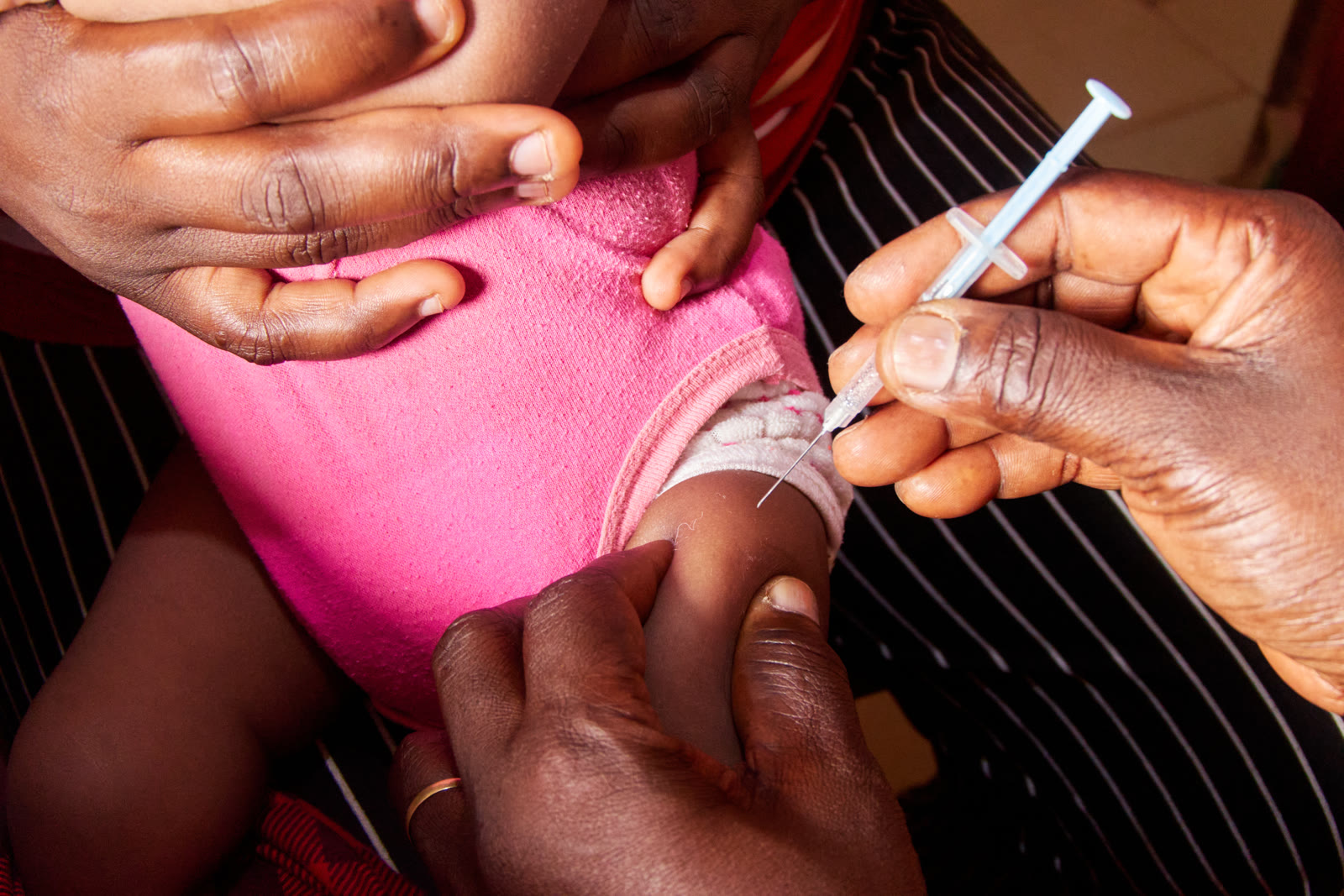
Image context: the cover photograph shows a real vaccination visit in Cameroon in April 2026. AP's reporting from the same programme found strong demand for malaria vaccination but weak completion of its later booster, making the scene directly relevant to the return-visit problem rather than a generic medical illustration.[7]
The Evidence Line
| Date / record | What changed | Confidence boundary |
|---|---|---|
| July 15, 2026, WHO-UNICEF release | DTP1 and DTP3 coverage each rose one percentage point in 2025; zero-dose children fell to 13.5 million, while 7.3 million children who started with DTP1 missed MCV1.[1] | High for the agencies' dated release. These are estimates, not a census of every child. |
| 2025 coverage revision | WHO's portal says roughly 5% of the global 2025 birth cohort lived in non-reporting countries whose values were extrapolated from 2024.[3] | Adequate for a global trend; weaker for treating small annual changes as exact head counts. |
| IA2030 target line | The 2030 strategy calls for a 50% reduction in zero-dose children and 90% global coverage for DTP3, MCV2, PCV3 and completed HPV vaccination.[5] | A policy benchmark, not a forecast. DTP3 at 85% and MCV2 at 77% remain below it.[1] |
| Big Catch-Up, 2023–2025 | A 36-country programme delivered more than 100 million doses to 18.3 million children aged 1–5, including 12.3 million older zero-dose children.[6] | Evidence that missed children can be found later; not proof that routine infant services are now durable. |
| Cameroon field report, July 15 | In an earlier Ghana-Kenya-Malawi malaria-vaccine pilot, coverage fell from about 80% for dose one to 46% for dose four, which is given much later.[7] | A concrete multidose example, not a global estimate and not the same schedule measured by DTP-to-measles dropout. |
The Recovery Looks Different From Each Rung
“Zero-dose” is a programme tracer, not a literal audit of every product a child may ever have received. WHO and UNICEF operationalize it through absence of DTP1 because that first routine infant dose is a useful signal of whether basic immunization services reached a child. DTP3 then tests whether repeated infant contacts held. The first measles dose usually comes later, so the DTP1-to-MCV1 path tests continuity across a longer interval.[1][4][9]
Those rungs answer different questions. DTP1 asks whether a clinic, outreach team or community programme could make initial contact. DTP3 asks whether the early series could be completed. MCV1 asks whether the family and service remained connected long enough to cross into a later visit. Combining all three into “coverage” hides where the handoff failed.
The UNICEF data page offers another reason to resist a single global verdict. It reports that 107 countries reached at least 90% DTP3 coverage in 2025, down from 124 in 2019, while more than half of zero-dose children were concentrated in nine countries.[2] A large country can contribute many missed children despite a high national rate; a smaller country can have a severe coverage collapse without moving the global percentage much. The global average is a summary, not a service map.
There is also real movement beneath it. Reporting from the WHO-UNICEF press briefing described Sudan gaining 35 percentage points in DTP1 coverage and 32 points in DTP3 during 2025 after mobile teams, reinforced field services and cross-border vaccine supply were deployed. The same briefing described sharp deterioration elsewhere, including countries affected by conflict, weak primary-care investment, workforce loss or hesitant demand.[8] Sudan's estimate will need continued scrutiny in a war setting, but its direction illustrates the operational point: access can recover when delivery changes, even under extreme constraints.
A Return Visit Is Infrastructure
It is tempting to interpret dropout as a caregiver decision. Sometimes refusal matters. The joint release also points to conflict, displacement, poverty, shifting political commitment and structural weakness.[1] But a later dose requires a chain of ordinary things to work again: the caregiver knows when to return; travel is possible; the clinic is open; the vaccine and supplies are present; a trained worker can find or reconstruct the record; and the next appointment survives school, work, migration, illness and insecurity.
AP's July 15 reporting from Cameroon's malaria-vaccine rollout puts human scale on that chain. The first three doses arrive relatively close together, while a fourth comes months later. In the three-country pilot cited by AP, first-dose coverage was about 80% and fourth-dose coverage 46%.[7] That does not explain the global DTP-to-measles figure, but it demonstrates why demand for a vaccine and completion of a schedule are not interchangeable outcomes. Each extra visit creates another chance for the programme to lose the child.
The Big Catch-Up shows the reverse mechanism. Between 2023 and 2025, participating countries expanded eligibility beyond infancy, trained workers to screen older children during routine care, updated policies and used community engagement to find those already missed. It reached 12.3 million older zero-dose children before ending on March 31, 2026.[6] That is a substantial repair. It is also expensive evidence of what happens when the first-year system does not close the loop.
The policy implication is narrow but important: the zero-dose count should remain a leading equity measure, but it cannot carry the whole recovery story. A programme that celebrates more first contacts while later-dose dropout rises is reporting entry without retention.
The Data Can Guide Action Without Pretending To Be Exact
WUENIC is constructed from administrative reports, coverage surveys, census and birth-population estimates, data-quality reviews, contextual evidence such as shortages or strikes, and consultation with country experts.[4] Each layer solves one problem and introduces another. Administrative coverage can miscount doses or use a weak denominator; surveys arrive late and carry sampling error; expert review can correct implausible series but does not turn them into direct observation.
The current release makes that limit unusually relevant. WHO says about 5% of the 2025 global cohort was represented by values extrapolated from 2024 because countries did not report.[3] The joint release also says only 18 national immunization surveys were submitted in the latest round, compared with 50 in 2024 and an annual average of 33 between 2015 and 2019.[1] Better delivery decisions therefore depend on protecting the measurement system at the same time.
One live discrepancy should stay visible. The July 15 joint release reports global MCV1 coverage at 84%, while UNICEF's current statistics page displays 86% for 2025.[1][2] This analysis uses the dated joint-release figure and does not try to reconcile the difference without a revision note. Readers using the data operationally should download the current series, record its revision date and expect historical values to change.
What Changes Now
Next 24 hours: ministries, funders and newsrooms should report DTP1, DTP3 and MCV1 separately. The most useful question is not only “How many zero-dose children remain?” but also “How wide is the population-level gap between first-dose and later-dose coverage?” National figures should be accompanied by denominators and revision dates.[1][3]
Next 7 days: country teams should identify where dropout grows between antigens and ages, then compare those districts with stock records, session cancellations, travel barriers, population displacement and reminder systems. A national percentage cannot show whether a missed return is concentrated in one province, one mobile population or one broken supply route.
Next 30 days: partners setting 2026 budgets should protect the unglamorous continuity layer—reliable sessions, outreach, defaulter tracing, interoperable records, community health workers and disease surveillance—alongside vaccine purchasing. The IA2030 target is not achieved when doses exist centrally; it is achieved when the schedule survives repeated contact.[5]
Three Paths From Here
Base path — entry improves faster than retention. DTP1 inches up, zero-dose counts continue to fall slowly, but DTP3 and measles coverage lag and outbreaks remain frequent. Trigger: first-dose gains are not matched by faster gains in later-dose coverage over the next annual release.
Upside path — catch-up becomes routine continuity. Countries reuse the Big Catch-Up's screening, wider age eligibility and community follow-up inside ordinary primary care, so children reached once are increasingly retained. Trigger: DTP3 and MCV1 rise faster than DTP1 while both zero-dose and dropout counts fall.[6]
Downside path — the data and delivery systems weaken together. Financing cuts reduce outreach and survey capacity, apparent national stability masks local deterioration, and measles or diphtheria outbreaks reveal the missed cohorts after the fact. Trigger: fewer empirical data points, widening first-to-later-dose differences and more countries reporting disruptive outbreaks.[1][3]
Uncertainty boundary: these scenarios do not predict an individual child's protection, and global coverage cannot establish why a particular child missed a dose. A corrected 2025 series, country-level administrative revisions or new survey results could change the size of either group.
Action Checklist
- Publish a simple aggregate coverage ladder—not a cohort funnel—for DTP1, DTP3, MCV1 and MCV2, with child counts, percentages, denominators and revision dates.
- Investigate access and continuity separately: first-contact barriers need different fixes from failed return visits.
- Audit missed opportunities at every child-health encounter instead of waiting for a campaign to rediscover children years later.
- Pair coverage estimates with stock, session, staffing, mobility and outbreak data so a percentage can lead to an operational cause.
- Preserve survey and surveillance funding; a weaker measurement system can make deterioration look like stability.
- Invalidation condition: revise this analysis if WHO and UNICEF reconcile the MCV1 discrepancy in a way that materially changes the DTP1-to-MCV1 dropout estimate, or if the next empirical series shows later-dose coverage accelerating while both missed groups shrink.
The encouraging part of the 2025 estimates is real: hundreds of thousands more children crossed the first threshold. The warning is that first contact is not completion. The next phase of the rebound will be judged by whether a vaccination service can become a relationship long enough to finish the schedule.
Sources
- World Health Organization and UNICEF, “Global childhood immunization coverage inches forward despite conflict and hesitancy” (July 15, 2026) — 2025 WUENIC headline estimates, dropout count, outbreak context, survey submissions and current uncertainty.
- UNICEF Data, “Vaccination and Immunization Statistics” (updated July 2026) — DTP3 target performance, country concentration, global series and the current MCV1 display used to flag a source discrepancy.
- World Health Organization, “WHO Immunization Data portal — Global” (2025 revision completed July 15, 2026) — release timing, extrapolation boundary and links to country profiles and downloadable series.
- World Health Organization, “WHO/UNICEF estimates of national immunization coverage” (July 7, 2025) — estimation inputs, administrative-data limitations, expert review and intended uses of WUENIC.
- World Health Organization, Immunization Agenda 2030 Mid-Term Review (2025) — impact-goal framework and 2030 targets for zero-dose reduction and vaccine coverage.
- WHO, UNICEF and Gavi, “Largest catch-up initiative delivers over 100 million childhood vaccinations” (April 24, 2026) — Big Catch-Up reach, operating changes, age-extension strategy and March 2026 completion.
- Ngala Killian Chimtom and Moki Edwin Kindzeka, Associated Press, “The new malaria vaccine helps in Africa but faces a test: Completing all 4 doses” (July 15, 2026) — multidose follow-through reporting and source page for Angel Ngwe's April 2026 field photograph.
- Marta Montoriol, EL PAÍS, “La vacunación infantil mejora, pero 13,5 millones de bebés siguen sin recibir una sola dosis” (July 15, 2026) — independent reporting from the WHO-UNICEF briefing on country-level gains, reversals and delivery mechanisms.
- World Health Organization Global Health Observatory, “IA2030 IG 2.1: Number of zero dose children” — official DTP1-based definition, estimation method and 50% reduction target.