As of 2026-05-05 06:04 UTC, the first EU-Armenia summit in Yerevan has not yet produced its promised joint declaration.[2] That timing matters. The live question is not what leaders will eventually call the meeting after the fact. It is what the pre-announced package already tells us about the direction of EU-Armenia ties. On that evidence, this summit is best read as a delivery test around connectivity, democratic resilience, and security support, with membership symbolism riding in the background rather than running the file.[1][2][3][4][5][6]
The strongest clue comes from the official language itself. The European Commission's preview says the summit should launch an EU-Armenia Connectivity Partnership, deepen security and defence cooperation through the new EU Partnership Mission in Armenia, and witness the initialling of a working arrangement between Frontex and Armenia's interior ministry.[3] The Council's summit page adds a €270 million resilience-and-growth plan, expected Global Gateway investments of up to €2.5 billion, and the new civilian mission's focus on hybrid threats, cyberattacks, and illicit financial flows.[2][5] That is a concrete agenda. It is also a narrow one. The sources describe a thicker partnership lane, not an accession timetable.[1][2][3][4]
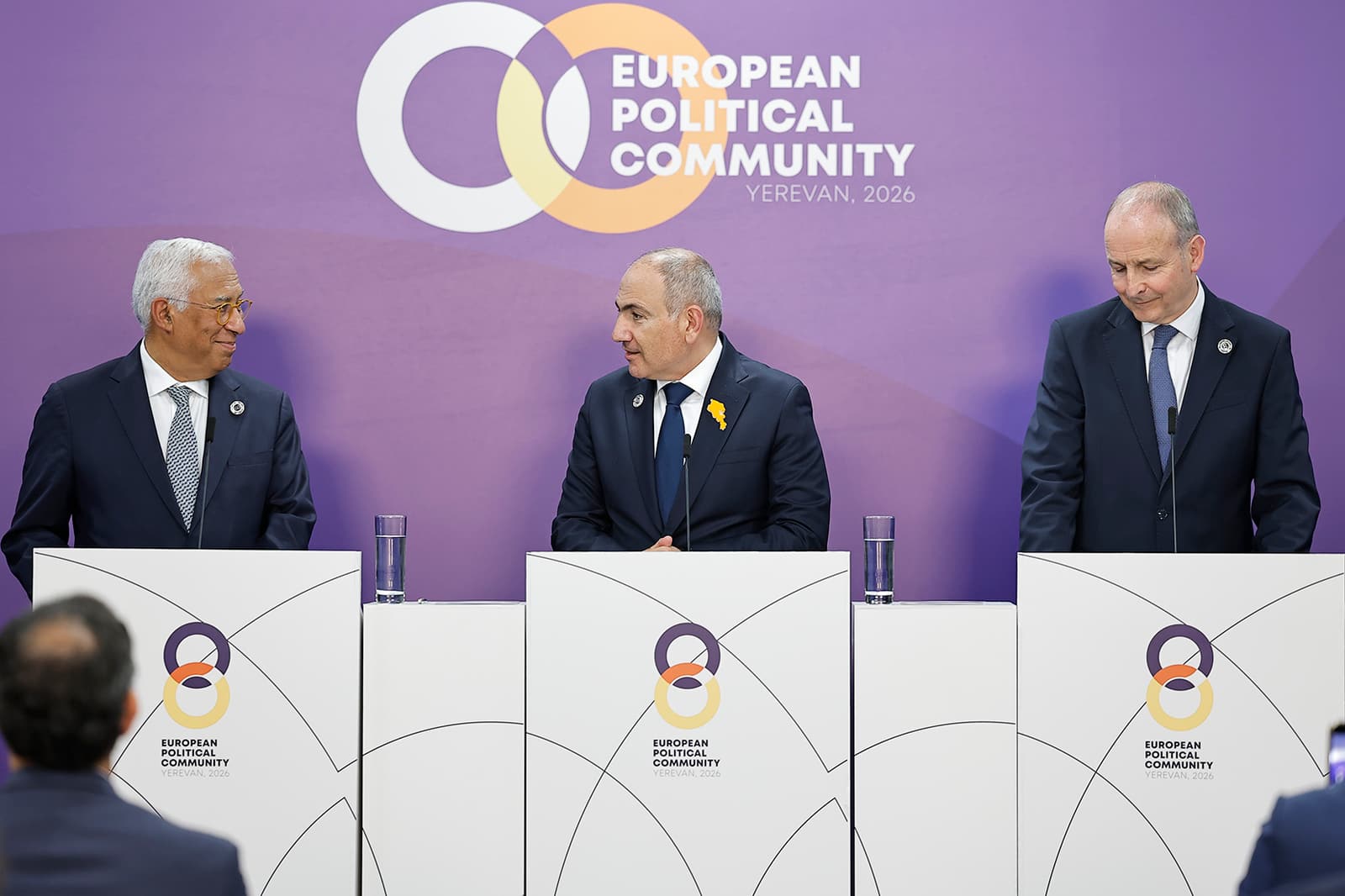
Image context: the cover uses a real photograph from Yerevan showing António Costa, Nikol Pashinyan, and Micheál Martin after the European Political Community meeting on May 4.[7] That is the right image because this summit sits inside a two-day diplomatic sequence in which Armenia is trying to turn symbolic hosting power into durable EU-backed delivery mechanisms.
Fact file
| Item | What is live now | Confidence note |
|---|---|---|
| Meeting status | The first EU-Armenia summit is taking place in Yerevan on 4-5 May 2026, with a joint declaration expected at the end.[2] | Strong. Direct from the Council summit page. |
| Political significance | AP describes it as Armenia's first bilateral summit with the EU and ties it to Yerevan's effort to loosen long-standing dependence on Russia.[1] | Strong on event framing; strategic interpretation still depends on follow-through. |
| Connectivity package | The Commission says leaders are expected to launch an EU-Armenia Connectivity Partnership spanning transport, energy, digital links, and people-to-people ties.[3] | Strong. Pre-announced deliverable from the Commission. |
| Security package | The Council says the new EUPM Armenia mission will help Armenia handle hybrid threats, cyberattacks, and illicit financial flows, with an initial two-year mandate.[2][5] | Strong. Formal Council decision already adopted. |
| Partnership baseline | The EU and Armenia adopted a new Strategic Agenda in December 2025 covering economic development, security, resilience, mobility, and institutional reform.[2][4] | Strong. Official partnership document. |
| Democratic-resilience backdrop | The European Parliament called the summit an "exceptional and historic milestone" and urged ambitious, concrete targets ahead of Armenia's 7 June 2026 parliamentary election.[6] | Strong on Parliament's political signal; Parliament is not the summit's executive decision-maker. |
| Membership boundary | Official summit materials describe partnership deepening, visa dialogue, reform support, and resilience tools, but they do not set out an EU accession roadmap.[2][3][4] | Strong as a document-reading point; it is an analytical inference from what the official package does and does not contain. |
What Brussels is actually putting on the table
The announced package has three layers. The first is connectivity. The Commission preview says the summit should launch a new partnership covering transport, energy, digital, and people-to-people links, alongside high-level dialogues and efforts to mobilize private investment.[3] The Council page reinforces that with the bigger financing frame: the EU's resilience-and-growth plan for Armenia is worth €270 million for 2024-2027, and Global Gateway investments are expected to reach €2.5 billion.[2] That means Brussels wants to make Armenia easier to connect, easier to finance, and easier to route through.
The second layer is security resilience. On 21 April, the Council established EUPM Armenia as a new civilian mission under the Common Security and Defence Policy.[5] Its mandate is unusually specific: strategic advice, capacity building, operational advice, and a project cell focused on multi-layered threats such as foreign information manipulation and interference, cyberattacks, and illicit financial flows.[5] That is not decorative signalling. It is a state-capacity file.
The third layer is institutional interoperability. The Commission says summit leaders will witness the initialling of a working arrangement between Frontex and Armenia's ministry of internal affairs.[3] On its own, that is a technical step. In context, it tells you what sort of partnership the EU is building: border management, regulatory routines, mission support, and sector-by-sector operating links rather than one large constitutional leap.
Why this is not a membership shortcut
The summit is still politically large. AP reports that Armenia has formally declared its ambition to join the bloc and is trying to pivot away from Russia's orbit after the collapse of its old security assumptions in the South Caucasus.[1] The European Parliament went further last week, calling the Yerevan double-header of the EPC and the EU-Armenia summit an unambiguous sign of pan-European solidarity and a chance to set ambitious targets.[6] None of that is trivial.
But solidarity language and accession mechanics are different categories. The official texts keep describing CEPA, the Strategic Agenda, the visa liberalisation dialogue, the resilience-and-growth plan, security missions, and connectivity investment.[2][3][4][5] Those are real instruments. They also belong to the grammar of deep partnership, not to the grammar of fast-track enlargement. If Brussels wanted this summit to read as an accession breakthrough, the source trail would look different: candidate-status language, screening steps, timetable markers, or institutional benchmarks tied explicitly to membership. Those signals are absent from the summit materials available as of 2026-05-05 06:04 UTC.[2][3][4]
That makes the summit more interesting, not less. The EU is testing whether it can anchor Armenia through operating systems rather than grand declarations alone. Armenia, for its part, is testing whether visible alignment with European institutions can deliver resilience and economic breathing room before the harder constitutional questions even come onto the table.[1][2][3][5][6]
Why the sequencing matters
The timing of the summit, directly after the 8th European Political Community meeting in the same city, gives Armenia a chance to turn ceremonial visibility into a narrower EU-focused file.[1][2][7] Prime Minister Nikol Pashinyan's remarks after the EPC summit emphasized connectivity, open borders, regional cooperation, and the need to counter hybrid threats.[7] Those themes match the EU's own pre-summit agenda unusually closely.[2][3][5]
That alignment matters because Armenia's most urgent needs are not abstract. The country is managing electoral pressure ahead of the 7 June parliamentary vote, continued exposure to Russian pressure operations, and a regional order still shaped by the aftershocks of the Armenia-Azerbaijan peace process.[1][2][5][6] The summit is therefore not just about whether Brussels likes Armenia's reform direction. It is about whether the EU can convert that sympathy into border cooperation, cyber and anti-FIMI support, investment pathways, and institutional routines that survive beyond one high-profile week in Yerevan.[2][3][5][6]
What to watch after the joint declaration
The first watch item is specificity. If the joint declaration stays at the level of political warmth, the summit will register mainly as symbolism. If it names timelines, dialogues, funding channels, or implementation tracks for the connectivity partnership and Frontex arrangement, the file becomes more operational immediately.[2][3]
The second watch item is security delivery. EUPM Armenia already exists on paper.[5] The meaningful question now is staffing, mandate execution, and how quickly the mission starts improving Armenia's ability to handle hybrid interference, cyber pressure, and illicit-finance risk in practice.[5][6]
The third watch item is electoral resilience. Parliament's late-April resolution tied summit ambition directly to Armenia's democratic resilience before the June vote.[6] If Moscow-linked disinformation or domestic institutional strain becomes more visible over the next month, the usefulness of the summit will be judged less by its language and more by whether EU support changed Armenia's operating capacity in time.[1][5][6]
The narrow conclusion is the useful one. The first EU-Armenia summit is historically important because it makes Brussels' westward signal to Yerevan unusually visible. Yet the more durable meaning sits lower down. As of 2026-05-05 06:04 UTC, the summit looks like a delivery test on resilience, connectivity, and state capacity. That is smaller than a membership breakthrough and more concrete than a photo-op, which is exactly why the next document and the next month matter so much.[1][2][3][4][5][6]
Sources
- AP News, "Armenia hosts a historic EU summit as it charts a course away from Russia" (May 5, 2026).
- Council of the European Union, "EU-Armenia summit, 4-5 May 2026" (meeting page, last review May 4, 2026).
- European Commission Directorate-General for Enlargement and Eastern Neighbourhood, "EU and Armenia deepen their relations in a first Summit in Yerevan" (May 1, 2026).
- European External Action Service, "European Union and Armenia adopt new Strategic Agenda to deepen partnership" (December 2, 2025).
- Council of the European Union, "Armenia: EU establishes a new civilian mission to contribute strengthening the country's resilience" (April 21, 2026).
- European Parliament, "Motion for a resolution on supporting democratic resilience in Armenia" (B10-0199/2026, accessed May 5, 2026).
- The Prime Minister of the Republic of Armenia, "The discussions at the EPC Summit highlighted the importance of regional cooperation. Prime Minister" (May 4, 2026) - source page for the Yerevan press photograph used as the article image.