As of 2026-04-09 21:04 UTC, the highest-signal aviation story to come out of the Reagan National collision is no longer the Potomac route closure by itself. The larger policy move happened on March 18, 2026, when the FAA suspended the use of controller-approved visual separation between helicopters and airplanes crossing arrival or departure paths in Class B, Class C, and TRSA airspace and replaced it with radar-based spacing requirements.[1][2] AP reported that the change reaches more than 150 of the nation's busiest airports.[3]
That matters because it changes the meaning of the DCA file. In January, the FAA made permanent the local restrictions around Ronald Reagan Washington National Airport, turning what had begun as temporary post-crash protections into a standing rule for helicopters and powered-lift aircraft unless they are conducting essential operations.[4][5] By March, however, the agency had moved beyond a Washington-only containment story. The new question became how much of the collision's lesson was really about one dangerous route and how much was about a wider air-traffic habit: relying on visual judgment to thread helicopters across fixed-wing traffic near busy terminals.[1][2][3]
The NTSB's final account points strongly toward the second reading. In its January 28, 2026 findings, the board said the DCA collision reflected systemic failures in airspace design, safety oversight, and risk management, and it specifically cited the air traffic system's overreliance on visual separation as part of the probable-cause chain.[6][7] Earlier, the board's urgent March 2025 recommendation memo had already shown why the risk could not be dismissed as a freak event: between October 2021 and December 2024, DCA logged 944,179 commercial operations and 15,214 airplane-helicopter proximity events that fell below 1 nautical mile laterally and 400 feet vertically, including 85 especially tight events below 1,500 feet lateral and 200 feet vertical separation.[7]
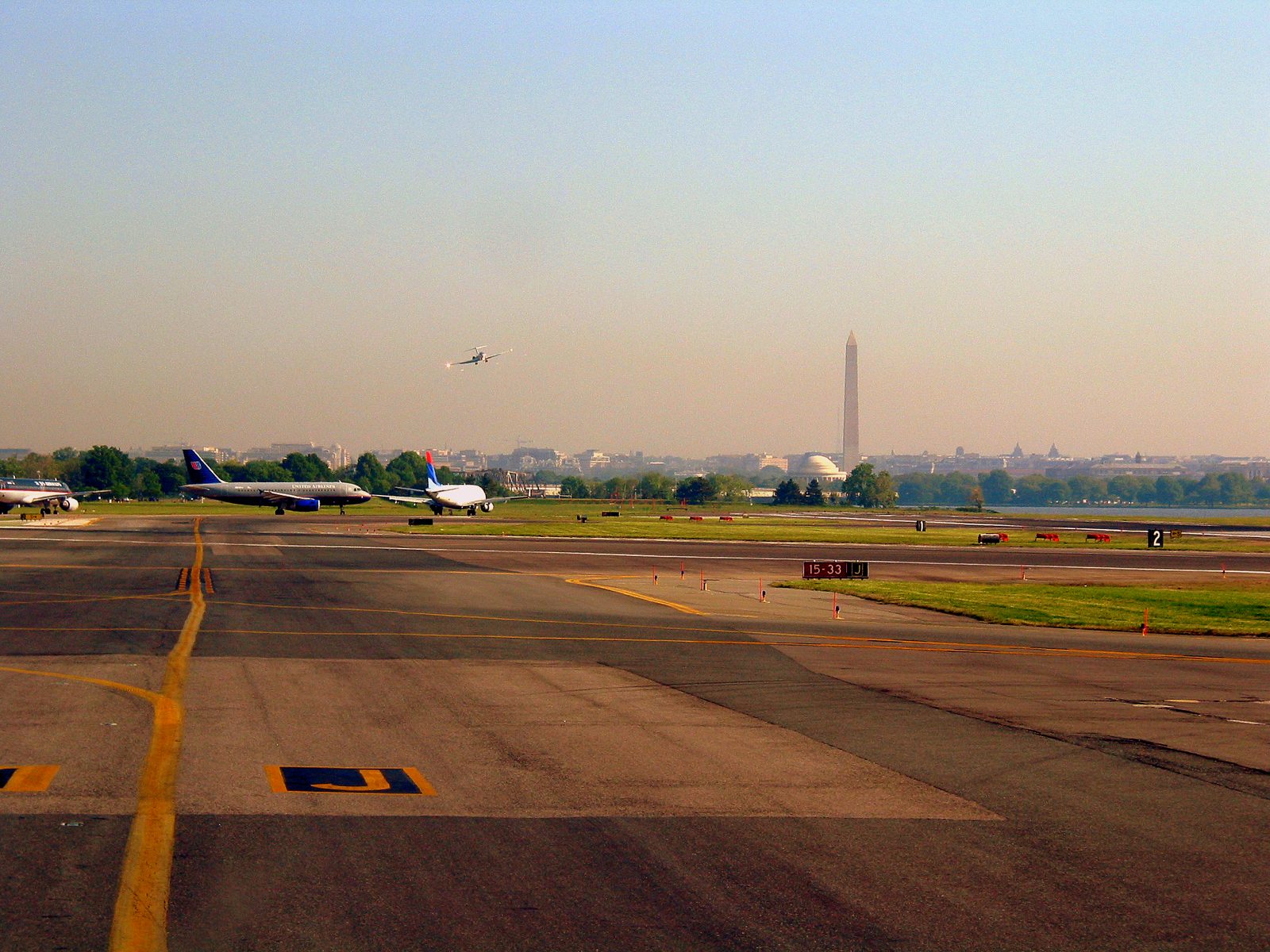
Image context: the cover photo shows active runway-side operations at Reagan National. It was selected to replace an overhead analytical-style view and keep the visual framing immersive and topic-grounded: the article is about live separation practice in mixed helicopter-airplane terminal traffic.[8]
What changed on March 18
The March change was not framed as a symbolic reaction. The FAA issued GENOT JO 7110.801, which revises the controller handbook language on visual separation for helicopter and powered-lift crossings of arrival and departure paths.[2] The press release puts the change in operational terms: controllers are no longer supposed to rely on pilots simply seeing and avoiding each other in those crossing situations. They are now directed to use radar to keep aircraft separated by specific lateral or vertical distances.[1]
That is a meaningful shift in aviation philosophy because visual separation had been one of the system's throughput tools. In good weather and busy terminal environments, it allowed controllers and pilots to preserve flow without always falling back to more conservative spacing. The March 18 notice says, in effect, that this trade no longer holds in the kinds of mixed helicopter-airplane crossings that matter most at large airports.[1][2]
The FAA also made clear that DCA was not the only reason it moved. The March 18 announcement cited recent close calls in San Antonio and Burbank as evidence that the underlying risk was broader than Washington.[1][3] Inference from the source set: the agency concluded that DCA exposed a recurring operating logic, not merely a local charting anomaly.
Why DCA became the prototype instead of the exception
The January rule around DCA remains important because it shows how the FAA first answered the crash. The interim final rule that took effect on January 23, 2026 permanently restricted helicopters and powered-lift aircraft in a defined area over the Potomac River near the airport, from the surface up to 1,500 feet MSL, except for essential missions such as lifesaving medical, active law-enforcement, air-defense, or presidential transport flights.[4][5] That was a hard local intervention, aimed at the precise geography where the accident chain had become intolerable.
But even before the national March notice, the FAA had already been treating DCA as a test case for something larger. Its post-crash timeline shows that the agency had temporarily eliminated visual separation between helicopters and fixed-wing aircraft at DCA in February 2025, amended local procedures again in March 2025, and then began reviewing other airports with high volumes of mixed helicopter and airplane traffic.[1][4] The March 18 expansion therefore did not appear out of nowhere. It was the outward extension of a method change that had already been piloted in the capital region.
This is the key analytical point. The national policy is not a copy-and-paste of the DCA restrictions. Most airports are not getting a Potomac-style corridor closure.[1][5] What they are getting is the broader lesson the FAA drew from DCA: when helicopters must cross arrival or departure paths at busy airports, the system should default to active radar spacing rather than to a controller's decision to let pilots handle it visually.[1][2]
What the new rule changes for operators
For airlines and tower operations, the practical effect is straightforward: some crossings that were once handled with minimal friction can now create more delay, sequencing work, or rerouting because controllers have to maintain explicit radar separation.[1][2][3] For helicopter operators, the message is just as clear. Immediate transit through busy terminal airspace is no longer something to assume, especially when the route cuts through final-approach or departure geometry.
The FAA's own announcement says urgent medical and law-enforcement missions may still move through these areas, but doing so can disrupt airline operations while controllers protect the needed spacing.[1] That language is important because it shows what the agency is prioritizing. Efficiency did not disappear, but it has plainly moved behind conflict prevention in the hierarchy of decision-making.
This is also why the March 18 file should be read as a news analysis story rather than as a narrow operations bulletin. The aviation system is not just adding one more rule. It is revising the acceptable balance between capacity and separation margin at the country's busiest airports. DCA supplied the evidence and the political force; the new radar requirement is the national operating consequence.[1][2][3][6]
What this still does not solve
The FAA's March move is substantial, but it does not close the whole DCA file. The NTSB's final findings went well beyond visual separation. The board pointed to route design, weak hazard review, inadequate data sharing, controller workload, military safety-management gaps, and limitations in cockpit collision-alerting technology.[6][7] It approved 74 findings and 50 recommendations, with calls for changes not only to air-traffic procedures but also to route design, staffing logic, safety systems, and airborne equipment.[6]
That is why the current policy read should stay bounded. The national radar-separation change fixes one of the most visible and reproducible parts of the accident chain. It does not, by itself, answer whether the FAA and military operators have fully repaired the data, staffing, route-design, and collision-avoidance problems that the board described.[6][7]
Bottom line
The DCA crash response now has two layers. The first layer is local and physical: permanent restrictions over a specific piece of Potomac airspace near Reagan National.[4][5] The second layer is national and procedural: at more than 150 busy airports, the FAA has decided that helicopter crossings of arrival and departure paths should no longer depend on visual separation, but on radar-managed spacing instead.[1][2][3]
That second layer is the bigger 2026 story. The most useful way to read the file now is not that DCA produced one exceptional closure. It is that the collision forced the FAA to admit a wider limit in the old system: near major airports, "see and avoid" was doing more safety work than it could reliably carry.[1][2][6][7]
Sources
- Federal Aviation Administration, "Trump's Transportation Secretary Sean P. Duffy & Federal Aviation Administration Announce New Measure to Enhance Safety between Airplanes & Helicopters" (March 18, 2026).
- Federal Aviation Administration, Notice (GENOT) JO 7110.801 - Interim Helicopter Separation Procedures (issued March 18, 2026).
- David Koenig, "FAA mandates radar separation for helicopters and planes after deadly DC midair collision." Associated Press, March 18, 2026.
- Federal Aviation Administration, "Trump's Transportation Secretary Formalizes Permanent Restrictions for Aircraft in Reagan National Airport Airspace" (January 22, 2026).
- GovInfo, Flight Restrictions in the Vicinity of Ronald Reagan Washington National Airport (DCA) (Federal Register PDF, January 23, 2026).
- National Transportation Safety Board, "Systemic Failures Led to Midair Collision Over Potomac River in Washington" (January 28, 2026).
- National Transportation Safety Board, Deconflict Airplane and Helicopter Traffic in the Vicinity of Ronald Reagan Washington National Airport (Aviation Investigation Report AIR-25-01, March 11, 2025 PDF).
- Wikimedia Commons, "File:Washington DCA Airport, runway 19 active (2478871298).jpg" (image source page).