As of 2026-05-12 22:35 UTC, the most useful way to read the Justice Department's new criminal case over the M/V Dali is as an accountability reset inside a file that already had a technical narrative.[1][2][4][5] By late 2025, the National Transportation Safety Board had already anchored the accident chain: a loose signal wire caused the first blackout, the ship lost propulsion and steering close to the Francis Scott Key Bridge, and the bridge itself lacked countermeasures that could have reduced its vulnerability to a vessel strike.[4][5] What the May 12, 2026 indictment adds is narrower and more prosecutorial. Federal prosecutors say the ship's operators had altered the vessel, were using a flushing pump that was not designed to restart automatically after blackout to supply fuel to two generators, and then later misled investigators about that choice.[1][2][3]
That matters because it shifts the center of gravity from a generic "catastrophic maritime accident" frame toward a maintenance-and-disclosure frame. The NTSB's work remains the baseline for how the casualty unfolded.[4][5] The indictment asks a different question: once the first failure occurred, were there prior operating choices and later statements that made the disaster more preventable than the public record had previously shown?[1][3]
The same-day civil context sharpens the contrast. Maryland announced on May 12 that it had finalized a $2.25 billion settlement with Grace Ocean Private Limited and Synergy Marine Pte Ltd., while explicitly preserving claims against shipbuilder Hyundai Heavy Industries.[6] So the live file now splits into two lanes: one lane closes part of the money question for the state, while the other opens a criminal question about operational conduct, documentation, and alleged deception.[1][6]
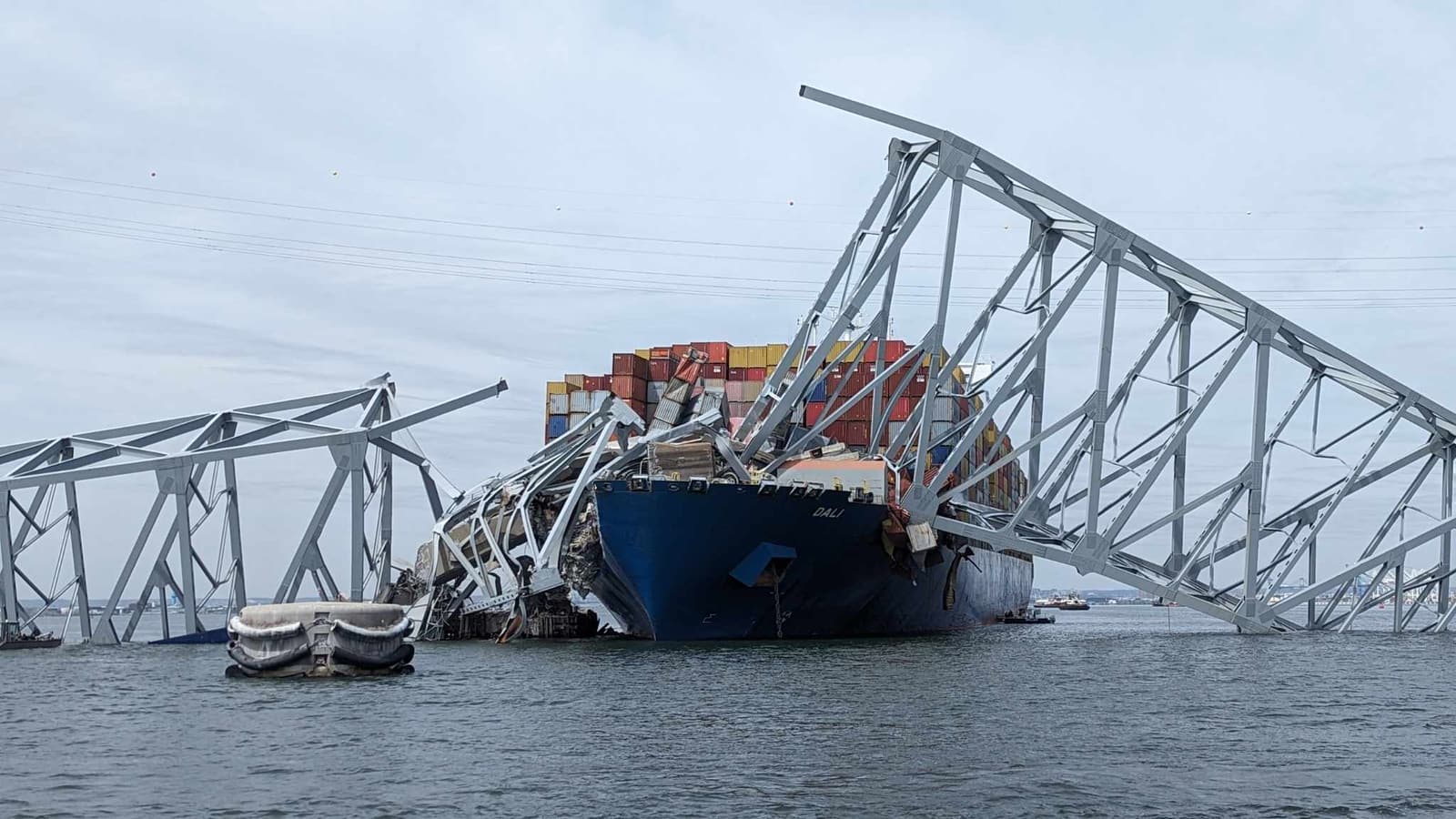
Image context: the cover uses a real March 26, 2024 recovery-scene photograph from the U.S. Army Corps of Engineers via Wikimedia Commons.[7] It belongs here because this article is not about maritime safety in the abstract. It is about the physical wreck, the actual ship, and the operational choices now being tested against that record.
Fact file
| Item | What is live now | Confidence note |
|---|---|---|
| New defendants | DOJ says Synergy Marine Pte Ltd., Synergy Maritime Pte Ltd., and technical superintendent Radhakrishnan Karthik Nair were charged in the unsealed indictment.[1][3] | High that these are the charges filed; no adjudication yet. |
| Core new allegation | Prosecutors say the defendants relied on a flushing pump to supply fuel to two generators, even though that pump was not designed to restart automatically after blackout, and that proper fuel pumps could have restored power in time for the ship to clear the bridge.[1][3] | High as the government's allegation. |
| Technical baseline | The NTSB says a single loose signal wire caused the initial blackout and left the ship without propulsion and steering near the bridge.[4][5] | High; direct NTSB finding. |
| Bridge-side contribution | The NTSB also found the bridge lacked impact-vulnerability countermeasures and that this contributed to the collapse and loss of life.[4][5] | High; direct NTSB finding. |
| Human toll and disruption | Six highway workers died, one worker survived with serious injuries, and more than 34,000 vehicles per day lost their normal crossing route after the collapse.[5] | High; direct NTSB investigation page. |
| Same-day civil development | Maryland finalized a $2.25 billion settlement with Grace Ocean and Synergy Marine and said claims against Hyundai Heavy Industries remain open.[6] | High; direct Maryland attorney general release. |
| Present boundary | The indictment contains allegations, not findings of guilt, and defense counsel has already signaled the defendants will contest the case.[3] | High on procedural posture; merits remain unresolved. |
What the indictment changes
The NTSB's 2025 findings never made this a mystery. They made it a sequence.[4][5] One loose wire triggered the first blackout. The ship's proximity to the bridge left very little recovery time. The bridge, designed for an earlier era of ship size, had not been hardened against the impact risk that modern ocean-going vessels posed.[4][5] That is still the foundation.
The indictment does not replace that foundation. It narrows the operational spotlight inside it. DOJ says the vessel's electrical redundancy had been undercut by an altered fuel-supply arrangement: two of the Dali's four generators were allegedly being fed by a flushing pump rather than proper fuel supply pumps, and the flushing pump could not automatically restart after blackout.[1][3] The government's theory is not that the first blackout never mattered. Its theory is that the second blackout became fatal because the ship had been put in a weaker recovery posture than it should have been.[1][2][3]
Inference from the DOJ allegations and the earlier NTSB findings: the legal story has moved from "what physically failed" to "what management decisions made failure recovery worse."[1][4][5] That is a sharper and more blame-specific question than a general retelling of the collapse.
Why the NTSB record still governs the file
It would be a mistake to read the indictment as though it wiped away the NTSB's causation work. The safety board's final record still explains the initiating event and the structural context.[4][5] The first blackout began with a loose signal wire connection. The bridge's vulnerability mattered. The limited time available to recover propulsion mattered. Communications to workers on the bridge mattered too.[4][5]
What the criminal case does is layer a different kind of accountability onto those findings. Prosecutors are not arguing that pilots suddenly became the core story. In fact, the NTSB credited quick actions by pilots, shoreside dispatchers, and the Maryland Transportation Authority with preventing even greater loss of life.[4] The criminal focus sits elsewhere: on maintenance configuration, reporting duties, and statements later made to investigators.[1][3]
That distinction is important for anyone reading this as a port-safety precedent. A technical report asks how an accident chain forms and how to keep it from recurring. A criminal indictment asks whether people or companies crossed legal lines inside that chain. Those are related questions, but they are not the same question.[1][4]
Why Maryland's settlement matters on the same day
The Maryland attorney general's release gives the day a second meaning.[6] The state says it has now locked in $2.25 billion from the vessel owner and operator, after rejecting the far smaller liability cap those interests had sought under the Limitation of Liability Act of 1851.[6] Maryland also says the settlement reflects the maximum recovery available from those vessel interests after reviewing resources and insurance limits.[6]
That civil development does not close the accountability file. It rearranges it. One lane now looks more like damages recovery and state fiscal repair. The other lane looks more like proof of conduct and knowledge. Maryland also keeps open a third lane by preserving claims against Hyundai Heavy Industries, which the NTSB had identified as bearing fault for the loss of power.[4][6]
So the practical reading on May 12 is not that one announcement supersedes the other. It is that the collapse has entered a more segmented phase. Money, engineering fault, and criminal culpability are no longer traveling together in one undifferentiated public narrative.[1][4][6]
Decision impact by horizon
Next 24 hours
Lawyers, insurers, maritime operators, and bridge-safety officials should read the charges and the settlement together. The paired signal is that the government no longer treats the Dali matter only as an accident-reconstruction archive. It now treats it as an active corporate-conduct case layered on top of a still-open infrastructure and shipbuilder-liability file.[1][4][6]
Next 7 days
Watch whether the defendants can point to documents or engineering records that weaken DOJ's theory about the flushing-pump configuration and alleged false statements.[1][3] That will matter more than general public rhetoric about negligence.
Next 30 days
The deeper issue is precedent. If the government's theory holds, operators across the shipping industry will have to read the case as a warning that workaround practices and post-casualty documentation are no longer merely regulatory exposure. In a catastrophic case, they can become criminal exposure.[1][2]
Scenarios
Base case: the case proceeds as a long technical prosecution, with the government leaning on engineering records, statements to investigators, and the contrast between the flushing pump and the ship's proper fuel supply pumps.[1][3][4]
Upside case for prosecutors: the documentary trail strongly supports the government's view that the defendants knew the workaround created a recovery weakness and later tried to obscure that fact from investigators.[1][3]
Downside case for prosecutors: the defense successfully blurs causation across the loose-wire trigger, shipbuilder responsibility, bridge vulnerability, and emergency-response timing, making the alleged pump workaround look less decisive than the indictment claims.[3][4][5][6]
Action checklist
- Watch for public release of more detailed charging documents or motions that specify how long the flushing-pump configuration had been in use and who approved it.[1]
- Watch the next Maryland and federal filings against Hyundai Heavy Industries; those cases will shape how much fault remains allocated to ship construction rather than ship operation.[4][6]
- Watch whether future port and bridge-safety guidance cites the Dali matter mainly for electrical-failure lessons, for bridge-vulnerability lessons, or for documentation and disclosure controls after a casualty.[4][5]
The narrow conclusion is the strongest one. On May 12, 2026, the Dali collapse file did not become simpler. It became more specific. The NTSB still supplies the accident architecture. The new indictment asks whether choices about maintenance configuration and candor toward investigators turned that architecture into a criminal case as well as a catastrophe.[1][3][4][5]
Sources
- U.S. Department of Justice, "Foreign Operators and Technical Superintendent of M/V Dali Indicted for Roles in Key Bridge Crash" (May 12, 2026).
- U.S. Department of Justice, "Principal Deputy Assistant Attorney General Adam Gustafson of ENRD Announces Charges of Corporations and an Individual for Roles in Key Bridge Crash" (speech, May 12, 2026).
- Michael Kunzelman and Ed White, "Ship operator and employee are charged in crash that caused the deadly collapse of Baltimore bridge." AP News, May 12, 2026.
- NTSB, "Loose Wire on Containership Dali Leads to Blackouts and Contact with Baltimore’s Francis Scott Key Bridge" (Nov. 18, 2025).
- NTSB, "Contact of Containership Dali with Francis Scott Key Bridge and Subsequent Bridge Collapse" (investigation page; accessed May 12, 2026).
- Office of the Attorney General of Maryland, "Attorney General Brown Announces Final Settlement with Owners and Operators of the M/V Dali in Francis Scott Key Bridge Collapse Case" (May 12, 2026).
- Wikimedia Commons, "File:MV Dali and the Francis Scott Key Bridge collapse - 240326-A-SE916-8776.jpeg" (source page for the article image).