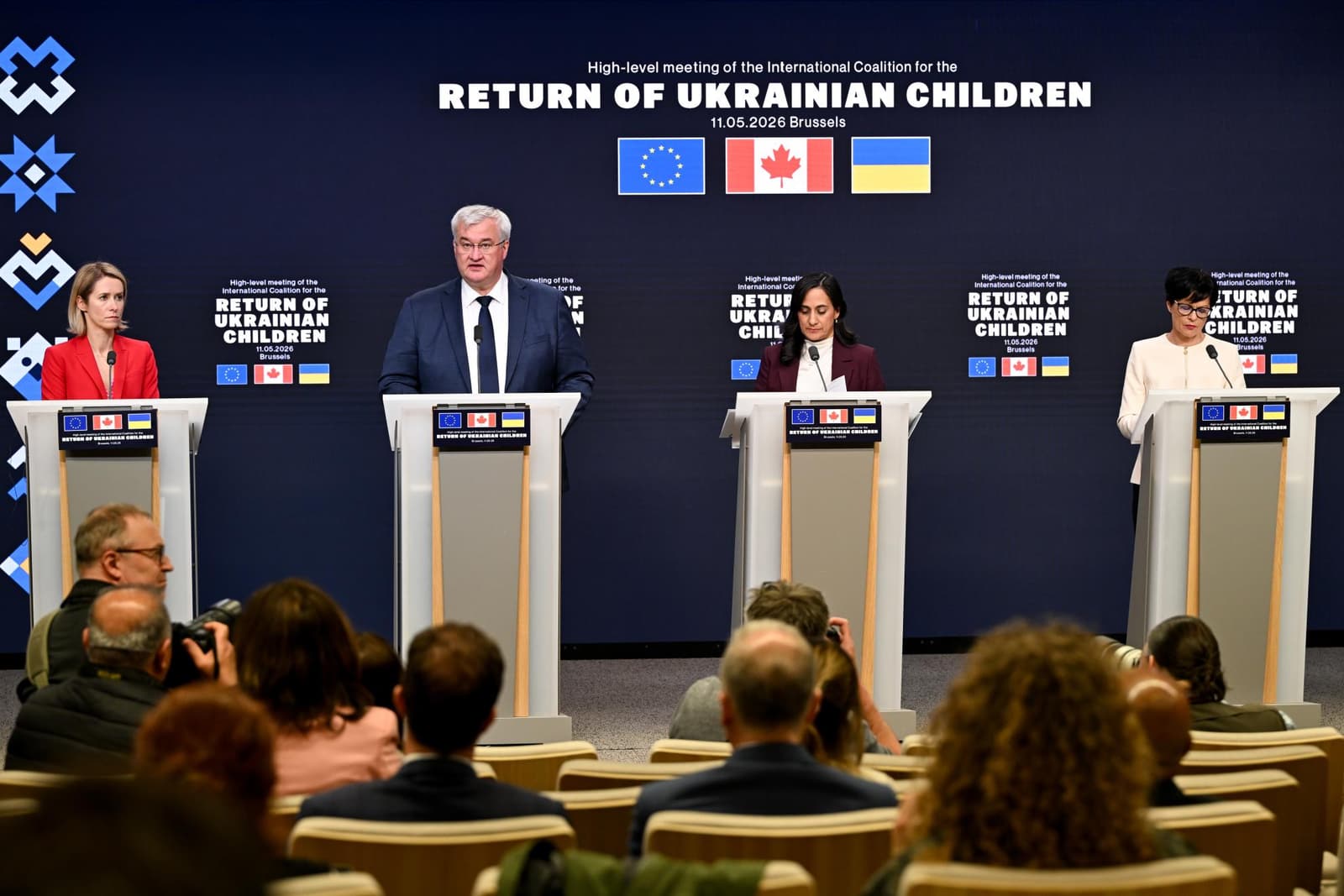
As of 2026-05-14 01:35 UTC, the high-level Brussels meeting on the return of Ukrainian children looks important for a narrower reason than the rhetoric around it might suggest.[1][2][3] The real shift is not that another coalition gathered, or that another round of condemnations was issued. The real shift is that the coalition spelled out a more operational sequence for what comes next: tracing and data verification, organised returns, diplomatic pressure, reintegration and rehabilitation, accountability, and sanctions.[1] That six-part frame turns a moral campaign into something closer to a standing work program.
That matters because the legal and political baseline was already in place before delegates arrived in Brussels. The UN General Assembly in December 2025 demanded the immediate, safe, and unconditional return of Ukrainian children who had been forcibly transferred or deported by Russia, while the ICC had already tied the issue to arrest warrants in 2023 over alleged unlawful deportation and transfer of children from occupied Ukrainian territory.[5][6] What Brussels added was not a new legal theory. It added a more visible operating checklist for governments that say they want to move from denunciation to recoveries.[1][4]
Image context: the lead image uses a real press-room photograph from the European Commission page on bringing Ukrainian children back home.[7] That is the right visual here because the article is about a negotiated process taking shape in public: officials at microphones, journalists in the room, a dated backdrop, and a coalition trying to translate outrage into repeatable administrative pressure.
What actually changed in Brussels
The clearest primary-source account is the co-chairs' summary published by Canada on May 12, 2026.[1] It says the meeting was built to keep the issue at the center of international attention while strengthening collective efforts to secure safe return and reintegration. More importantly, it names the six work strands explicitly.[1] That detail is the story. Coalitions often speak in generalities; this one left Brussels with a published task list.
The European Commission's pre-meeting announcement had already hinted at that direction. On April 21, Brussels said the gathering would focus on tracing, return, reintegration, accountability, and coordinated sanctions, and it cited Ukrainian authorities' figure of more than 20,000 children unlawfully deported or forcibly transferred since the full-scale invasion.[3] In Brussels, that agenda stopped being advance language and became the structure of the post-meeting record.[1][3]
President Volodymyr Zelenskyy described the same logic in sharper political terms. In his May 11 video address to the meeting, he said the task was to document where children are, trace the full chain of abduction and concealment, bring them back, and help them rebuild normal life.[2] That sequence is worth noticing. It begins with documentation, not with symbolism. The implication is that the coalition increasingly sees records, tracing, and verified casework as the hinge between moral pressure and actual returns.[1][2]
Why the six-track plan is more than messaging
The first reason is that the meeting joined return work to reintegration capacity, not just rescue language.[1][2] Canada's summary says the EU announced nearly EUR 50 million to reinforce Ukraine's child-protection system, with support aimed at timely, community-based services, early-childhood initiatives, child-centered justice, and digital systems for compensation claims.[1] That is a significant move because it treats return as an institutional burden, not a television moment. A child who comes back still needs placement, support, legal follow-through, and administrative recognition.[1][5]
The second reason is that the coalition is trying to tighten the link between diplomatic coordination and sanctions. On the same day as the meeting, the EU said it had adopted restrictive measures against 16 individuals and seven entities tied to the unlawful deportation, forced transfer, forced assimilation, indoctrination, militarised education, and related handling of Ukrainian minors.[4] Canada's summary adds that Canada imposed sanctions on 23 persons and five entities and framed those measures as part of the same push.[1] The point is not that sanctions alone produce returns. The point is that Brussels tried to make the return agenda harder to separate from the cost-imposition agenda.[1][4]
This is where the meeting begins to look more serious than a standard pledge event. The UN resolution already demanded return and cessation of practices such as family separation, citizenship changes, adoption, and indoctrination.[5] Brussels tried to connect that normative demand to tools governments can actually keep updating: sanction lists, tracing systems, rehabilitation budgets, and diplomatic outreach.[1][3][4][5]
What Brussels still cannot solve
The obvious limit is enforcement. Neither the UN General Assembly resolution nor the Brussels meeting created a mechanism that can compel Russia to comply on command.[1][5] The ICC arrest warrants deepen the legal stigma around alleged child deportation and transfer, but they do not by themselves recover children or open archives.[6] Even the strongest part of the Brussels outcome, the six-track work plan, still depends on states sustaining pressure, sharing information, and funding a long administrative process.[1][2][4]
There is also a measurement problem. Pre-meeting and post-meeting documents use different framing numbers: the European Commission referred to over 20,000 children unlawfully deported or forcibly transferred according to Ukrainian authorities, the EU sanctions page cited an estimate of nearly 20,500, and the co-chairs' summary said the Bring Kids Back UA framework had enabled the return and reintegration of over 2,100 children to date.[1][3][4] Those figures are not contradictory in a simple sense, but they point to the central difficulty of the whole issue. This is a case file problem as much as a speech problem. Identification, verification, and status tracking remain part of the story, not bookkeeping after the fact.[1][2][4]
That is also why the meeting's most durable contribution may be procedural rather than theatrical. If the coalition can keep translating cases into verified records, records into diplomatic demands, and returns into funded reintegration, it gains a working architecture that can survive beyond one summit day.[1][2][3] If it cannot, the Brussels meeting will read later as one more high-level gathering that correctly described a crime but could not steadily narrow it.
What to watch next
In the next 30 days, the most useful signal will be follow-through on the six published work strands rather than new declarations.[1] Watch for additional sanction actions, case-tracing updates, or more detailed announcements on how the new EU child-protection funding and digital claims support will be used.[1][4]
Over the next 90 days, the harder test is whether coalition members keep the return issue attached to broader diplomatic negotiations instead of letting it drift back into a humanitarian sidebar. Canada's summary explicitly said participants wanted Russia's obligation to return children to remain a priority in any peace negotiations.[1] If that linkage stays alive, Brussels will have done more than stage a conference. It will have turned a demand into a standing diplomatic checklist with money, records, and penalties attached.
Sources
- Global Affairs Canada, "Co-Chairs Summary – Kaja Kallas, High Representative and Vice President of the European Commission; Marta Kos, Commissioner for Enlargement; Anita Anand, Minister of Foreign Affairs of Canada; and Andrii Sybiha, Minister of Foreign Affairs of Ukraine" (May 12, 2026).
- President of Ukraine, "International Coalition for the Return of Ukrainian Children Has Brought Together Nearly 50 Countries: Switzerland and Cyprus Joined Today – President" (May 11, 2026).
- European Commission Directorate-General for Enlargement and Eastern Neighbourhood, "EU, Ukraine and Canada to co-host high-level meeting on returning Ukrainian children" (April 21, 2026).
- European External Action Service, "Ukrainian children unlawfully deported and forcibly transferred to Russia: EU sanctions 16 individuals and seven entities" (May 11, 2026).
- United Nations in Ukraine, "General Assembly demands return of Ukrainian children by Russia" (December 3, 2025).
- International Criminal Court, "Situation in Ukraine: ICC judges issue arrest warrants against Vladimir Vladimirovich Putin and Maria Alekseyevna Lvova-Belova" (March 17, 2023).
- European Commission, "Bringing Ukrainian children back home" (meeting page and press-room photograph, accessed May 14, 2026).