As of 2026-04-26 23:03 UTC, NASA's Crew-13 announcement is easier to misread as a biography bundle than to read as the operating note it actually is. The real change is not simply that Jessica Watkins, Luke Delaney, Joshua Kutryk, and Sergey Teteryatnikov now have an International Space Station mission. It is that NASA says the next Dragon crew rotation has been advanced from November to no earlier than mid-September in order to increase the frequency of U.S. crew-rotation missions to the station.[1] That turns a standard crew reveal into a cadence signal.
The crew choices reinforce the same point. Watkins, a geologist who already logged 170 days on Crew-4, gets command and becomes the first NASA astronaut set to launch aboard a SpaceX Dragon twice.[1][3] Delaney, Kutryk, and Teteryatnikov are all first-time space fliers.[1][2][4][6] So the shape of the assignment is not random. NASA has paired one returning station operator with three rookies while keeping the familiar multinational structure intact: two NASA seats, one Canadian Space Agency seat, and one Roscosmos seat.[1][2][5][6]
That combination makes the announcement more consequential than a routine astronaut profile package. It says something about how NASA wants the station program to run through the back half of 2026: faster turn, stable partner mix, and a command structure that leans on one proven Dragon and ISS veteran while onboarding three newcomers under the same mission.
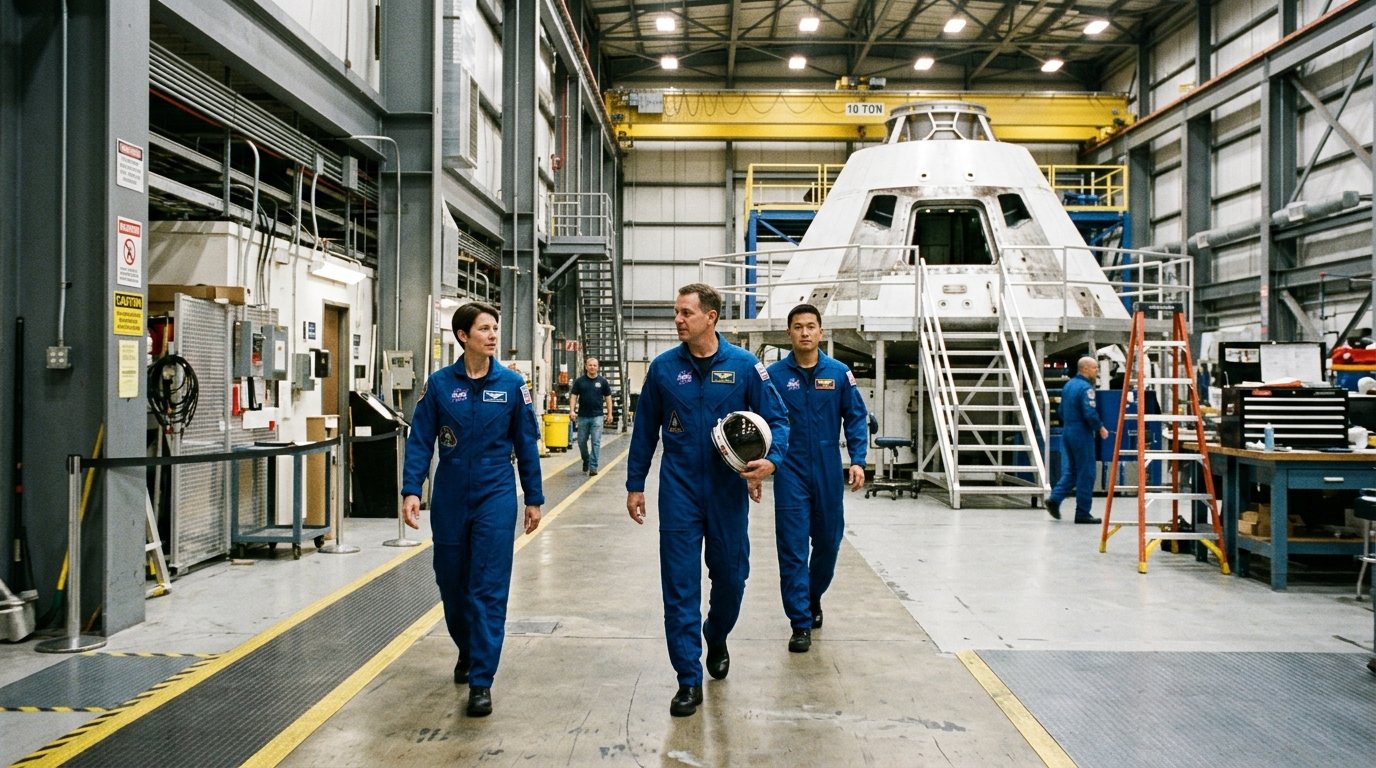
Image context: the cover now uses an aerospace training-hangar scene. The subject is still Crew-13, but the article's center of gravity is the cadence machinery behind crew rotation: preparation, vehicle, station, timing, and seat mix working as one operational chain.[1]
The schedule move is the real headline
NASA spelled out the operational core in one sentence: Crew-13 is being pulled forward from November to no earlier than mid-September to help increase the frequency of U.S. crew rotation missions to the station.[1] That matters more than the personality blurbs because the Commercial Crew Program exists to provide safe, reliable, and cost-effective transport to and from the ISS on a recurring basis, not just to fly isolated missions when convenient.[5]
Put against the current cycle, the shift is noticeable. Crew-12 launched on February 13, 2026, carrying two NASA astronauts, one ESA astronaut, and one Roscosmos cosmonaut to the station.[5] If Crew-13 flies in mid-September, NASA will have compressed the gap between consecutive Dragon rotation launches to roughly seven months rather than letting the next turnover slide closer to the end of the year.[1][5] That does not sound dramatic in headline form. Operationally, it is the whole story.
Why? Because the ISS is now a throughput system as much as it is a destination. Crew rotations have to fit around cargo traffic, Dragon availability, launch-site use, return planning, and handover windows with the crew already aboard. When NASA moves a mission earlier and explains the move as a frequency increase, the agency is signaling that cadence itself is a live management objective, not a background variable.[1][5]
The three-agency mix still matters
The second important signal is diplomatic and structural rather than personal. Crew-13 keeps the multinational pattern intact. NASA provides the commander and pilot. Canada gets a mission-specialist seat through Kutryk. Roscosmos keeps a seat through Teteryatnikov.[1][2][6] In station terms, that continuity matters because it shows the seat-exchange logic is still functioning as ordinary operations rather than as an exception that needs to be explained every time.
Kutryk's assignment is especially notable on the Canadian side. CSA says this will be his first space mission, the fourth CSA astronaut to take part in a long-duration ISS mission, and the first Canadian astronaut to fly under NASA's Commercial Crew Program.[2] That is more than a biographical flourish. It shows Commercial Crew is now mature enough to carry allied long-duration assignments as routine station business, not just NASA-owned transport.
Teteryatnikov's role points the same way from the Russian side. TASS reported that Roscosmos identified him as Crew-13's mission specialist after interagency selection, confirming that the U.S.-Russian seat-sharing pattern remains embedded in the station roster despite the wider strain in the relationship.[6] NASA's own release already treated his seat as standard mission composition, not as a special political announcement.[1]
One veteran, three first-timers is not an accident
The experience split inside the crew is probably the clearest clue about NASA's intent. Watkins is the only member coming in with actual long-duration station time and prior Dragon flight time.[1][3] Delaney is a first-time space flier, but he arrives with a deep flight-test and airborne-science background that fits the pilot seat.[1][4] Kutryk and Teteryatnikov are also first-time fliers, but each comes out of a test-and-operations culture that makes sense for mission-specialist roles inside a high-procedure environment.[1][2][6]
That structure looks less like a celebrity lineup than a deliberate station-management design. NASA is not sending four rookies together. It is putting one returning operator in command and surrounding her with three first-mission crew members whose backgrounds are heavy on disciplined technical execution. For a mission that is also being moved earlier to improve cadence, that is a coherent choice.
Watkins' seat carries an additional signal because she is not just returning to orbit. NASA says she will be the first NASA astronaut to launch aboard a SpaceX Dragon spacecraft twice.[1] That detail matters because it shows how far the Dragon rotation system has moved from novelty to repeat-use institutional infrastructure. A second Dragon flight for the same NASA astronaut is exactly the kind of milestone that only appears once a transport architecture starts feeling normal.
What this announcement does not prove
The limits matter too. A September target is not the same thing as a September launch. NASA still has to hold Dragon readiness, station traffic, launch-range coordination, and downstream return planning together.[1][5] One advanced mission also does not by itself prove that the agency has solved every cadence bottleneck for 2026 and 2027. It proves only that NASA wants one specific turnover to happen earlier and believes it is operationally plausible enough to publish.
The same caution applies to the partnership story. A three-agency crew shows continuity, but it does not answer bigger questions about station extension politics, deorbit planning, or how partner priorities may shift later in the decade.[2][5][6] Those are separate files. Crew-13 is narrower. Its significance sits in routine function: a working roster, a moved-up date, and a continuing crew-exchange pattern that still looks alive in day-to-day station operations.
What to watch now
The first watch item is simple: whether mid-September holds. If it does, NASA will have converted a stated cadence objective into a visible schedule gain.[1]
The second is the handover geometry with Crew-12 and Expedition 75/76. The closer NASA pushes the next rotation toward early fall, the more the timing itself becomes part of the station story rather than a logistics footnote.[1][5]
The third is what the crew mix suggests about future assignments. If NASA keeps pairing one returning station veteran with multiple first-time fliers while holding the partner-seat pattern steady, Crew-13 will look less like a one-off and more like a template.[1][2][3][4][6]
The useful conclusion is narrower than the celebratory version. Crew-13 is not mainly important because NASA introduced four names and a new patch. It is important because NASA used the crew reveal to say that the station rotation clock is being pulled tighter, that the NASA-CSA-Roscosmos roster pattern is still functioning, and that Jessica Watkins is now being used as the experienced anchor for that faster cycle.[1][2][3][5][6]
Sources
- NASA, "NASA Shares SpaceX Crew-13 Assignments for Space Station Mission" (April 23, 2026).
- Canadian Space Agency, "CSA's Joshua Kutryk assigned to Crew-13 Space Station mission" (April 23, 2026).
- NASA, "NASA Astronaut Jessica Watkins" biography page (accessed April 26, 2026).
- NASA, "NASA Astronaut Luke Delaney" biography page (accessed April 26, 2026).
- NASA, "Commercial Crew Program" overview page (accessed April 26, 2026).
- TASS, "Russian cosmonaut Teteryatnikov assigned Crew-13 seat" (accessed April 26, 2026).