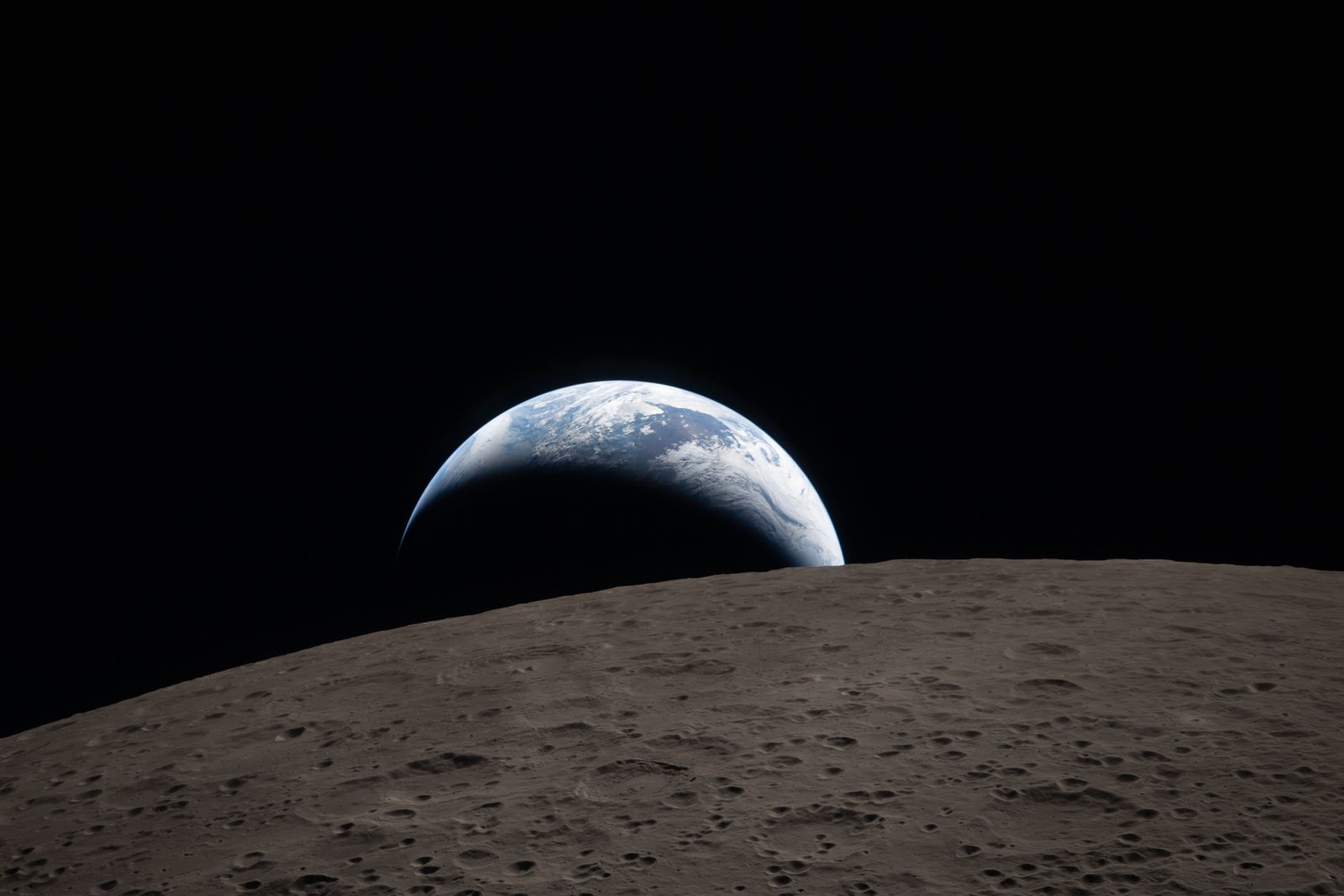
As of 2026-04-27 16:02 UTC, NASA's April 7 release of Artemis II moon-flyby photography still reads like more than a gallery drop. The pictures turned a mission that could have remained a stack of launch, trajectory, and splashdown updates into something the public could actually inspect: a crewed lunar flyby with its own visual record, its own scientific texture, and its own proof that Orion worked as a human observation platform beyond Earth orbit.[1][2][3][4]
That is the real news value of the images. Artemis II had already launched on April 1, completed the burn that sent Orion toward the Moon, executed its April 6 far-side flyby, and splashed down on April 10 after a ten-day mission.[2][3][4] But the release of Earthrise, Earthset, eclipse, and crater photographs gave the program a second layer of evidence. Instead of asking the public to trust that a crew went out, swung around the Moon, and came back, NASA put the mission's viewpoint on the record.[1][5][6]
Quick facts
| Item | What is established | Confidence note |
|---|---|---|
| Launch and mission frame | Artemis II launched on April 1, 2026, for an approximately 10-day crewed mission around the Moon and back.[4] | NASA's launch and mission releases are explicit on date and duration. |
| Lunar flyby | The key photo set came from the crew's roughly seven-hour far-side lunar flyby on April 6.[1][6] | NASA states the images were captured during the April 6 observation period. |
| Public photo release | NASA released the first official flyby images on April 7, with more expected after initial review.[1] | High confidence from the release itself. |
| What the images show | NASA highlighted a rare in-space solar eclipse, Earthset/Earthrise views, impact craters, lava flows, surface fractures, and six observed meteoroid flashes.[1] | These details come from NASA's captioned release and gallery notes. |
| Mission closeout | Orion and its crew returned to Earth on April 10 after setting a new farthest-human-spaceflight record for a lunar mission since Apollo.[2][3] | NASA documented both the record and the splashdown outcome. |
What NASA actually released
NASA did not publish one symbolic beauty shot and call it a day. The April 7 release and the follow-on lunar-flyby gallery show a sequence of images with different functions inside the mission story.[1][6] One set captures the Moon backlit during a solar eclipse, with Orion visible in the frame and bright planetary points beyond the lunar disk.[1] Another shows Earth setting behind the lunar limb just before Orion passed behind the Moon and lost contact with Earth for about forty minutes.[1] Another frames Vavilov Crater and the terrain around the Hertzsprung basin in long-shadow detail.[1] Another gives the now-signature Earthrise view through the Orion window, with the bright crescent of Earth hanging over a dark horizon.[1][6]
Put together, those images do two jobs at once. They are visually strong enough to circulate as symbols, but they are also operational traces. The Earthset and Earthrise pictures tie the flight to specific phases of the flyby timeline. The crater photography shows the crew were not merely passengers looking out windows; they were observing terrain and capturing usable geological context.[1] NASA says the astronauts documented craters, lava flows, fractures, color differences, and brightness contrasts, all of which feed the mission's scientific and observational value.[1]
Why the pictures matter more than the usual mission glamour
Large government space programs live on public belief as much as on hardware. Artemis II had already produced the classic proof points before the photos arrived: liftoff, translunar injection, a deep-space distance record, and safe recovery.[2][3][4] Those are necessary milestones. They are also abstract to most readers. A mission can clear them all and still feel like a sealed technical event happening somewhere offstage.
The photo release changed that balance. Once NASA published the crew's own view, the mission stopped looking like a program-management achievement alone and started behaving like a witnessed human journey. The distinction matters for Artemis because the campaign is not trying to win a one-day headline. It is trying to normalize a sequence of increasingly ambitious missions in which the public has to believe the architecture is real, repeatable, and worth following.[1][5]
That is also why the best image from the set is arguably not the most dramatic eclipse frame but the Earthrise picture. It compresses several claims into one view: the crew actually got there, they were far enough away for Earth to become a delicate crescent, Orion's windows and cameras functioned in the environment NASA asked them to survive, and the mission could return a human-scale perspective rather than telemetry alone.[1][6]
The deeper operational signal
The imagery also says something narrower and more technical about Artemis II itself. NASA's mission updates show that the crew had to move through a disciplined sequence: launch, orbit-raising work, translunar injection, proximity operations, the lunar flyby period, communications gaps while behind the Moon, and then the trip home.[2][4][5] The released photographs sit inside that sequence, not outside it as decoration.
That matters because one of the enduring questions around Artemis has been whether Orion and the broader campaign can make deep-space flight look routine enough to support the next steps. The public photo set is not proof of long-term routine by itself. It is proof that during this mission, the spacecraft supported sustained human observation, image return, and a coherent record of what the crew saw at the moment the program most needed to show it could do more than launch.[1][5][6]
NASA's own recap reinforces that point. The agency's postflight image-and-video roundup does not frame the mission as a single instant of glory; it presents a chain of milestones, from launch through ocean recovery, with the flyby visuals occupying the middle of that chain.[5] In other words, the pictures are part of the evidence package for the mission's full arc.
What the images do not prove
The photographs do not settle every program question that matters next. They do not answer how quickly Artemis III and later missions will fly, how the landing cadence will mature, or how budget and industrial constraints will behave once the excitement of Artemis II fades.[5] They also do not convert a successful flyby into a lunar-surface capability. A crewed swing around the Moon remains a different task from landing, operating there, and repeating it.
But that limit is exactly why the release is worth reading carefully. The mission did not need the images to count as a technical success. It needed them to become legible to outsiders as a lived event with scientific and operational texture. That is a smaller claim than "Artemis is solved," and a more defensible one.[1][2][3][5]
What to watch next
The first thing to watch is how often NASA continues using the Artemis II visual archive in the months before the next crewed mission milestone. If the agency keeps returning to these images, that will be a sign it sees them as foundational public evidence rather than one-week social-media material.[5][6]
The second is whether future Artemis communications keep this same balance between spectacle and operational clarity. The strongest parts of the April 7 release were not the adjectives; they were the captions that tied each frame to a moment in the flyby, a terrain feature, or a communications boundary.[1][6]
The third is whether Artemis II's visual record begins to function as a reference point for Artemis III readiness. A moon program moves from aspiration to habit when later missions can treat an earlier mission's images as known baseline rather than as miraculous firsts.[5]
The narrow conclusion is the useful one. Artemis II's moon-flyby photos mattered because they turned a successful test flight into public proof of return: not just that the crew launched and landed, but that human beings once again carried cameras, judgment, and attention to the Moon's vicinity and brought back a view that can be examined by everyone else.[1][2][3][6]
Sources
- NASA, "NASA's Artemis II Crew Beams Official Moon Flyby Photos to Earth" (April 7, 2026).
- NASA, "NASA's Artemis II Crew Eclipses Record for Farthest Human Spaceflight" (April 6, 2026).
- NASA, "NASA Welcomes Record-Setting Artemis II Moonfarers Back to Earth" (April 10, 2026).
- NASA, "NASA's Artemis II Mission Leaves Earth Orbit for Flight around Moon" (April 2, 2026).
- NASA, "Artemis II Mission Milestones: An Image and Video Recap" (April 21, 2026).
- NASA, "Artemis II Lunar Flyby" gallery (accessed April 27, 2026).